


TL;DR
- AI makes code cheap, but production failures still cost money and trust; owning code determines how fast you can fix issues.
- Code ownership means you can read, modify, host, and redeploy your app without a vendor’s permission.
- Use 5 rules: repo in your account, PR-based AI changes, runnable without the tool, data+integrations in repo, human gates for risky actions.
- Real incidents (site lockout, wrong collections message, false analytics alarms) were fixed fast because the author owned code, logs, and deploys.
- Before shipping: verify source control, build without vendor, deploy anywhere, export data, document integrations, PR review, quick rollback, and human gates.
Fact Box
- Stack Overflow’s 2025 survey: 84% use or plan to use AI tools; 46% distrust AI accuracy vs 33% trust it.
- Veracode’s 2025 GenAI report found AI-generated code introduced risky security flaws in 45% of tests.
- On 05/07/2026, Candid Studios’ site, portal, storage, and tools went dark due to a bot-protection setting at the network edge.
- On 08/12/2026, a collections message went to a client for a paid invoice; the job was paused and 3 fixes shipped the same day.
- Before adding a human-approval gate, off-hours replies at Candid took about 3.9× longer than business-hours replies.
The day my company’s website went dark, the servers were fine, and the only reason I could prove it was that I owned every line of code behind it. That is the day code ownership stopped being a theory for me.
If you are building software with AI right now, you are probably asking yourself a few questions. Do I actually own the code an AI app builder or coding agent writes for me? What happens to my product if the platform I built it on changes its prices or shuts down? Can I trust AI-written code in production if I never read it? And how do I keep moving fast without signing my business over to someone else’s servers? Andrej Karpathy, who coined the phrase that half the industry now uses, described the mood perfectly in February 2025: “There’s a new kind of coding I call ‘vibe coding’, where you fully give in to the vibes, embrace exponentials, and forget that the code even exists.” (Andrej Karpathy on X, 02/02/2025). He was describing throwaway weekend projects. My argument in this article is that for a real business, the code very much exists, and code ownership is what decides whether you control it or it controls you.
The problem is not hypothetical. The Stack Overflow 2025 Developer Survey found that 84% of respondents are using or planning to use AI tools in their development process, while more developers actively distrust the accuracy of AI tools (46%) than trust it (33%). Security research points the same way. Veracode’s 2025 GenAI Code Security Report tested more than 100 large language models on 80 coding tasks and found that AI-generated code introduced risky security flaws in 45% of tests. When nearly everyone is shipping AI-written code and nearly half of it can carry a known flaw, the person who can read, change, and redeploy that code is the person who stays in business.
By the end of this article you will know what code ownership really means when an AI writes most of your software, the 5 ownership rules I follow across two companies, how to compare an AI app builder, a coding agent, and a code generator on ownership, and which real incidents taught me each lesson. I will also show you the ownership checklist I use before any AI-built tool touches a customer.
Terminology: The Words You Need Before We Start
Before I get into the story, here are the terms I will use. People mix them up constantly, and the difference matters for ownership.
| Term | What it means in this article |
|---|---|
| Code ownership | Your legal right and your practical ability to read, copy, modify, host, and redeploy the source code of your application without asking anyone’s permission. |
| AI app builder | A hosted platform that turns a prompt into a running app, often keeping the code and the hosting inside its own service. |
| AI coding agent | A tool such as Claude Code, Codex, Cursor, or OpenCode that edits files in a repository you control. |
| Code generator | A tool that produces a full codebase from a description or schema, which you can then download and run yourself. Flatlogic’s generator is an example. |
| Vendor lock-in | A situation where leaving a platform costs so much time or money that you effectively cannot leave. |
| Repository (repo) | The version-controlled folder, usually on GitHub or GitLab, that holds your source code and its full history. |
| Pull request (PR) | A proposed change to a repository that can be reviewed, tested, and merged or rejected. |
| Model routing | Choosing which AI model handles a given request, based on rules, cost, or a judge model. |
| Egress | The ability to take your code and data out of a platform in a usable form. |
If you only remember one definition, make it the first one. Code ownership is not just a clause in the terms of service. It is the practical ability to fix your own product at 2 AM without waiting for a vendor.
The Main Idea: AI Makes Code Cheap, So Code Ownership Becomes Everything
Here is the idea the rest of the article supports. AI has made writing code dramatically cheaper. It has not made running a business on that code any cheaper. Bugs still happen. Integrations still break. Customers still get the wrong message at the wrong time. When those things happen, the only question that matters is how fast you can find the problem and ship a fix.
If the code lives inside a platform you do not control, your speed is capped by that platform. If the code lives in your own repository, your speed is capped only by you and your agents. I think of it this way:
- AI lowers the cost of writing code close to zero.
- Production failures still cost real money and real trust.
- The fix for a production failure is always a code change.
- So the value of an AI-built product depends on who is allowed to make that change.
That is the whole argument. The stories below are the evidence.
Diagram: How Ownership Changes the Fix Path
The diagram below compares what happens when something breaks in an owned codebase and in a closed platform.
flowchart LR
A[Customer reports a problem] –> B{Who owns the code?}
B –>|You own the repo| C[Agent reads the code and logs]
C –> D[Pull request with the fix]
D –> E[Review and merge]
E –> F[Deploy the same day]
B –>|Platform owns it| G[Open a support ticket]
G –> H[Wait for the vendor]
H –> I{Is the fix on their roadmap?}
I –>|Yes| J[Fix ships on their schedule]
I –>|No| K[Work around it or migrate]
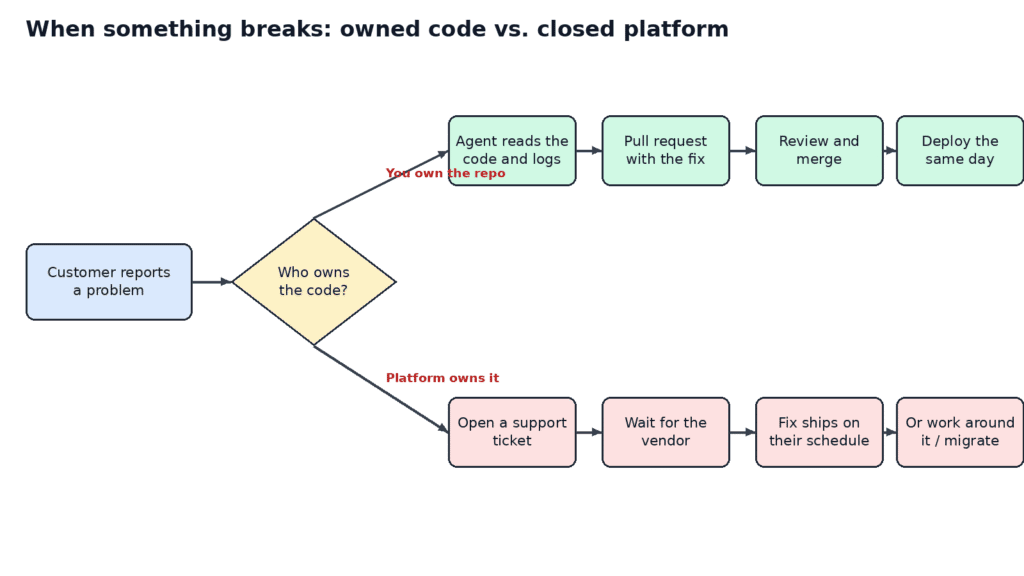
Flowchart comparing the fix path for an owned codebase and a closed AI platform
Figure 1. When you own the code, the fix path is a pull request. When you do not, it is a support ticket.
Story One: The Day the Whole Website Went Dark
On 05/07/2026, every public and private surface at Candid Studios returned the same “blocked” page at once. The website, the client portal, the cloud storage, the galleries, and the internal tools all went dark. The servers behind them were perfectly healthy.
The cause was a bot-protection setting at the network edge. It could not tell a real customer’s browser from a robot, so it locked out real customers first. The lesson I wrote down that day was simple: prove the server works, then prove the edge, before touching any setting.
Why does this belong in an article about code ownership? Because I could prove the server worked. I had the code, the logs, and the deployment in my own hands. I could hit each service directly and show that the application was fine, which narrowed the problem to one layer in minutes instead of hours. If you cannot see your own code and logs, you cannot even tell whether the problem is yours.
The story had a second chapter. After that outage, the same kind of bot challenge later blocked webhooks from a CRM we still depended on, and booking and collections updates stalled three times. The fix that has to stay is a dedicated exception for that one webhook path. Because I owned the integration code, I knew exactly which path needed the exception and could test it myself.
Story Two: The Invoice That Had Already Been Paid
On 08/12/2026, an automated collections message went out to a client for an invoice that our portal already showed as paid. It is the kind of message that makes a customer wonder whether you are paying attention at all.
When I traced it, the automation was reading an old campaign snapshot instead of the live balance. The same day, I shut off the collections job, changed the code so it reads the amount due right before every send, and added a nightly check of open invoices against Stripe.
I want you to notice the timeline. Problem found, root cause found, and three separate fixes shipped, all on the same day. None of that required permission from anyone. That is code ownership in practice. If that automation had lived inside a closed workflow tool, I would have been limited to whatever settings the vendor exposed, and “read the live balance from Stripe right before sending” may not have been one of them.
Story Three: The Analytics Alarm That Was Wrong
Ownership also protects you from your own tools. On 10/13/2026, the analytics checker inside Savage’s platform raised four high-priority alerts saying that pages on candidstudios.net had no Google Analytics tag. The tag was there. The site loads it after a visitor’s first input to keep pages fast, so a basic HTML scan missed it.
Because the checker was my code, the fix was a pull request that teaches it to read the page’s own scripts before raising an alarm. I did not have to accept a false alarm forever, and I did not have to “optimize” the website in a way that would slow it down just to please a third-party scanner. Owning your tools means you can make them tell the truth about your business.
A week earlier, the same platform’s weekly rank snapshot had failed on 10/05/2026 and again on 10/12/2026, because a single keyword error threw away the whole week’s report. The report is designed to publish all or nothing, so that a failed check is never shown as a ranking drop. The fix retries the specific errors that the data provider does not charge for. Again, the change was small, and it was mine to make.
The 5 Code Ownership Rules I Follow
Those incidents turned into rules. Here are the 5 code ownership rules I now apply to anything an AI helps me build, whether it is a CRM, an internal dashboard, or a desktop app.
Rule 1: The Repository Lives in an Account You Control
Every project starts as a repository in my own GitHub organization. AI agents work inside that repository, not inside a hosted sandbox I cannot export. If a tool cannot work against my repository, I treat it as a prototyping toy, not as a place to build the business.
Rule 2: Every AI Change Arrives as a Reviewable Pull Request
My agents do not push straight to production. Each change arrives as a pull request with a description of what broke and how it was fixed. That history is one of the most valuable things I own. When a problem comes back months later, I can read exactly why a line exists.
Rule 3: You Can Run It Without the Tool That Wrote It
This is the test I care about most. If the AI tool that wrote the code disappeared tomorrow, could I still build, run, and deploy the application with ordinary developer tools? If the answer is no, I do not own a product. I own a subscription.
Rule 4: Your Data and Your Integrations Are Part of the Code
Ownership is not only about source files. The database schema, the webhook handlers, the Stripe and phone integrations, and the deployment configuration all need to be in the repository too. The 05/07/2026 outage and the webhook stalls taught me that the integration layer is where most of the surprises live.
Rule 5: Keep a Human Decision on the Things That Matter
Owning the code lets you choose where people stay in the loop. At Candid, after our AI sales agent and a teammate both answered the same client on the agent’s first day on live threads in July 2026, the obvious fix was human approval on every message. I chose not to do that, because before the agent, off-hours replies took roughly 3.9 times longer than business-hours replies, and a human gate would have brought that delay back. Instead I routed only the risky cases to a person, such as known contacts and people writing from more than one address. I could only make that precise choice because I owned the code that made the decision.
Comparing Your Options on Code Ownership
Not every AI tool treats ownership the same way. Here is how I compare the three broad categories. This is my own assessment from building with them, not a vendor ranking, and you should check the current terms of any specific product yourself.
| Question | Hosted AI app builder | AI coding agent in your repo | Code generator with export |
|---|---|---|---|
| Where does the code live? | Usually on the platform | In your repository | In your repository after generation |
| Can you export the full source? | Varies by plan and product | Yes, it never left | Yes, by design |
| Can you self-host? | Often limited | Yes | Yes |
| Who controls the deploy? | The platform | You | You |
| Best fit | Quick prototypes and demos | Ongoing product work | Fast start on a standard business app |
| Main ownership risk | Lock-in and pricing changes | Quality depends on your review | You must maintain what you take over |
Flatlogic has written about this exact question in Do You Own the Code in AI Builders? and in Why Vibe Coding Tools Can’t Deploy Real Applications. Both are worth reading alongside this one, because they look at the problem from the platform side while I am looking at it from the founder side. Their research on starting a web app with AI and vibe coding is also a useful reality check.
Examples You Can Apply to Your Own Business
Abstract rules are easy to agree with and hard to apply. Here are a few examples of how ownership plays out for the kinds of readers I talk to most.
A service business owner replacing a CRM. Candid Studios replaced an off-the-shelf CRM with a portal where the inquiry, proposal, contract, invoice, crew assignment, and every text, email, and call sit on one project. Before that, customers were writing to 27 phone lines and several inboxes, and the status of a booking lived in one person’s head. The portal is the system of record now, and because we own it, every odd requirement of a multi-day, multi-crew booking can be modeled instead of forced into someone else’s fields.
A founder building a SaaS MVP. If you need a standard business app with users, roles, and CRUD screens, you do not have to choose between speed and ownership. Flatlogic Generator will convert this description into a fully functional business web application, and you get the source code to keep. Their Custom SaaS and MVP in a Week pages describe that route.
An operations lead automating internal work. If your team lives in spreadsheets and email, an owned internal tool lets you encode your real rules. Our footage import tool, for example, runs as a dry run by default and never overwrites a file that already exists at a different size. That rule came from a real 80 GB wedding film that arrived as a Dropbox link on 10/13/2026. A generic tool would not have known that rule mattered.
A developer running several AI agents. If you use more than one coding agent, ownership of the workspace matters too, which brings me to CodeWrench.
Example of a Successful Solution: CodeWrench, Built on Open Source and Owned End to End
I run several coding agents at once, and I got tired of picking models by hand and juggling terminal windows. So Savage Digital Solutions built CodeWrench, a free Mac app for Apple silicon that runs Claude, Codex, Cursor, Grok, and OpenCode agents in one window. It is in public preview, it is written in TypeScript and Rust, and it is built on top of the open-source T3 Code project with our own additions.
CodeWrench is itself an argument for owning your stack, in three ways.
- It runs on your own Mac with your own accounts. There is no hosted sandbox. It controls agents and files on the host, so your code stays in the repositories you already own.
- It routes each task to a model, and you can always overrule it. Local rules run first. Long text, several attachments, or words like “debug” point to a stronger model, and a short question points to a lighter one. When the rules are not confident, a small judge model gets a short window to decide, using your own OpenRouter key, with a daily spending cap of $0.10. A model you pick by hand always wins.
- The routing is visible. The first version of the router was advisory and invisible. I changed it so every decision is shown under the message with the reason, and the app records how often people override it.
That last change is a small ownership lesson of its own. When a tool makes decisions for you, you should be able to see them and reverse them. That is true for a model router, and it is true for a platform that hosts your entire application.
Diagram: How CodeWrench Routes a Message
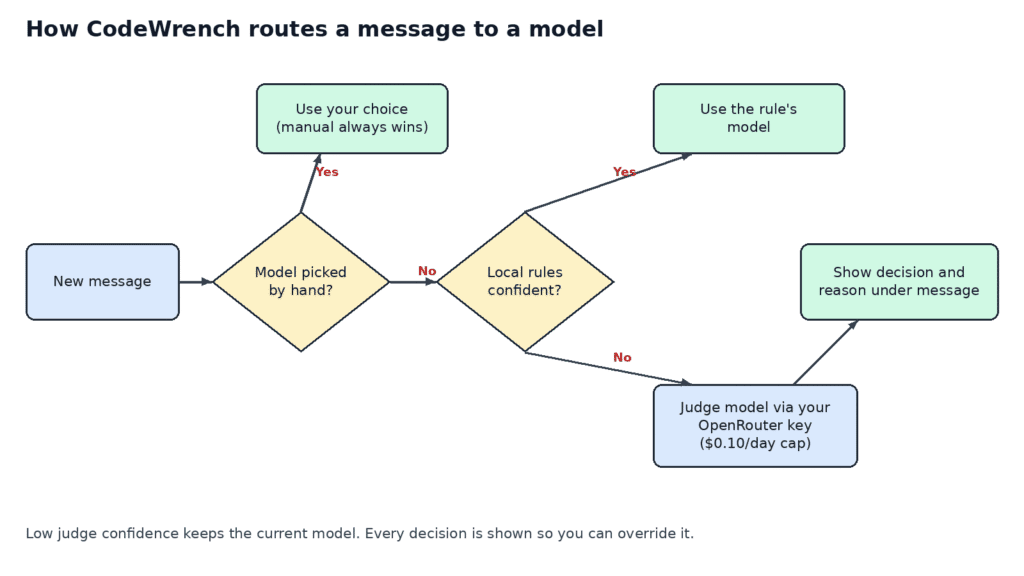
Diagram of the CodeWrench model routing flow from local rules to judge model to chosen model
Figure 2. CodeWrench routing: manual choice first, local rules second, a capped judge model only when needed.
Example of a Successful Solution: Flatlogic Case Studies
My own projects are not the only proof. Flatlogic’s case studies describe client platforms delivered as real codebases, such as Optelos, an AI-powered visual inspection platform, and Back at You, a social CRM for businesses. What I find useful about those examples is the pattern rather than the industry: a business with unusual requirements ends up with software it can keep developing, instead of a prototype trapped inside a tool.
Mistakes That Cost Founders Their Code Ownership
Here are the mistakes I see most often, including a couple I made myself.
- Building the real product inside the prototype tool. The prototype works, customers arrive, and nobody ever moves the code somewhere you control.
- Letting an agent push straight to production. You lose the pull request history that explains why the code looks the way it does.
- Forgetting the data layer. Owning the front end while your data sits in a platform you cannot export is only half of the job.
- Trusting automation you cannot read. Our sales lane once sent three couples the exact same check-in question they had already received a week earlier. It was stopped two minutes later, and the fix sends any repeated question to a person instead. I could only fix it that precisely because I could read the logic.
- Counting the model before counting the writers. In August 2026, a night message and a morning message from Candid both reached customers who had not replied, because two automations had no lock on the same client. The model was not the problem. Our rule now is one outbound message per client until they reply.
My Code Ownership Checklist Before Anything Ships
This is the checklist I run before an AI-built tool touches a customer.
| Check | Question to answer | Pass condition |
|---|---|---|
| Source | Is the full source in a repository I control? | Yes, with full history |
| Build | Can I build it without the AI tool that wrote it? | Yes, with standard tooling |
| Deploy | Can I deploy it to infrastructure I choose? | Yes |
| Data | Can I export the database in a standard format? | Yes |
| Integrations | Are webhooks and API keys documented in the repo? | Yes, keys stored as secrets |
| Review | Does every change arrive as a pull request? | Yes |
| Rollback | Can I roll back the last deploy in minutes? | Yes |
| Human gate | Are the risky actions routed to a person? | Yes, by rule |
If a tool fails more than one of these checks, I keep it for prototypes only.
A Contrarian Note: Ownership Is Also a Responsibility
I want to be fair to the other side. Owning code is not free. When you own the code, you also own the bugs, the updates, the security patches, and the 2 AM pages. The 45% figure from Veracode applies to code you own just as much as code you rent. Ownership gives you the power to fix problems. It does not fix them for you.
That is why I pair ownership with review, tests, and small, boring rules. One test in our AI agent’s send gate is designed to always fail: a draft claiming it already sent a contract and charged a card. If that case ever passes, the gate itself is broken. I kept that scoring rule-based on purpose, so the same draft gets the same verdict every time. Owning the code is what lets you write tests like that, and writing tests like that is what makes owning the code safe.
Conclusion: Key Points About Code Ownership
Here is what I hope you take away from this article.
- AI has made code cheap, but it has not made production failures cheap, so code ownership is now the main source of speed and safety.
- Code ownership means the practical ability to read, change, host, and redeploy your application without anyone’s permission.
- My 5 rules are simple: keep the repository in your account, review every AI change as a pull request, make sure you can run it without the tool that wrote it, treat data and integrations as code, and keep human decisions on what matters.
- Real incidents, from a full site lockout to a paid invoice chased by mistake, were fixed the same day because the code was mine.
- Ownership is also a responsibility, so pair it with tests, reviews, and clear rules.
If you want to build a business application quickly and still walk away with code ownership from day one, take a look at Flatlogic’s AI web app generator or its AI Software Development Agent. Describe your app, generate the full-stack codebase, and keep the source in your own repository. If your project needs a custom build, Flatlogic also offers a free 30-minute consultation through its services team.
Comments