


TL;DR
- AI web builders turn a one-sentence prompt into site structure, copy, visuals, and iterative edits via prompts.
- They beat templates on personalization, faster content creation, and rapid experimentation (new pages and messaging variants).
- Limits remain: generic output risk, content accuracy issues, and weak support for advanced customization and integrations.
- Templates aren’t obsolete yet; AI is making “templates” dynamic while full-stack generators (e.g., Flatlogic) push beyond marketing sites.
Fact Box
- AI builders can generate a website in minutes, shifting work from manual template edits to prompt-driven iteration.
- The article says startups can generate websites, landing pages, and web apps in hours rather than weeks.
- AI-generated copy often needs human review to match a company’s unique value proposition and ensure accuracy.
- Flatlogic Generator is positioned as generating full-stack apps with DB, auth, business logic, and an admin panel.
What if building a startup website became as easy as describing your idea in a single sentence? Read on to discover why AI web builders are rapidly changing the way founders launch products, and whether traditional website templates are becoming obsolete.
When startup founders search for information about AI website creation, they usually ask questions such as:
- Are AI web builders better than traditional website templates?
- Can AI-generated websites save time and development costs?
- What are the limitations of AI web builders for growing startups?
- Should founders still use website templates in 2026?
As computer scientist and AI pioneer Andrew Ng once said:”AI is the new electricity”.
Just as electricity transformed every industry over the last century, artificial intelligence is now reshaping how digital products are built, launched, and scaled.
The rise of AI web builders reflects a growing challenge faced by startups: creating professional websites quickly while keeping costs under control. According to research from McKinsey, generative AI could contribute trillions of dollars in economic value annually by increasing productivity across knowledge work. Meanwhile, studies from Gartner and Forrester consistently highlight the importance of rapid digital experimentation for business growth. For startups operating with limited resources, the ability to generate websites, landing pages, and web applications in hours rather than weeks can significantly affect time-to-market and competitiveness.
In this article, you’ll learn how AI web builders evolved from traditional website templates, where they outperform conventional approaches, their current limitations, and what startup founders should consider when choosing between AI-generated websites and template-based solutions.
The Evolution of Web App Creation
To understand why AI app builders are attracting so much attention, it helps to look at how web application development has evolved over the years.
The Era of Custom Development
In the early days of the web, building an application required significant technical expertise. Companies had to hire experienced developers or assemble dedicated engineering teams to write front-end and back-end code, design databases, manage infrastructure, and maintain deployments. Even relatively simple web applications could take months to build and launch.
For startups, this often created a difficult tradeoff:
- Spend valuable funding on development.
- Delay product launch and market validation.
- Release a limited version with fewer features.
Custom development offered maximum flexibility and scalability, but it demanded considerable time, resources, and technical knowledge.
The Rise of Frameworks and Starter Templates
The introduction of modern frameworks such as React, Angular, Vue, Django, Ruby on Rails, and Laravel transformed the development process. Instead of building every component from scratch, developers could leverage reusable architectures, pre-built modules, and starter templates.
This shift delivered several major benefits:
- Faster development cycles
- Lower engineering costs
- Standardized best practices
- Improved scalability and maintainability
For more than a decade, frameworks and application templates became the default starting point for startups looking to launch products quickly without sacrificing quality.
However, these solutions introduced their own limitations.
Developers still needed to configure authentication, databases, APIs, deployment pipelines, user management systems, and administrative dashboards. While templates accelerated development, they often required substantial customization before becoming production-ready.
In other words, they solved part of the coding problem but not necessarily the product development problem.
Enter AI App Builders
The emergence of generative AI has introduced a fundamentally different approach to application development.
Instead of selecting a boilerplate project and manually customizing it, founders and developers can increasingly describe what they want using natural language:
“Create a project management SaaS platform with user authentication, subscription billing, team workspaces, task tracking, and an admin dashboard.”
Within minutes, an AI-powered platform can generate:
- Application architecture
- Front-end interfaces
- Database schemas
- API endpoints
- Authentication systems
- Admin panels
- Business logic
- Documentation
The workflow shifts from assembling and modifying predefined components to directing an intelligent system that generates much of the foundation automatically.
This distinction is why many experts view AI app builders as the next evolutionary step beyond traditional frameworks, starter kits, and templates. Rather than simply accelerating coding, AI has the potential to fundamentally change how startups transform ideas into working products.
How AI Web Builders Work
AI web builders simplify website creation by transforming natural language instructions into fully functional websites. Instead of choosing a template and manually customizing every element, users can describe their business, target audience, and goals, and the AI generates a website tailored to those requirements.
Most AI web builders follow a similar workflow:
Understanding User Intent
The process begins with gathering information about the business. Users typically provide details such as their industry, products or services, target audience, and branding preferences. The AI analyzes this information to determine the type of website that best fits the user’s objectives.
Generating Website Structure
Based on the provided input, the AI creates a website layout with relevant sections and navigation. For example, a SaaS startup might receive feature highlights, pricing tables, customer testimonials, and a call-to-action section, while an ecommerce business may get product showcases and category pages.
Creating Content and Visuals
Many modern AI builders can also generate website copy, including headlines, product descriptions, FAQs, and calls-to-action. Some platforms even create images, select color schemes, and recommend design elements that align with the brand identity.
Refining and Optimizing
Once the initial website is generated, users can make changes through simple prompts rather than manual editing. For example, they can ask the AI to redesign a section, rewrite content for a different audience, or add new pages. Advanced platforms may also suggest SEO improvements, conversion optimizations, and design enhancements based on industry best practices.
By automating tasks that traditionally required designers, developers, and copywriters, AI web builders significantly reduce the time and effort needed to launch a professional website. For startups looking to validate ideas quickly and establish an online presence with limited resources, this speed and accessibility are among the technology’s biggest advantages.
Similarities Between AI Builders and Templates
Despite the excitement surrounding AI-powered website creation, AI builders and traditional website templates share a common goal: helping users launch websites quickly and affordably without requiring extensive technical expertise.
Both approaches are designed to simplify the website creation process by reducing the amount of design and development work needed. Instead of building a website from scratch, users can rely on pre-existing design patterns and best practices to create a professional online presence faster.
Some of the key similarities include:
- Faster website creation compared to custom development.
- Lower costs than hiring designers and developers for every project.
- User-friendly interfaces that make website creation accessible to non-technical users.
- Built-in best practices for layout, navigation, and user experience.
- Preconfigured functionality such as contact forms, landing pages, and SEO features.
Both AI builders and templates are particularly attractive to startups because they enable teams to focus on validating business ideas rather than spending months building a website from the ground up.
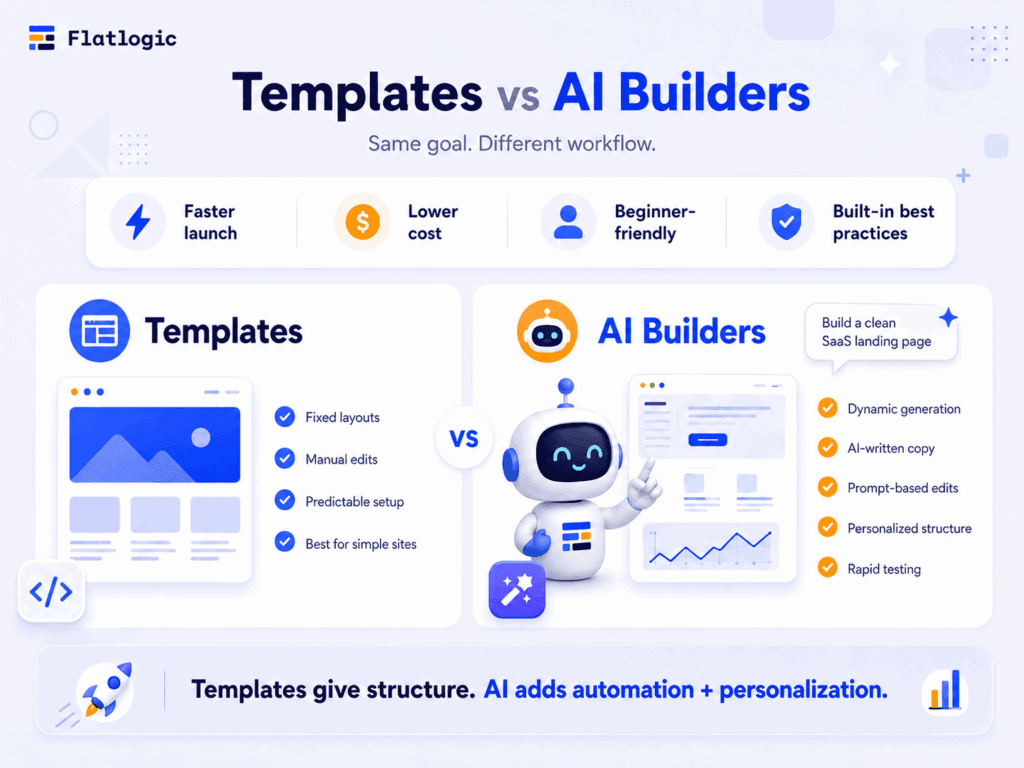
The main difference lies in how the final website is created. Templates provide a predefined structure that users customize manually, while AI builders generate a website dynamically based on user input and business requirements. In essence, both solutions aim to accelerate website creation, the AI approach simply introduces a higher level of automation and personalization.
Where AI Builders Surpass Traditional Templates
While AI builders and website templates share many similarities, AI-powered platforms introduce capabilities that go far beyond what traditional templates can offer. Rather than providing a fixed design that users must adapt to their needs, AI builders generate websites dynamically based on specific business goals, audiences, and requirements.
Greater Personalization
Traditional templates are built around predefined layouts and design structures. Although users can customize colors, images, and content, the overall framework often remains the same. AI builders can generate unique page structures, messaging, and visual elements tailored to a particular business, resulting in a more personalized website experience.
Faster Content Creation
One of the biggest advantages of AI builders is their ability to generate content automatically. Instead of writing every headline, product description, and call-to-action manually, users can receive AI-generated copy that serves as a strong starting point. This significantly reduces the time required to launch a new website.
Easier Iteration and Updates
Making substantial changes to a template-based website can be time-consuming, especially when multiple pages need to be updated. AI builders allow users to modify layouts, content, and design elements through simple prompts, making it easier to test new ideas, campaigns, or positioning strategies.
Intelligent Recommendations
Many AI builders go beyond website generation by providing suggestions for SEO, user experience, content optimization, and conversion improvements. Traditional templates typically leave these decisions entirely to the user, whereas AI-powered platforms can offer guidance based on industry best practices and data-driven insights.
Better Support for Rapid Experimentation
Startups often need to adapt quickly as they validate products and respond to customer feedback. AI builders make it easier to create new landing pages, test messaging variations, and launch updated website versions without extensive manual work. This flexibility can be especially valuable in fast-moving markets where speed is a competitive advantage.
While traditional templates remain a practical option for many businesses, AI builders offer a more adaptive and automated approach. By combining website generation, content creation, and optimization capabilities in a single workflow, they enable startups to move from idea to launch faster than ever before.
The Limitations of AI Web Builders
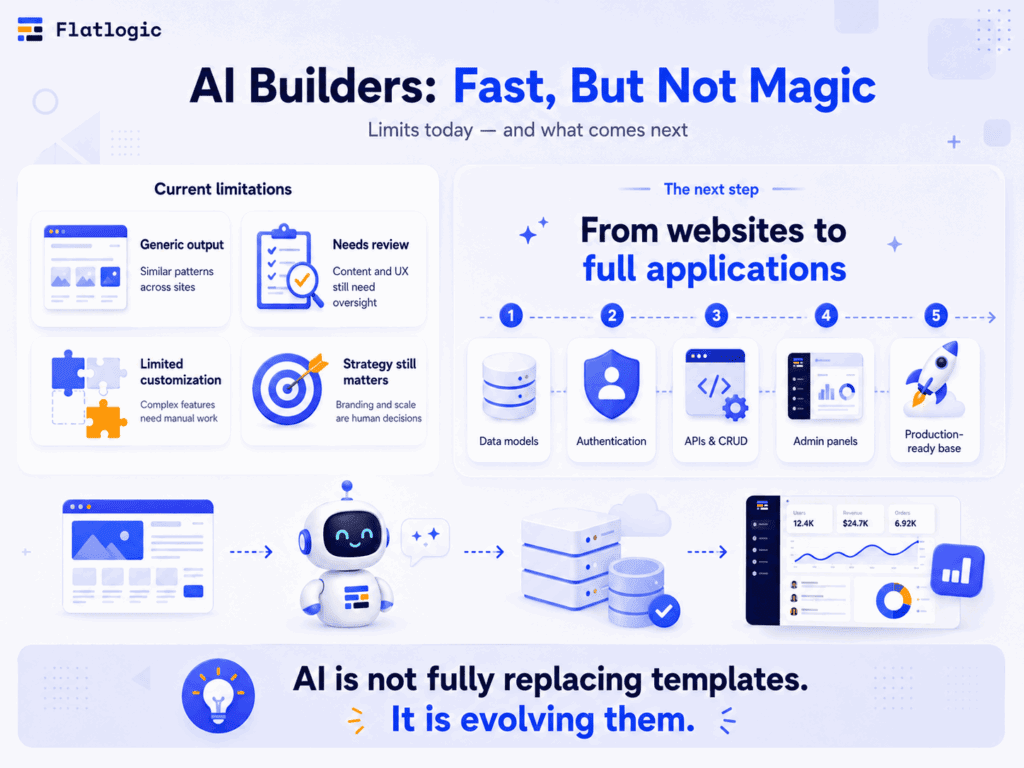
Although AI web builders have made website creation faster and more accessible than ever, they are not without limitations. While these platforms can generate impressive results in a matter of minutes, they still struggle to match the flexibility, creativity, and strategic thinking that experienced designers and developers bring to a project.
One of the most common concerns is the risk of generic output. AI models are trained on existing websites and design patterns, which means they often produce layouts and content that follow industry standards. While this can be beneficial for usability, it may make it harder for startups to create a distinctive brand identity and stand out in a competitive market.
Another challenge is content quality and accuracy. AI-generated headlines, descriptions, and marketing copy can provide a strong starting point, but they are not always aligned with a company’s unique value proposition. Founders still need to review, edit, and refine the content to ensure it accurately reflects their products, messaging, and target audience.
AI builders can also be limited when it comes to advanced customization. Startups with complex requirements, such as custom workflows, specialized integrations, interactive features, or unique user experiences, may find that AI-generated websites require additional development work. In these cases, traditional development approaches often provide greater flexibility and control.
Finally, AI tools still require human oversight. Decisions related to branding, user experience, SEO strategy, compliance, and long-term scalability cannot be fully automated. While AI can accelerate website creation, it cannot replace the strategic decision-making needed to build a successful digital presence.
For most startups, the best approach is to view AI web builders as powerful productivity tools rather than complete replacements for designers, developers, or marketers. Used effectively, they can dramatically reduce launch time while still benefiting from human expertise where it matters most.
Are AI Builders Replacing Templates?
The short answer is not yet, but they are changing the role templates play in website creation.
Traditional templates remain a popular choice because they offer a predictable structure, proven designs, and a straightforward setup process. For many small businesses and startups, templates continue to provide an affordable way to launch a professional website without starting from scratch.
However, AI builders are rapidly expanding what is possible. Instead of forcing users to adapt their content to a predefined design, AI can generate layouts, copy, and visual elements based on specific business goals and requirements. This creates a more personalized experience and significantly reduces the amount of manual work involved.
Rather than completely replacing templates, AI builders are evolving the concept of templates themselves. In many cases, AI-generated websites still rely on design patterns and best practices similar to those found in traditional templates, but they apply them dynamically instead of through fixed layouts.
As AI technology continues to improve, the line between templates and AI-generated websites will likely become increasingly blurred. Startups may no longer choose from a library of predefined designs; instead, they may simply describe what they need and receive a customized website built around their goals.
For now, templates and AI builders are likely to coexist rather than compete directly. Templates offer simplicity and predictability, while AI builders provide greater automation, personalization, and flexibility. The best choice depends on a startup’s budget, technical requirements, and growth ambitions.
From Website Builders to Full Application Generation: The Flatlogic Approach
While most AI web builders focus on creating marketing websites and landing pages, many startups eventually need something more powerful: a functional web application with a database, authentication, business logic, and an admin panel.
This is where platforms like Flatlogic take a different approach.
Instead of generating only the visual layer of a website, the Flatlogic Generator uses AI to help create full-stack web applications. Founders can describe their project requirements, data models, and desired functionality, and the platform generates a production-ready application foundation that includes both front-end and back-end components.
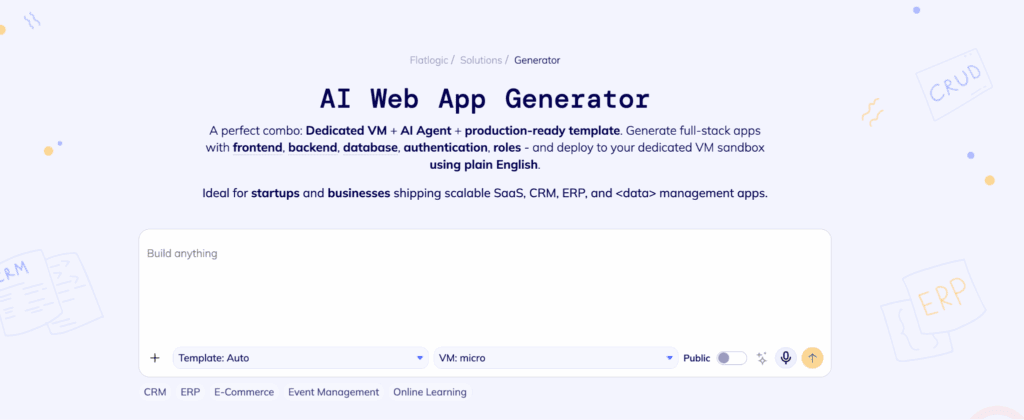
For startups, this can significantly reduce the time required to move from an idea to a working product. Rather than spending weeks configuring databases, authentication systems, CRUD operations, APIs, and administrative dashboards, teams can start with a generated application and focus on building features that differentiate their business.
Some of the key advantages include:
- AI-powered application generation based on business requirements.
- Automated database schema creation and data modeling.
- Built-in authentication and user management.
- Generated admin panels and CRUD functionality.
- Modern technology stacks ready for customization and scaling.
This reflects a broader industry trend: AI is moving beyond website generation and into application generation. For startups, the real opportunity is not simply launching a website faster, it’s accelerating the creation of the software products that power their business.
As AI development tools continue to evolve, platforms like Flatlogic demonstrate how the future may involve generating entire application foundations rather than assembling them manually from templates, frameworks, and boilerplate code.
Conclusion
AI web builders are not merely another website creation trend. They represent the next stage in the evolution of digital product development.
Traditional templates simplified website creation by providing reusable structures. AI builders take this concept further by generating customized structures, content, and recommendations based on user intent.
For startups, the advantages are clear: faster launches, lower costs, easier experimentation, and greater accessibility for non-technical founders.
Yet AI builders are not a complete replacement for human expertise. Strategic thinking, brand differentiation, complex functionality, and long-term scalability still require human involvement.
So, are AI web builders becoming the new website templates? In many ways, yes. They are gradually assuming the role that templates once played as the fastest path from idea to online presence. But rather than replacing templates outright, AI is transforming the entire website creation process into something more dynamic, personalized, and intelligent.
For startup founders, the opportunity is not choosing between AI and templates. It’s understanding when each approach delivers the most value, and leveraging AI to accelerate the journey from concept to growth.
Comments