


TL;DR
- AI consulting helps startups turn AI into practical, ROI-driven execution instead of endless experimentation.
- Start with business goals and high-impact use cases; validate early with MVPs to reduce risk and wasted spend.
- Consultants can act as an external AI team, covering strategy, data readiness, integration, and optimization.
- Common quick-win use cases: support automation, marketing/sales optimization, ops automation, forecasting, personalization.
- Choose partners who prioritize measurable outcomes, clear pricing, and scalable architectures—not hype or one-size-fits-all tools.
Fact Box
- Only about 31% of companies report a positive ROI from AI investments, largely due to lack of strategy and execution clarity.
- AI consulting aims to deliver tangible outcomes in weeks or months, not years, by leveraging MVPs and proven architectures.
- The article lists common SMB AI use cases: support automation, lead scoring, ops automation, forecasting, personalization, fraud detection.
- Common AI project failure reasons cited: no clear strategy, poor data quality, wrong use cases, lack of integration, unrealistic expectations.
- AI consulting is positioned as a hybrid between building in-house and buying tools, balancing speed, cost, and scalability for SMBs.
What if the difference between struggling with AI and scaling your business faster than competitors is not the technology itself, but how you implement it?
When business owners search for AI consulting, they are rarely just curious. They are looking for answers to pressing, practical questions:
- Where do we even start with AI?
- How much will it cost, and will it pay off?
- What use cases actually work for small businesses?
- Do we need an in-house team, or can we outsource everything?
As Andrew Ng once said, “AI is the new electricity”. The implication is clear: businesses that fail to adopt it risk falling behind, just as those who ignored electricity once did.
Yet, despite the hype, many SMBs and startups struggle to move from experimentation to real results. Research shows that while AI adoption is accelerating, success is far from guaranteed. For example, only about 31% of companies report a positive ROI from AI investments, largely due to a lack of strategy and execution clarity. At the same time, SMEs face persistent challenges, including skills shortages, limited budgets, and data constraints. This creates a critical gap between AI potential and AI reality.
In this article, you’ll learn how AI consulting helps bridge that gap. We’ll break down what AI consulting actually includes, why SMBs and startups need it, common pitfalls to avoid, and how to turn AI into a measurable growth driver.
What Is AI Consulting?
For SMBs and startups, AI consulting is not just about implementing advanced technology. It’s about making artificial intelligence practical, cost-effective, and aligned with real business goals.
At a high level, AI consulting means partnering with experts who help you understand where AI can actually create value in your business, and then guiding you through the process of turning that potential into measurable results.

Unlike large enterprises, smaller companies don’t have the luxury of experimenting endlessly. Every investment must deliver impact. That’s why AI consulting for SMBs focuses less on complex research and more on practical execution, fast ROI, and scalable solutions.
Turning AI from Concept Into Action
Many founders and business owners are aware of AI’s potential, but struggle with questions like:
- Which tools should we use?
- Do we need custom models or existing solutions?
- How do we integrate AI into our current workflows?
AI consulting answers these questions by translating abstract AI capabilities into concrete business applications. Instead of overwhelming teams with technical complexity, consultants focus on solving specific problems, such as reducing support workload, improving marketing performance, or optimizing operations.
A Strategic, Not Just Technical Service
A common misconception is that AI consulting is purely technical. In reality, it sits at the intersection of business strategy and technology.
For SMBs and startups, this means:
- Identifying high-impact use cases that align with business goals
- Estimating ROI before implementation
- Prioritizing initiatives that deliver quick wins
- Avoiding unnecessary complexity
Rather than starting with algorithms, AI consulting starts with your business model and works backward to determine where AI fits.
Acting as an External AI Team
Most SMBs don’t have in-house data scientists, ML engineers, or AI strategists, and hiring them can be expensive and time-consuming.
AI consulting fills this gap by acting as an on-demand AI team, providing:
- Strategic guidance
- Technical expertise
- Implementation support
- Ongoing optimization
This allows companies to access top-level expertise without committing to long-term hiring or building internal infrastructure from scratch.
Focus on Practical, Scalable Solutions
For startups and SMBs, scalability is critical. AI consulting emphasizes solutions that:
- Work with existing tools and systems
- Can grow with the business
- Deliver value quickly without heavy upfront investment
In many cases, this means leveraging pre-built AI services, APIs, and platforms rather than developing everything from scratch.
Reducing Risk and Increasing ROI
AI projects carry inherent risks, especially for companies with limited budgets. Poor implementation can lead to wasted resources and missed opportunities.
AI consulting minimizes these risks by:
- Validating ideas before development
- Ensuring data readiness
- Designing scalable architectures
- Monitoring performance and improving outcomes over time
The result is a more predictable path from investment to return.
Bridging the Gap Between Business and Technology
Perhaps the most important role of AI consulting is bridging the gap between what AI can do and what your business actually needs.
For SMBs and startups, success with AI is not about adopting the most advanced technology. It’s about applying the right technology in the right way.
AI consulting ensures that every step, from strategy to execution, is aligned with business objectives, helping companies move beyond experimentation and into real, measurable growth.
Why SMBs and Startups Need AI Consulting
For SMBs and startups, adopting AI isn’t just a technical decision. It’s a strategic one. While the promise of automation, efficiency, and growth is compelling, the path to achieving those outcomes is rarely straightforward. Without the right guidance, businesses often face delays, wasted budgets, or solutions that never move beyond experimentation.
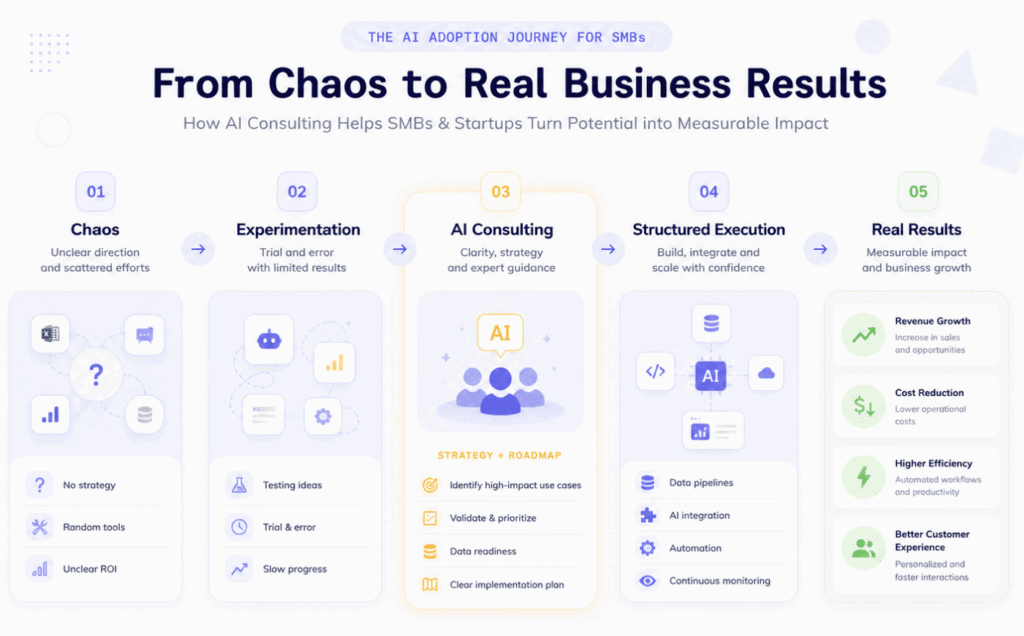
AI consulting exists to remove that uncertainty. It helps smaller companies navigate complexity, prioritize what matters, and achieve results faster, with fewer risks.
1. Limited Resources Require Smarter Decisions
Unlike large enterprises, SMBs and startups operate under tighter constraints, whether it’s budget, time, or talent. Every investment must deliver clear value.
AI consulting helps businesses:
- Focus on high-impact use cases instead of trying everything
- Avoid unnecessary tools and infrastructure costs
- Allocate resources efficiently from the start
Instead of spreading efforts thin, companies can concentrate on initiatives that actually move the needle.
2. Lack of In-House Expertise
AI is a multidisciplinary field that combines data science, engineering, and business strategy. Building an internal team with all these capabilities is expensive and time-consuming.
AI consultants bring:
- Proven experience across industries
- Knowledge of best practices and common pitfalls
- Access to modern tools and frameworks
This allows SMBs to benefit from expert-level execution without the overhead of hiring a full team.
3. Avoiding Costly Trial-and-Error
Many companies approach AI through experimentation, testing tools, running pilots, and hoping something works. While experimentation is valuable, uncontrolled trial-and-error can quickly become expensive.
Common mistakes include:
- Choosing the wrong use case
- Implementing overly complex solutions
- Underestimating data requirements
- Failing to integrate AI into existing workflows
AI consulting reduces these risks by providing a clear roadmap and validated approach from the beginning.
4. Faster Time-to-Value
Speed is critical, especially for startups competing in dynamic markets. Long implementation cycles can delay results and reduce competitive advantage.
AI consulting accelerates the process by:
- Leveraging pre-built solutions and proven architectures
- Streamlining development and integration
- Delivering MVPs quickly for early validation
This enables businesses to see tangible outcomes in weeks or months, not years.
5. Turning Data Into a Strategic Asset
Many SMBs already have valuable data, but don’t fully utilize it. Customer interactions, sales records, and operational data often remain underleveraged.
AI consulting helps transform this data into actionable insights by:
- Structuring and preparing datasets
- Identifying patterns and opportunities
- Enabling predictive and prescriptive analytics
As a result, businesses can make more informed decisions and uncover new growth opportunities.
6. Staying Competitive in a Rapidly Changing Market
AI adoption is accelerating across industries. What was once a competitive advantage is quickly becoming a baseline expectation.
Without AI, businesses risk:
- Falling behind more efficient competitors
- Missing opportunities for automation and optimization
- Delivering less personalized customer experiences
With AI consulting, SMBs can adopt the right capabilities at the right time, ensuring they remain competitive without overextending themselves.
7. Building Scalable Foundations
Startups and growing SMBs need solutions that evolve with them. Poorly designed systems can create bottlenecks as the business scales.
AI consulting ensures that:
- Solutions are built with scalability in mind
- Systems integrate smoothly with existing infrastructure
- Future expansion is planned from the beginning
This prevents costly rework and supports long-term growth.
In essence, AI consulting is not just about implementing technology. It’s about enabling smarter, faster, and more confident decision-making.
For SMBs and startups, the real value lies in having a clear path forward: knowing what to build, how to build it, and how to ensure it delivers real business impact.
Key Benefits of AI Consulting
AI consulting provides SMBs and startups with a clear, structured path to adopting artificial intelligence that delivers real business value. Instead of approaching AI as a set of disconnected tools or experiments, companies gain a strategic framework that connects technology directly to outcomes such as cost savings, efficiency, and revenue growth.
One of the biggest advantages is the ability to move faster with less risk. Rather than spending months testing different solutions, businesses can rely on proven approaches, validated use cases, and expert guidance. This significantly reduces uncertainty and ensures that every step, whether it’s selecting tools, preparing data, or integrating systems, contributes to measurable results.
Another key benefit is cost efficiency. AI projects can become expensive when poorly planned, especially for companies with limited budgets. AI consulting helps avoid unnecessary investments by focusing only on initiatives that have a clear return on investment. It also encourages the use of existing tools and scalable solutions instead of building everything from scratch.
Beyond efficiency and cost savings, AI consulting enables better decision-making. By transforming raw data into actionable insights, businesses can understand customer behavior, optimize operations, and identify growth opportunities more effectively. This shift from intuition-based to data-driven decisions is often a turning point for scaling companies.
Core Benefits
- Faster implementation using proven frameworks, reducing time-to-value
- Lower operational costs by automating repetitive tasks and optimizing workflows
- Improved decision-making through data analysis and predictive insights
- Reduced risk thanks to structured planning and validated use cases
- Scalable architecture that supports long-term business growth
- Better customer experience through personalization and automation
Business Impact Overview
| Area | Without AI Consulting | With AI Consulting |
| Implementation speed | Slow, experimental, unpredictable | Fast, structured, and goal-oriented |
| Costs | Often exceeds the budget due to trial-and-error | Optimized with clear investment priorities |
| ROI | Difficult to measure or delayed | Defined upfront and continuously tracked |
| Data utilization | Fragmented or underused | Centralized and leveraged for insights |
| Scalability | Requires rework as business grows | Designed for growth from the start |
| Team productivity | Limited by manual processes | Enhanced through automation and AI support |
Ultimately, AI consulting helps SMBs and startups turn AI into a practical business tool, not just a technological experiment. By combining strategy, execution, and continuous improvement, companies can achieve faster results, minimize risks, and build a strong foundation for sustainable growth.
Common AI Use Cases for SMBs and Startups
For SMBs and startups, the real value of AI comes from solving practical business problems, not from experimenting with complex technologies. The most effective approach is to focus on use cases that deliver quick wins, improve efficiency, and generate clear ROI.
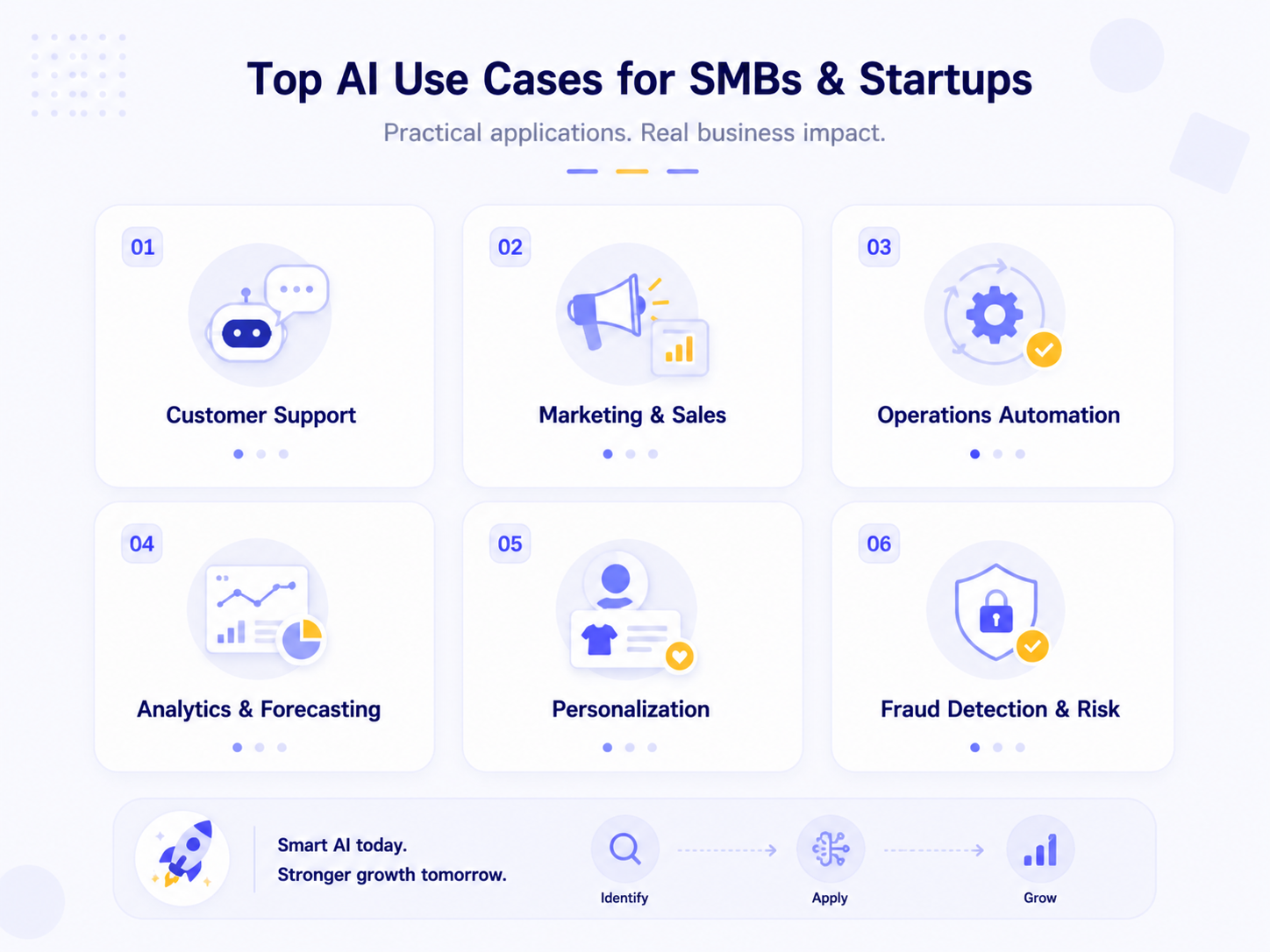
Instead of trying to apply AI everywhere, successful companies prioritize areas where automation, prediction, or personalization can make an immediate impact. These typically align with core business functions such as customer support, marketing, operations, and analytics.
Most Common Use Cases
- Customer support automation (AI chatbots, ticket routing, automated responses)
- Marketing and sales optimization (lead scoring, personalized campaigns, content generation)
- Workflow and operations automation (document processing, scheduling, internal workflows)
- Data analytics and forecasting (sales prediction, customer segmentation, demand planning)
- Personalization and recommendation systems (product suggestions, tailored user experiences)
- Fraud detection and risk analysis (transaction monitoring, anomaly detection)
Business Impact by Use Case
| Use Case | Example Application | Business Value |
| Customer Support Automation | AI chatbot handling FAQs | Reduced workload, 24/7 support |
| Marketing & Sales | AI-generated emails, lead scoring | Higher conversions, better targeting |
| Operations Automation | Invoice processing, workflow automation | Time savings, fewer errors |
| Analytics & Forecasting | Sales and demand prediction | Better planning, reduced uncertainty |
| Personalization | Product or content recommendations | Increased engagement and retention |
| Risk & Fraud Detection | Transaction monitoring | Improved security, reduced losses |
How to Choose the Right Use Case
Not every use case is equally relevant for every business. The best starting point is identifying areas where:
- Processes are repetitive and time-consuming
- Data is available but underutilized
- Improvements can directly impact revenue or reduce costs
For example, an e-commerce startup might prioritize recommendation systems and automated support, while a SaaS company may focus on lead scoring and churn prediction.
The key is to start small, validate results quickly, and scale what works. By focusing on the right use cases, SMBs and startups can unlock the real power of AI without unnecessary complexity or risk.
Why AI Projects Fail Without Consulting
Many SMBs and startups start AI initiatives with high expectations, but without a clear strategy, those projects often stall or fail to deliver real value. The issue is rarely the technology itself; it’s the lack of direction, preparation, and alignment with business goals.
Common reasons for failure include:
- No clear strategy, AI is adopted because of hype, not a defined business need
- Poor data quality, incomplete or unstructured data, leads to unreliable results
- Wrong use cases, focusing on low-impact or overly complex problems
- Lack of integration, AI tools don’t fit into existing workflows
- Unrealistic expectations, expecting immediate results without iteration
Without expert guidance, businesses often waste time and budget on experiments that never scale. AI consulting helps avoid these pitfalls by providing a structured approach, ensuring that every initiative is aligned with measurable outcomes and long-term business value.
How AI Consulting Solves These Problems
AI consulting addresses the most common reasons projects fail by replacing guesswork with a structured, outcome-driven approach. Instead of experimenting with tools in isolation, businesses get a clear roadmap that connects AI initiatives directly to measurable business goals.
The first step is bringing clarity and focus. Consultants help define what success looks like, identify the most valuable use cases, and prioritize initiatives that can deliver quick, tangible results. This eliminates the common problem of pursuing AI without a clear purpose.
Another critical area is data readiness. Many AI projects fail because the underlying data is incomplete, inconsistent, or poorly structured. AI consultants assess existing data, clean and organize it, and set up pipelines that ensure reliable inputs for models and analytics. This significantly improves the accuracy and usefulness of AI solutions.
AI consulting also ensures practical implementation. Instead of overengineering solutions, consultants choose the right tools and technologies based on the business context, often leveraging existing platforms and pre-built components to reduce complexity and cost. They also handle integration, making sure AI fits seamlessly into current workflows rather than disrupting them.
Equally important is risk reduction. By validating ideas early, through prototypes or MVPs, consultants help businesses test assumptions before committing significant resources. This approach minimizes costly mistakes and allows companies to iterate based on real feedback.
Finally, AI consulting supports continuous improvement and scalability. AI is not a one-time deployment; it requires ongoing monitoring, optimization, and adaptation as the business grows. Consultants ensure that systems are built to scale and continue delivering value over time.
In essence, AI consulting transforms AI adoption from a risky, uncertain process into a structured journey, helping SMBs and startups move confidently from idea to implementation to measurable impact.
Build vs Buy vs Consult
When adopting AI, SMBs and startups typically face three options: build solutions in-house, buy ready-made tools, or work with an AI consulting partner. Each approach has its pros and trade-offs, and the right choice depends on your resources, timeline, and business goals.
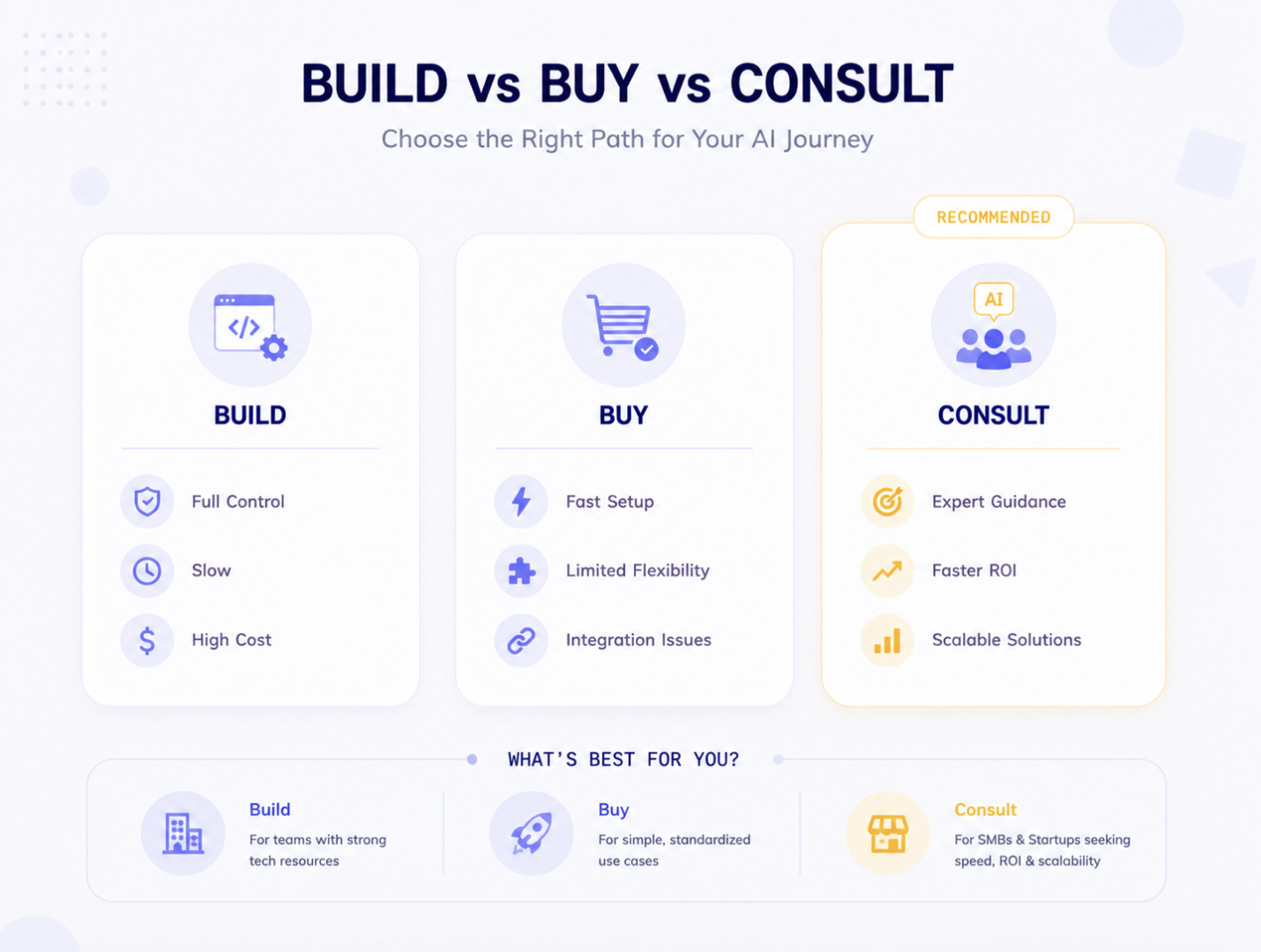
Quick Comparison
| Approach | Pros | Cons |
| Build | Full control, highly customizable | Expensive, slow, requires expertise |
| Buy | Fast setup, lower upfront cost | Limited flexibility, integration issues |
| Consult | Expert guidance, balanced approach | Requires an external partner |
What It Means in Practice
- Build is suitable for companies with strong technical teams and long-term AI investment plans.
- Buy works best for simple, standardized use cases where speed matters more than customization.
- Consult offers a hybrid approach, helping you choose, customize, and implement the right solutions without unnecessary complexity.
For most SMBs and startups, consulting provides the best balance between speed, cost, and scalability, ensuring AI delivers real business value without overextending internal resources.
How to Choose the Right AI Consulting Partner
Choosing the right AI consulting partner can make the difference between a successful AI initiative and a costly experiment. For SMBs and startups, the ideal partner is not just technically strong, but also focused on delivering real business outcomes.
A good AI consulting partner should understand your business model, constraints, and growth goals. Instead of pushing complex solutions, they should help you identify practical opportunities where AI can create a measurable impact quickly.
What to Look For
- Proven experience, track record of delivering AI projects, ideally in your industry
- Business-first approach, focus on ROI, not just technology
- End-to-end capabilities, from strategy and data preparation to implementation and scaling
- Flexibility, the ability to adapt solutions as your business evolves
- Clear communication, transparency in timelines, costs, and expected outcomes
Red Flags to Avoid
- Overly technical focus without linking to business value
- Promising instant results without validation or iteration
- Lack of clarity in pricing or the delivery process
- One-size-fits-all solutions that ignore your specific needs
Ultimately, the right partner should act as an extension of your team, helping you make smarter decisions, move faster, and ensure that every AI initiative contributes to real, sustainable growth.
Conclusion
AI is no longer a question of if, it’s a question of how well you implement it. For SMBs and startups, the difference between wasted budgets and real growth comes down to having a clear strategy, the right use cases, and the ability to execute efficiently.
Throughout this article, we’ve seen that AI consulting is not just about technology. It’s about turning complexity into clarity. It helps businesses focus on what truly matters, avoid common pitfalls, and move from experimentation to measurable results faster and with less risk.
👉 If you’re looking to turn AI into a real growth driver, Flatlogic’s AI consulting services can help you identify the right opportunities and implement them эффективно from day one.
The companies that win with AI are not the ones using the most advanced tools. They are the ones applying AI most practically and strategically.
By starting with the right foundation today, your business can not only keep up with the market but also stay ahead of it.