


TL;DR
- Code ownership is more than legal IP; it’s practical control over code, repos, CI/CD, infra, docs, and data.
- Weak ownership creates vendor lock-in: even small changes, cloud moves, or partner swaps can become slow and costly.
- Transfer-ready assets (repo history, pipelines, schemas, tests, diagrams) can save weeks or months in vendor transitions.
- AI increases lock-in risk: models, prompts, data flows, and providers must be portable to keep future options open.
- Before signing, clarify ownership, access, handover terms, third-party dependencies, and who controls production/deployments.
Fact Box
- The article cites BCG research: 62% of IT buyers have concerns about lock-in with digital platforms.
- The article cites BCG research: 70% of IT buyers are actively scanning the market for alternatives.
- The article says the cited BCG study surveyed 500 IT decision-makers across NA, Europe, and APAC.
- The article cites McKinsey 2025 research: 88% of organizations report regular AI use in at least one function.
- The article cites IBM 2026 research: 71% of surveyed executives said switching their primary AI vendor/model is difficult.
Building business software is getting easier. The interesting part is figuring out how much control your business actually has over that software once it is built.
As a CEO, founder, CIO, CTO, or technology decision-maker, you have probably asked yourself: How quickly can we build the software we need? Should we work with an external development partner? Who should own the code once the project is complete? What happens if we need to change vendors, modernize the application, or move in a different technology direction later?
These questions matter.
Because custom software is no longer just a technology project. It can become part of how your business operates, serves customers, manages data, and grows. GlobalLogic once said, “Don’t just write code; take absolute ownership of the legacy you are building.” And once that happens, the question of who controls the software becomes much bigger than who wrote the code.
Enterprises are already in a dilemma.
According to BCG research, 62% of IT buyers have concerns about lock-in with digital platforms. The research also shows that 70% are actively scanning the market for alternatives. The study surveyed 500 IT decision-makers across North America, Europe, and Asia-Pacific.
When I look beyond these numbers, I notice something important: businesses may be comfortable with their technology partners today. But you might still want the option to choose differently when building custom business software.
Business needs rarely stay the same. You may need to change a workflow, add a new integration, introduce AI, scale the application, or move to a different development partner. At that point, should your business still depend entirely on the original vendor to make those changes?
The answer should not be yes. With proper code ownership, your business has more control over how the software evolves.
For me, that is the real value of code ownership: it protects your ability to respond when the business changes-and helps prevent a technology dependency from becoming a business risk.
In this article, I want to unpack what code ownership actually means, why it matters long after the first release, what you should clarify before signing a development agreement, and how to build software while keeping control of its future.
What Does Code Ownership Actually Mean?
Code ownership is often treated as a contractual question: Who owns the source code?
For a CXO, the more important question is what that ownership gives the business.
If the software supports a critical business process, ownership should give you the ability to make strategic decisions about it. Without being forced into one vendor, one technology path, or one operating model.
Consider a simple example.
A logistics company invests $2 million in a custom operations platform. The application manages orders, fleet operations, customer data, and integrations with 8 external systems. Three years later, the business acquires another company and needs 5 new integrations, AI-based forecasting, and a redesigned customer portal.
The software may still be working perfectly.
But if only the original development partner can confidently modify the system, the business has a problem. A project that started as a $2 million technology investment can become a dependency that affects future budgets, timelines, and strategic choices.
This is why I look at ownership beyond the source code itself.
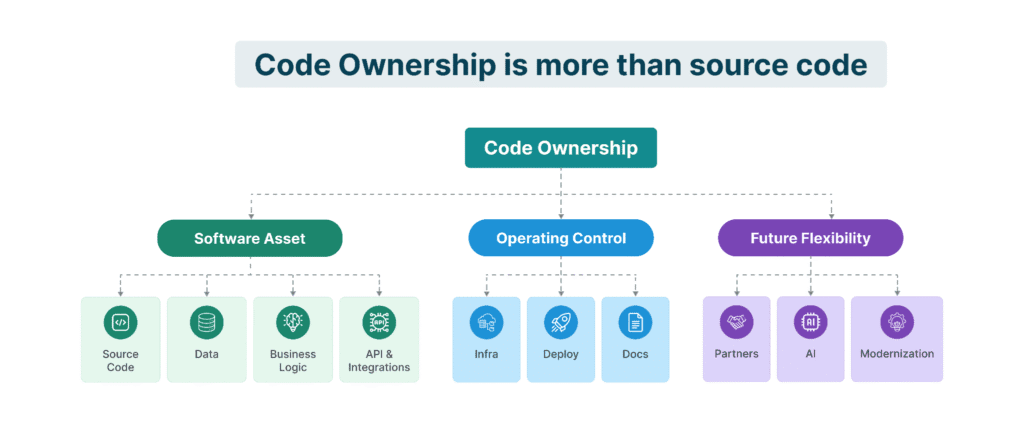
| Ownership Area | What it should mean for your business |
| Source code | Gives the business the ability to change or extend a critical application as requirements evolve. |
| Data | Protects access to an important business asset and keeps migration options open. |
| Infrastructure | Reduces the risk of being tied to a particular operating environment. |
| Documentation | Preserves the knowledge behind the software, even when people or partners change. |
| Third-party dependencies | Makes technology and vendor exposure visible before it becomes expensive to change. |
| Deployment | Gives the business greater freedom to decide who operates and maintains the application. |
The numbers can change from one business to another. The principle does not.
This leads us to the most important question –
Why Does Code Ownership Matter for Your Business?
Code ownership becomes clearer when you look at what sits behind a business application.
Source code is only one part of it. Repositories, APIs, databases, cloud environments, deployment pipelines, documentation, and third-party dependencies also matter.
If these assets remain with the development partner, the business may own the application on paper. But it may still depend on the vendor to run or change it.
Keep Business Changes in Your Hands
Take a business application with 200+ APIs, 15 microservices, and several external integrations.
The company may own the source code. But what if the vendor controls the Git repository, CI/CD pipeline, and deployment setup? Even a simple change can then require the vendor.
This becomes important when the business wants to add AI, replace an integration, change a workflow, or move to another cloud platform. Without technical control, business change can become vendor-dependent.
What if you don’t have the actual controls?: The result can be slower releases, additional costs, and less freedom to act when priorities change.
Do Not Let Vendors Become Gatekeepers
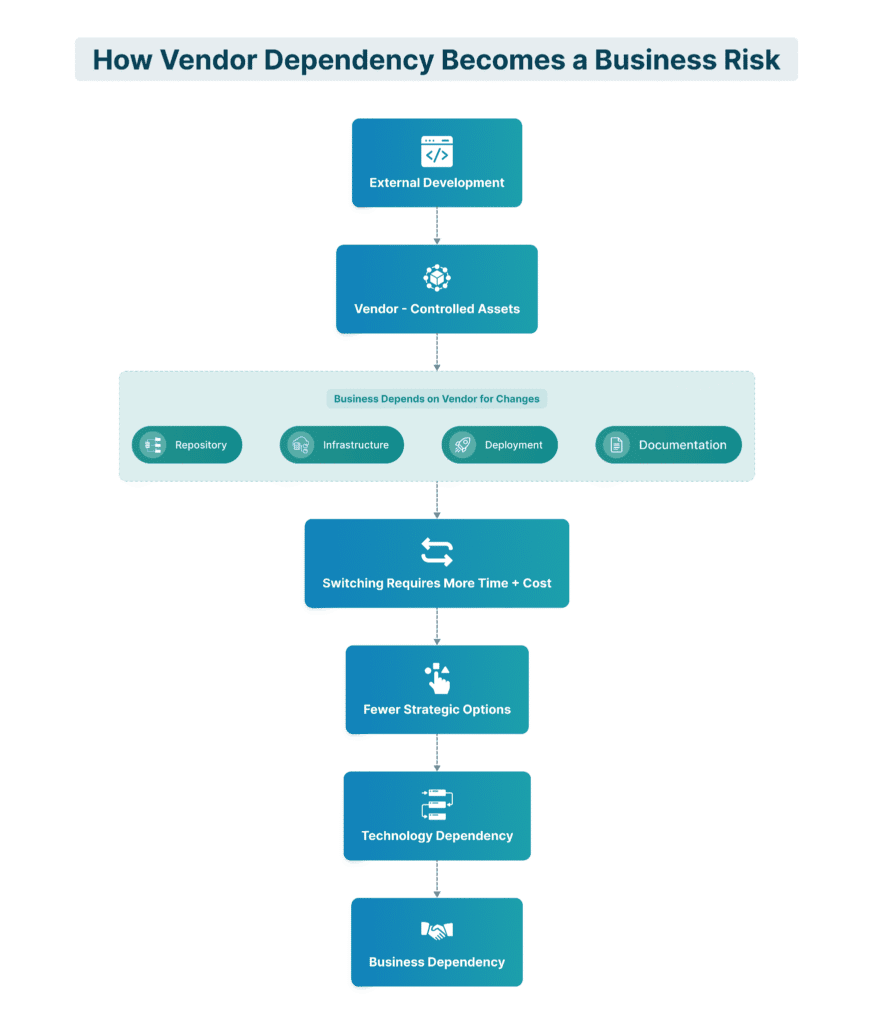
Vendor dependency can hide inside the architecture. The vendor may control cloud accounts, repositories, deployment pipelines, environment settings, or proprietary components.
Everything may work fine at first. The problem appears when the business wants to change providers or build an internal team.
Consider a $1 million application built with undocumented APIs, vendor-specific libraries, and deployment scripts known only to the original team. Replacing that vendor is no longer a simple business decision.
The technical dependency has now become a business dependency.
What happens when ‘vendors are the only gatekeepers’?:
The company may have fewer options in negotiations. It may also face higher transition costs and longer timelines.
Make the Software Easier to Transfer
Moving to a new partner requires more than handing over source code.
The new team may need:
- Version-control repositories and commit history
- CI/CD pipelines and deployment configurations
- Cloud infrastructure and environment settings
- API specifications and integration details
- Database schemas and migration scripts
- Architecture diagrams and technical documentation
- Test suites and automated testing environments
- Third-party libraries and licensing information
Without these assets, the new team has to spend time figuring out how the system works. That can mean weeks or months of additional work.
What if you don’t have the ability to do ‘smooth software transfer’? :
The business may also pay the new partner to reverse-engineer systems it already paid to build. Poor ownership can turn a vendor transition into a second development project.
Get More From the Software You Already Paid For
Building software is a long-term investment for businesses.
Suppose an enterprise spends $2 million on a core platform. Two years later, it wants to add AI, integrate an acquired company, and handle 40% more transaction volume.
If the company controls the architecture, infrastructure, database design, and deployment process, the existing platform can support those changes. If it does not, the business may spend heavily just to understand and modify what it already paid for.
What is the frustrating outcome of ‘not fully optimizing the investment’?:
The company owns an expensive software asset but cannot easily extract its full value. The cost is not limited to development. Delayed modernization can also affect operations, customer experience, and future investment decisions.
Keep Your Technology Options Open
Technology will change. The application may start with one cloud provider, database, AI model, or integration architecture. Five years later, those choices may no longer make sense.
If you control its repositories, APIs, infrastructure, and deployment setup, the software teams have more freedom to modernize. If the vendor controls them, even a technology change can become a vendor-dependent project.
What happens when you don’t have ‘freedom to new technologies’?
That can slow down modernization. It can increase switching costs. It can also force the business to keep technologies that no longer fit its strategy.
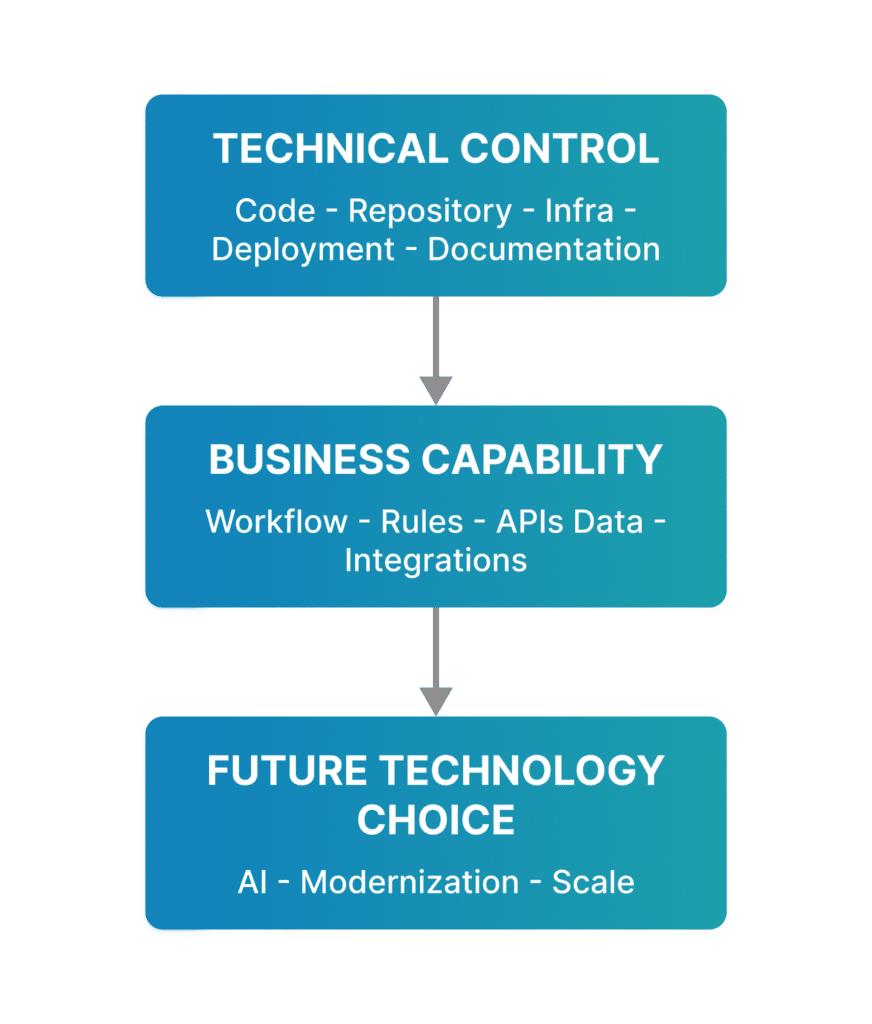
What Are You Actually Protecting When You Own the Code?
When you own the code, you are protecting much more than source files.
You are protecting the business capability, investment, knowledge, and future options built into the software.
Your Intellectual Property
Custom software often contains years of work.
It may include hundreds of workflows, APIs, automation rules, and features designed around your business.
A platform developed over 2-3 years can represent a $1M+ investment.
When your business owns that technology, the investment remains yours to extend, improve, or reuse.
Business benefit: Your software remains a long-term business asset, not just a completed project.
Your Business Logic
Your software also captures how the business operates.
It can contain pricing rules, approval processes, customer journeys, and automated decisions. A system with 100+ business rules may reflect years of operational experience.
When your business owns the code and documentation, that knowledge stays accessible to your teams and future partners.
Business benefit: The company can preserve its way of working even as people, teams, and vendors change.
Your Ability to Build on What Already Exists
A mature application may have 15-20 core services and 50+ APIs supporting different parts of the business.
When your business owns the underlying technology, future teams can build on that foundation.
You do not have to treat every new requirement as a completely new project.
Business benefit: Existing technology can continue supporting growth instead of becoming a sunk investment.
Your Data and Data Flows
Business software sits close to some of the company’s most valuable information. Customer data. Transaction data. Operational data. Product data.
A platform may process millions of records each month across multiple business systems.
When your business controls the software and its data pathways, you have more freedom to connect that information with new platforms, analytics tools, and AI initiatives.
Business benefit: Your existing data can support future growth and innovation.
Your Freedom to Operate Your Business Software
Ownership also extends to the assets that keep the software running. This includes deployment processes, infrastructure configurations, testing environments, and other operational assets.
When your business has access to them, you have more choice in how the application is maintained and operated. You can work with the existing partner, move to another partner, or gradually build more capability internally.
Business benefit: Your operating model can change without forcing you to replace the entire software investment.
Your Future Technology Choices
Technology changes faster than most business applications. The platform you build today may need AI capabilities, new integrations, higher capacity, or a different architecture a few years from now.
When your business owns the underlying technology, you can make those changes around the asset you already have.
Business benefit: You can direct future technology budgets toward new value instead of rebuilding what you already paid for.
That is what you are really protecting with code ownership: not just the code, but the freedom to keep getting business value from it.
The Code Can Be Yours and You Can Still Be Dependent
One assumption I often see in software projects is simple: “If the code belongs to us, we are in control.”
I do not think that is always true.
You can legally own the source code and still depend heavily on the original development partner. The real issue is not just who owns the code. It is who can actually use, understand, change, and operate it.
Here are the myths I would challenge.
Myth 1: “We Have the Source Code, So We Are Independent”
I would not consider source code handover the finish line. Imagine your company receives 500,000+ lines of code after a major software project.
The code is yours. But the original vendor still knows how the architecture works, where the critical integrations sit, how deployments happen, and why certain technical decisions were made.
In that situation, the business owns the code but still needs the vendor to work with it.
My view: ownership should give you usable control, not just legal possession.
Myth 2: “Documentation Is Only a Technical Detail”
I see documentation as part of the ownership package. Architecture diagrams, API documentation, database structures, deployment guides, and system dependencies make the software understandable to someone other than the original team.
Without them, a new partner may spend weeks learning the system before making meaningful changes. That creates transition costs the business did not plan for.
Good documentation turns ownership into something another team can actually use.
Myth 3: “Our Vendor Can Manage Everything. We Do Not Need Access.”
This can work while the relationship is strong. But I would still want the business to have appropriate access to its critical technology assets.
That includes code repositories, cloud environments, deployment pipelines, monitoring tools, testing environments, and project documentation.
The goal is not to make the business manage every technical system itself.
The goal is to avoid a situation where one external company becomes the only route to your own software.
Myth 4: “Code Ownership Means We Should Build Everything In-House”
I do not see it that way. External development partners can provide skills, scale, and specialised expertise. There is no need to eliminate that model simply to maintain ownership.
What matters is keeping the option to change the model later. You may continue with the same partner. You may bring some work in-house. You may move to another partner.
The choice should belong to the business.
Myth 5: “If We Never Plan to Change Vendors, This Does Not Matter”
This is another assumption I would challenge. You may have no reason to change vendors today.
But business conditions can change. The company may acquire another business, enter a new market, adopt a new technology, or need capabilities the current partner does not provide.
I prefer to build ownership around those future possibilities rather than today’s relationship. For me, real code ownership means keeping your options open, even when you have no immediate plan to use them.
How AI Changes the Code Ownership Equation
After busting these myths, there is one more change I would bring into the conversation: AI is making software ownership even more important.
AI is no longer limited to experiments. McKinsey’s 2025 research found that 88% of organizations report regular AI use in at least one business function, although most are still experimenting or piloting rather than scaling AI across the enterprise.
That changes how I think about code ownership.
AI features will increasingly sit inside the software businesses already depend on. They may handle recommendations, document processing, forecasting, customer interactions, workflow automation, or internal decision support. The question is no longer only who owns the application.
It is also who controls the AI layer around it.
AI Adds Another Layer of Dependency
An AI-enabled application may depend on models, APIs, prompts, retrieval systems, proprietary data, and third-party infrastructure.
For example, your application may use one AI model today and need to switch to another model tomorrow because of cost, performance, security, or capability.
If the application is designed around a single provider with limited portability, that change may not be simple.
IBM’s 2026 research found that 71% of surveyed executives said switching their primary AI vendor or model would be difficult.
Code ownership gives the business a stronger foundation for making those AI choices.
Your Data Becomes Even More Valuable
AI depends heavily on business data. Customer records, internal documents, transaction history, product information, and operational data can all become inputs for AI systems.
IBM’s 2025 CEO research found that 72% of surveyed CEOs viewed proprietary data as key to unlocking generative AI value.
That makes ownership of the surrounding application architecture important. The business should know where its data sits, how it reaches AI systems, and how that data can be moved or reused.
The more valuable your data becomes, the more important it is to control the software that connects to it.
AI Makes Portability More Important
I do not think businesses need to predict which AI model will dominate five years from now. They need to avoid building systems that make future choices unnecessarily difficult.
That means keeping important application logic, data structures, integrations, and AI components understandable and replaceable where practical. The goal is to make sure today’s AI decision does not become tomorrow’s permanent constraint.
This is also why software supply-chain visibility matters. NIST recommends practices such as Software Bills of Materials (SBOMs) to improve visibility into software components and their relationships.
For me, AI strengthens the original case for code ownership.
The faster technology changes, the more valuable it becomes to keep your options open.
Do You Really Need to Own Everything?
Not necessarily. I would not tell every business to own every line of code, every infrastructure component, or every technology service.
That would be unrealistic.
| What to protect | Why it matters |
| Core application and business logic | This represents the workflows and capabilities built specifically for your business. |
| Business data and integrations | These connect the software to your operations, customers, and other systems. |
| Ability to operate and change the software | This protects your freedom to maintain, modernize, or change partners. |
The better question is what your business cannot afford to lose control over. For most custom business software, I would separate ownership into three layers.You may not need to own every cloud service or third-party tool. You may not need to operate every server yourself. You may not even need an internal engineering team.
But you should understand which dependencies are critical and keep control over the assets that determine your ability to change.
That is the balance I would aim for: not zero dependency, but intentional dependency.
The Questions You Should Ask Before Building Business Software
Before signing a software development agreement, I would ask questions that go beyond price, timeline, and technology stack.
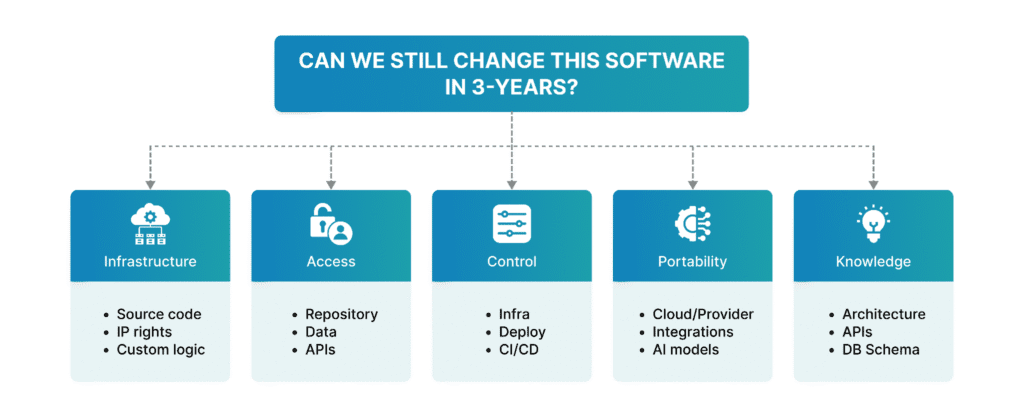
1. Who owns the source code?
Get the ownership position clearly defined in the agreement.
2. Where will the code live?
Ask whether your business has direct access to the repository from the beginning.
3. Who owns the business logic and custom components?
Clarify what is being created specifically for your business and what belongs to the vendor.
4. What happens if we change development partners?
Ask how the application, documentation, environments, and technical knowledge will be transferred.
5. Do we control our data and data structures?
Understand where data lives and how it can be exported or migrated.
6. What third-party dependencies are built into the application?
Ask for visibility into commercial software, open-source components, APIs, AI models, and other external dependencies.
7. Can we change AI or cloud providers later?
This matters more as AI becomes part of core business software.
8. Who controls deployment and production access?
You should understand who can deploy, maintain, monitor, and recover the application.
9. What documentation will we receive?
Do not limit this to a user manual. Ask about architecture, APIs, databases, integrations, deployment, and operational documentation.
10. What happens to our technology if the relationship ends?
This is the question I would never skip.
A good development relationship should work well while it lasts. But the agreement should also protect the business if circumstances change.
The goal is simple: build a relationship that you want to continue, without creating a system you are unable to leave.
Final Thoughts: Build the Software. Keep the Choice.
I see code ownership as a business decision, not just a legal or technical one.
The software you build today can become part of your operating model for years. Its value will depend not only on what it does now, but on how easily you can change it as the business evolves. AI will accelerate that change. New platforms will emerge. Business models will shift. Development partners will change.
You cannot predict every change. But you can build software that leaves room for it. That is the principle I would take into every custom software project: build for today’s business, but keep control over tomorrow’s choices.
If you are planning to build or modernize business software, Flatlogic can help you take that approach – from product scope and architecture to development, deployment, and long-term evolution. Flatlogic says its delivery model provides businesses with a real codebase, repository access, and deployment setup, with options for both custom development and AI-assisted application building.
Comments