


TL;DR
- Talk to customers before coding; 15–20 interviews can reveal the real problem worth solving.
- Avoid bloated v1s: focus on one core workflow and ship the smallest useful MVP, not a cheap unfinished product.
- Don’t pick tech first; choose architecture that fits current needs and can grow as usage scales.
- Define and track metrics beyond signups (activation, usage, conversion, churn, MRR) to guide decisions.
- Treat security and onboarding as day-one work; launch is the start of learning, not the finish line.
Fact Box
- The article recommends interviewing 15–20 potential customers before building to validate what to build.
- A cited study of 88 startup experience reports found failure patterns like product uncertainty, poor quality, and team problems.
- The article states VARStreet currently has catalog integrations with 50+ distributors.
- Example plan: test the MVP with 10 sellers, observe usage, and iterate based on where they get stuck.
- It argues getting real feedback in 3 months is better than spending a year building in isolation.
Building your first SaaS product can feel like the beginning of something huge. However, one wrong decision early on can turn months of hard work into a product nobody wants. Stay with me until the end, because I will explain to you the mistakes I have seen founders make and, more importantly, what I would do differently.
When I started looking into why so many SaaS products struggle, the questions that popped into my mind were like: How do I know whether my SaaS idea is worth building? How do I avoid wasting money on features nobody needs? And how do I know when I should listen to customers instead of following my original plan?
One piece of advice from Y Combinator co-founder Paul Graham answers the heart of the problem: “Make something people want.”
The problem is more complex than it initially seems. Software startups operate with limited money and limited information. Research on early-stage software startups has found that teams often prioritize product development, even though understanding the problem and learning from customers are critical to startup success.
One study of 88 startup experience reports identified several important engineering-related failure patterns. These included product uncertainty, poor product quality, and team problems. Startup failure is not always caused by a bad idea. It happens because a good idea is built in the wrong way.
By the time you finish this article, I want you to look at your SaaS idea differently. I will explain the most common mistakes startups make when building their first SaaS product. These include building too many features, ignoring customer feedback, and choosing the wrong technology.
I will also cover security risks and what startups often overlook after launch. I will also use practical examples so you can see how these mistakes can happen in a real startup.
What Does SaaS Actually Mean?
SaaS stands for software as a service, and it means using software over the internet instead of installing it on a computer. I can use the software from anywhere with an internet connection. The SaaS provider takes care of keeping the software up to date. It is like using a service online rather than owning and managing the software myself.

Key SaaS Terms to Know
Before going deeper, let me quickly explain a few terms that will appear throughout this article.
| Term | Simple meaning |
| MVP | Minimum Viable Product. The smallest useful version of a product that can be given to real users for learning and validation. |
| Product-Market Fit | The point where a product solves a real problem for a specific market, and customers clearly want it. |
| User Persona | A simple description of the type of customer the product is designed for. |
| Churn | The percentage of customers who stop using or paying for a SaaS product. |
| MRR | Monthly Recurring Revenue. Subscription revenue expected each month. |
| ARR | Annual Recurring Revenue. Subscription revenue expected each year. |
| API | Application Programming Interface. A means of connecting different software systems so they can exchange data. |
| Multi-Tenant SaaS | A SaaS architecture where one application serves multiple customers while keeping their data separated. |
| Technical Debt | Future development work created by taking shortcuts today. |
| Onboarding | The process of introducing a new customer to the product and helping them start using it. |
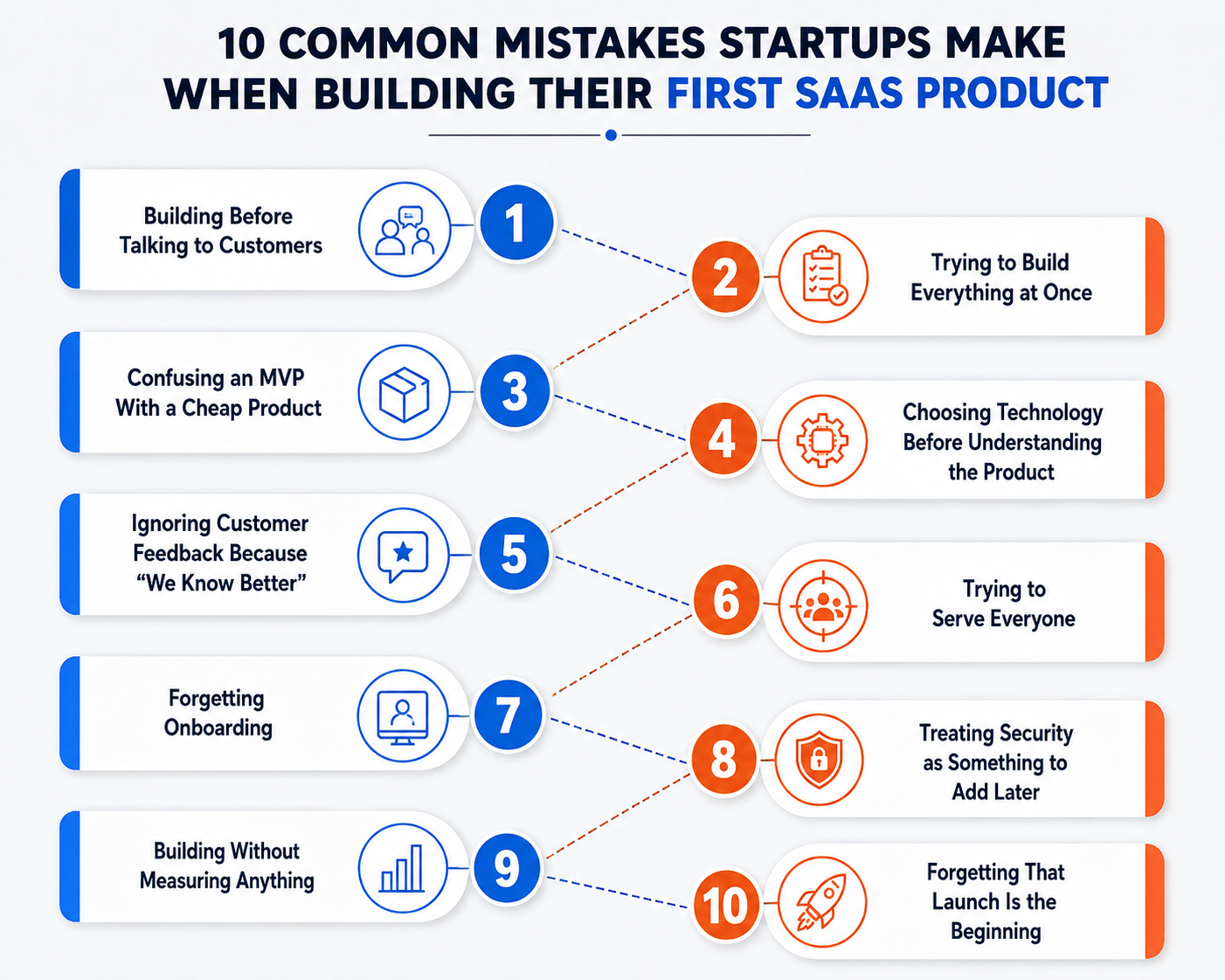
10 Common Mistakes Startups Make When Building Their First SaaS Product
Before you build your first SaaS application, make sure to avoid the following mistakes:
1) Building Before Talking to Customers
This is probably the mistake I would be most careful about. I have an idea. I believe it solves a problem. But instead of talking to potential customers, I immediately start coding. After three months, I have a working product.
Then I show it to customers. Their response?
“It’s interesting, but I don’t really need it.”
That is a painful sentence after spending thousands of dollars and hundreds of hours. Customer interviews can prevent this. Suppose I want to build a SaaS platform for small online sellers.
I would speak with customers first and then decide which features to build. Talking to 15-20 sellers would help me understand which problems are worth solving before building anything.
I would ask:
– Which part of your workflow feels the most difficult?
– What are you doing manually?
– Which tools are you already using?
– What do you hate about those tools?
– What problem would you happily pay to remove?
The answers could completely change my product. Maybe I thought sellers needed advanced analytics. Instead, I discovered that they spend three hours every day copying order information between systems. Now I am aware of their problem, which allows me to design my SaaS product accordingly
2. Trying to Build Everything at Once
This is the part that excites many first-time founders. They create a feature list that looks like this:
- Dashboard
- Mobile app
- AI assistant
- CRM
- Reporting
- Payment processing
- Chat
- Email automation
- Inventory
- Accounting
- Social media integration
- Third-party APIs
- Advanced permissions
- Custom reports
The problem is that the first version can have too many features. Many believe that adding more features makes a product more valuable to customers. But the opposite can happen. More features mean:
More development → more bugs → more testing → more cost → slower launch.
A better approach is to identify the one core problem. If I am building a SaaS product that helps sales teams create quotes faster, the first version may only need:
Customer → Products → Quote → Approval → Send
Everything else can come later. An MVP is the first version of the product, not its final form.
3) Confusing an MVP With a Cheap Product
Some founders think MVP means, “Let’s build something quickly and release a product that feels unfinished.” That is not the goal. An MVP should be small in scope but valuable to users.
Imagine I am building quoting software for small to medium-sized resellers.
A bad MVP might have:
- Too many features that are not essential to quoting
- No integration with distributor catalogs
- No real-time product pricing or availability
- No shipping carrier integration
- No tax calculation or compliance support
- Advanced reports and dashboards that customers do not need yet
- Complex approval workflows
- Mobile app before the core product is stable
A better MVP revolves around a core quoting workflow with these functions:
- Connect to distributor catalogs so resellers can search and add products
- Create quotes with products, quantities, and prices
- Calculate shipping costs through shipping carrier integrations
- Calculate taxes using tax compliance software
- Send quotes to customers by email
It is a small product, but it solves a real problem for its target users. That is what makes a good MVP different from an incomplete product. The goal is not to build everything at once, but to build enough to deliver real value and improve over time.
SaaS-based VARStreet quoting software is a good real-world example of how a product can grow this way. It didn’t start with every feature that exists today.
The initial focus was on making the core quoting process useful for resellers. This included finding products, connections with only a few distributors, and creating quotes. It also covered freight and tax calculations and sending quotes to customers.
As customers started using this quoting tool, their evolving needs helped shape the product. More distributor connections were added so resellers could access products and pricing from more sources.
Features such as approval workflows were introduced when customers needed better control over quotes. Integrations such as DocuSign were added to collect payments faster.
More advanced capabilities were then added as customer requirements became more complex. These included quoting complex configurations & bundles, along with CRM integration and mobile quoting. Integrations with manufacturer portals such as Cisco and Dell were also added.
Currently, VARStreet has catalog integrations with 50+ distributors. This is an important lesson about MVP development. Start with the features that solve the main problem. Then listen to customers, understand what is slowing them down, and add features that address those needs.
4) Choosing Technology Before Understanding the Product
I have also seen founders start with a technology question like “Should we use React or Node.js?”
These questions matter, but they should not be the first questions. The first question should be like “What does the customer need the product to do?”
Technology should support the product rather than become the product strategy.
For a first SaaS-based eCommerce platform, unnecessary technical complexity can become expensive. For example, if I have only 50 early customers, I may not need a highly complex architecture designed to handle millions of shoppers and orders at once.
The goal is not to build the most advanced architecture from day one, but to choose an architecture that meets my current eCommerce requirements and can grow as the number of stores, products, and customers increases.
5) Ignoring Customer Feedback Because “We Know Better”
This is one of the most dangerous mistakes that cannot be ignored. I build the product, launch it, and watch customers start using it. Then, one of them tells me, “This feature is difficult to use.”
My first reaction might be, “They just don’t understand how it works.” But that reaction should be a warning sign.
Instead of blaming the customer, I should stop and ask myself whether the feature is actually confusing or difficult to use. If several customers face the same problem, it is probably not a customer problem. The problem is with the product that I need to fix.
Research on software startup pivots has found that negative customer reactions and flawed business models can trigger major changes in startup direction. So I would rather discover a problem after one month than after one year.
6) Trying to Serve Everyone
One common mistake I see startups make is trying to create a SaaS product that works for everyone. The idea often sounds something like, “Our SaaS is for every business.” At first, that sounds impressive because it suggests a huge potential market. But in practice, it makes product development much harder.
If my SaaS-based product is designed for value-added resellers (VARs), distributors, manufacturers, and retailers, how do I design the product?
Every group has different needs. Instead, I might choose one narrow customer segment. VARStreet business management software is a good example of this focused approach. It is designed specifically for IT and office supplies VARs.
Instead of trying to build a product for every type of business, the VARStreet platform focuses on the specific needs of resellers. It brings together functions such as eCommerce, sales quoting, and product catalog management.
Now I know:
- Who my customer is
- What language to use
- What problems to research
- What features matter
- Where to find customers
- Which competitors to study
Starting narrow does not mean staying narrow forever. It simply gives me a clear starting point and helps me focus on solving a specific problem for a specific group of customers.
Once I understand what those customers need and the product starts gaining traction, I can gradually expand into new customer segments.
7) Forgetting Onboarding
Here is a situation that happens more often than founders expect. A customer signs up for the SaaS product, reaches the dashboard, and then gets stuck because they do not know what to do next.
The product may have powerful features, but if customers cannot understand how to use them, they may simply stop using the product. This is where onboarding becomes important
A good SaaS onboarding flow should help customers move from:
Sign Up → Setup → First Action → First Value → Regular Use
Suppose I build project management software.
Instead of dropping the customer onto an empty dashboard, I could guide them through:
- Create a workspace
- Invite a teammate
- Create a project
- Add the first task
- Complete the first workflow
The goal is not to show every feature. The goal is to help the customer experience the product’s value quickly.
8) Treating Security as Something to Add Later
I would never want security to become a “phase two” feature.
SaaS products often handle sensitive information such as customer data, business records, payment information, employee information, or internal documents.
A startup should think about security from the beginning.
That includes areas such as:
- Authentication
- Password management
- Authorization
- Role-based access
- Data separation
- Secure APIs
- Backups
- Logging
- Session management
- Data encryption
- Dependency updates
This becomes particularly important in multi-tenant SaaS applications. If Company A uses my B2B eCommerce platform, its users should never be able to access Company B’s data. Security is not something customers notice when everything works. They notice it when something goes wrong.
9) Building Without Measuring Anything
Another mistake I would avoid is launching a SaaS product and focusing only on the number of signups. Seeing 500 users register may sound like a great achievement, but that number does not tell me whether the product is actually successful.
I need to know what happens after signup. Do users activate the product, return regularly, use the main features, invite their colleagues, or upgrade to a paid plan? How many users stop using the product after signing up?
These questions give me a much clearer picture of how the product is performing. That is why I would define important product metrics before launch and use them to understand what is working and what needs improvement.
This is why I would define product metrics before launch. For example:
| Metric | What I would learn |
| Signups | Are people interested? |
| Activation rate | Are new users reaching value? |
| Daily/Monthly active users | Are people returning? |
| Feature usage | Which features matter? |
| Conversion rate | Are free users becoming customers? |
| Churn | Are customers leaving? |
| MRR | Is recurring revenue growing? |
| Customer acquisition cost | How much does acquiring a customer cost? |
| Customer lifetime value | How much revenue does a customer generate over time? |
The point is not to measure everything. It is to measure what helps me make decisions.
10) Forgetting That Launch Is the Beginning
I used to think of launching a SaaS product as the finish line, but I soon realized that it was only the beginning. Once the product is live, the real learning starts. I need to see how customers use it, identify what works and what does not, and keep improving the product based on what I learn.
After launch, I still need to:
- Fix bugs
- Talk to customers
- Improve onboarding
- Monitor performance
- Add important features
- Remove unnecessary features
- Improve security
- Track usage
- Reduce churn
- Support customers
- Improve pricing
- Test messaging
A SaaS product is never really “finished.” It evolves with its customers, their changing needs, and the feedback they provide.
The Startup SaaS Mistake Flowchart
Here is the way I would summarize the entire problem:
FIRST SaaS PRODUCT
│
┌───────────────┼────────────────┐
│ │ │
PRODUCT USERS BUSINESS
│ │ │
▼ ▼ ▼
Build too much Ignore feedback Wrong pricing
Wrong tech Poor onboarding No revenue plan
Poor UX Wrong audience High acquisition cost
│ │ │
└───────────────┼────────────────┘
▼
SLOW LEARNING
│
▼
MONEY + TIME LOST
│
▼
BETTER APPROACH
│
┌───────────────┼────────────────┐
▼ ▼ ▼
Validate first Build small Measure results
│ │ │
└───────────────┼────────────────┘
▼
TALK TO USERS
│
▼
IMPROVE PRODUCT
│
▼
SCALE WHAT WORKS
The core lesson is simple: Validate → Build → Measure → Learn → Improve → Scale
Not: Imagine → Build → Build more → Launch → Hope
A Simple Example: How I Would Build a SaaS Product Today
Suppose I want to create a SaaS platform for small online sellers. My first instinct might be to build a complete business management platform with many features, but I would stop and talk to sellers first.
After speaking with them, I might discover that their biggest problem is managing orders from multiple sales channels.
They currently download spreadsheets, copy order data manually, check inventory & pricing, and update customers themselves. Now I have something much more valuable than just a product idea: I have identified a clear problem that my SaaS platform can solve.
Phase 1: Validate
- I talk to potential users.
- I document their workflow.
- I identify the most painful step.
Phase 2: Define the MVP
- I build only core features:
- Create Store → Add Products → Receive Orders → Manage Orders → Update Order Status
- I do not build 50 additional features.
Phase 3: Test
- I give the product to 10 sellers.
- I watch what they do.
- I ask where they get stuck.
Phase 4: Improve
- I discover that users don’t care about the dashboard.
- They desperately want automatic pricing & availability updates.
- This changes my roadmap.
Phase 5: Charge
Once the product provides clear value, I test pricing.
Phase 6: Scale
- Only after proving demand do I invest more heavily in automation, integrations, reporting, mobile apps, AI features, and other advanced capabilities.
- This approach reduces risk.
- More importantly, it turns customers into part of the product development process.
What I Would Do Differently If I Started Again
If I were building my first SaaS product today, I would follow these rules:
1. Talk to users before writing serious code
I would spend time understanding the problem.
2. Choose one customer group
I would rather solve one group’s problem extremely well than solve everyone’s problem badly.
3. Define one core workflow
I would identify the action that creates the most value.
4. Build the smallest useful product
Not the smallest possible product.
The smallest useful one.
5. Launch earlier
I would rather get real feedback in three months than spend a year building in isolation.
6. Track meaningful metrics
I would measure activation, usage, conversion, retention, and revenue.
7. Treat security seriously
I would design authentication, permissions, data separation, and other security controls from the start.
8. Keep the architecture practical
I would build for current needs while leaving room for growth.
9. Listen to customers
I would not automatically build every requested feature, but I would look for repeated problems.
10. Keep improving after launch
I would treat launch as the beginning, not the end.
Conclusion
When I look at the common mistakes startups make when building their first SaaS product, I see one common pattern. Founders often spend too much time building and not enough time learning.
And I would keep Paul Graham’s advice close throughout the process: “Make something people want.”
If I can do that, I don’t need to build the biggest SaaS product. I need to build the right SaaS product. And that can make all the difference. Need help turning a SaaS idea into a working product?
If the goal is to move from an idea to a launch-ready SaaS application without spending months building every basic SaaS component from scratch, Flatlogic’s Custom SaaS App service is worth exploring.
The best time to think about architecture, scalability, and user management is before those decisions become expensive to change.
Comments