


TL;DR
- Custom web dev is the B2B backbone in 2026: align ops, integrate deeply, scale securely, and differentiate.
- Off-the-shelf tools create silos; bespoke apps model complex workflows and compliance by design.
- Upfront costs are higher, but ROI improves via fewer licenses, less debt, and extensible architecture.
- Expect longer launches (months+); mitigate with discovery, agile, modular design, and continuous testing.
- Flatlogic builds scalable B2B admin systems, SaaS, ERP/CRM-like tools, and modernizes legacy stacks.
Fact Box
- Custom projects can take months or even over a year to launch, longer than deploying off-the-shelf software.
- The guide recommends planning for 10x user growth, new regions, and higher transaction volume.
- Key 2026 trends: modular/API architectures, AI automation, stronger security, PWAs, and low-code integration.
- Flatlogic delivers admin panels, custom B2B SaaS, database-driven apps, ERP/CRM-like tools, and legacy modernization.
- Higher upfront costs are offset long-term by fewer licenses, reduced workarounds, and easier feature expansion.
The difference between market leaders and market followers in B2B is rarely their idea. It’s the software infrastructure that powers it. Read to the end to understand why custom web development has become the strategic backbone of modern B2B success.
When searching for insights about custom web development services for B2B software, decision-makers usually ask:
- Do we really need custom development, or can off-the-shelf solutions handle our complexity?
- How scalable and secure will our B2B platform be in 3-5 years?
- What is the long-term ROI of building custom software?
- How do we avoid costly technical debt and integration bottlenecks?
As Bill Gates once said: “The first rule of any technology used in a business is that automation applied to an efficient operation will magnify the efficiency”. In B2B environments, the opposite is also true: automation applied to inefficient or poorly structured systems magnifies chaos.
The problem is significant. Research from McKinsey & Company consistently shows that digital leaders outperform competitors in revenue growth and operational efficiency. At the same time, Gartner studies highlight that integration challenges and legacy system limitations remain among the top barriers to digital transformation in B2B enterprises. Businesses often adopt fragmented SaaS tools that fail to communicate effectively, resulting in siloed data, duplicated workflows, and security risks.
This article will walk you through what custom web development services mean in a B2B context, why they matter strategically, how they differ from generic solutions, what terminology you need to understand, and how companies can leverage tailored development to build scalable, secure, and high-performance B2B software. By the end, you’ll have a practical framework for evaluating whether custom development is the right move and for executing it successfully.
What Is Custom Web Development?
At its core, custom web development is the process of designing and building web applications and platforms that are uniquely tailored to a business’s needs, rather than deploying a pre-built template or generic solution. From customer portals and enterprise dashboards to multi-tenant SaaS platforms and internal operational tools, custom development delivers software that aligns precisely with business logic, workflows, and strategic goals.

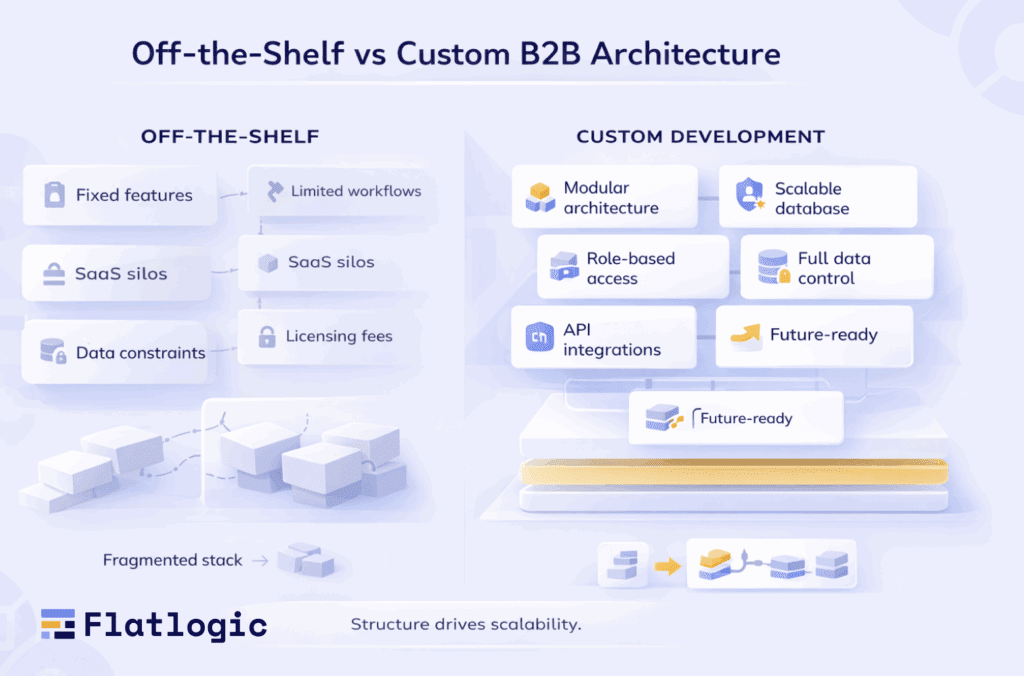
This differs significantly from off-the-shelf software, which is built to serve a broad audience with fixed features and limited flexibility. For B2B organizations with bespoke sales processes, complex integrations, and strict compliance requirements, off-the-shelf solutions often fall short, making customization not just desirable but necessary.
Why Custom Web Development Is Essential for B2B
Tailored Experiences for Complex Business Logic
Most B2B workflows involve multiple stakeholders, decision layers, and data touchpoints. Custom web development allows businesses to model these workflows directly into the software instead of forcing teams to adapt to rigid, one-size-fits-all solutions.
For example:
- Multi-stage approval processes
- Tiered pricing models
- Integration with industry-specific tools (ERP, CRM, supply chain modules)
- Customized dashboards and role-based access
These features can be built to match exact customer journeys and internal processes, increasing operational accuracy and user satisfaction.
Scalability and Future-Ready Architecture
Most off-the-shelf platforms can struggle to grow with a business, especially once additional features and integrations are required. By contrast, custom web applications are built with scalability in mind: modular architecture, extensible APIs, and clean code bases make future enhancements easier and more cost-effective.
This is particularly important for B2B firms that are looking to expand, enter new markets, or support additional business lines without needing to rebuild their core platform from scratch.
Data Control and Enhanced Security
Data is the backbone of every B2B operation, and how it’s managed matters. Custom web development empowers businesses with full control over where and how data is processed, stored, and secured. Proprietary security protocols, encryption standards, and regulatory compliance (e.g., GDPR or industry-specific requirements) can be baked into the system architecture.
This is especially critical for industries such as:
- Healthcare
- Finance
- Logistics
- Manufacturing
- Supply chain services
In these sectors, industry regulations and data sensitivity make custom solutions far superior to generic platforms.
Competitive Differentiation
In a market where digital interactions increasingly define brand perception, custom software becomes more than an operational tool; it becomes a competitive asset. A bespoke web platform conveys professionalism, reliability, and innovation, helping B2B companies stand out in crowded sectors where buyer decisions hinge on trust and performance.
Flatlogic Custom Web Development Services
Flatlogic provides custom web development services focused on building structured, scalable B2B applications. The company works with startups, scale-ups, and enterprise teams that need internal systems, SaaS platforms, or business process automation tools.
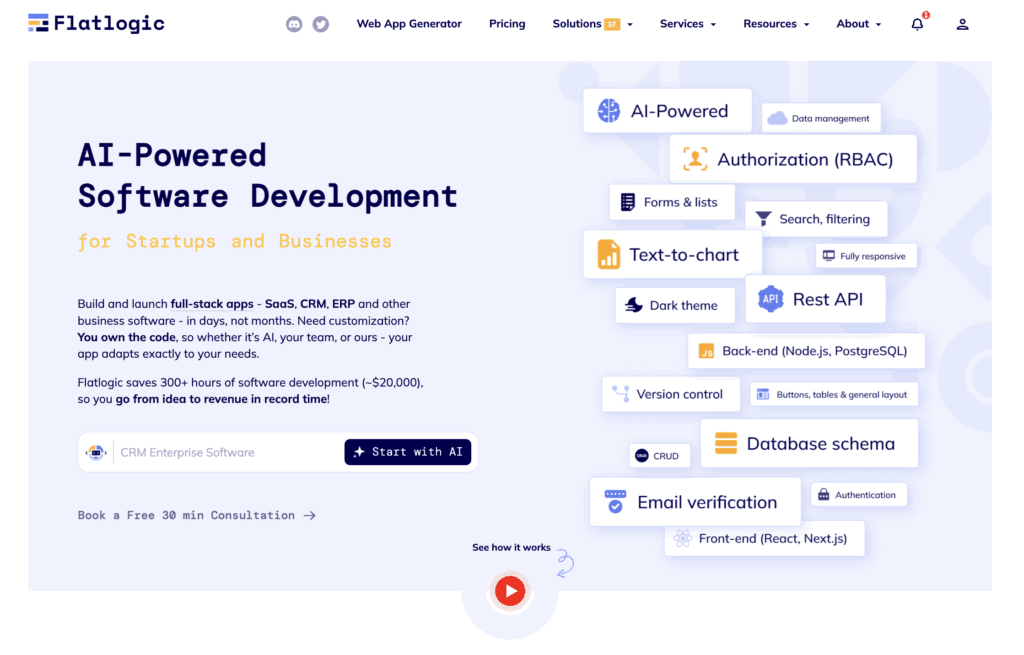
What Flatlogic Delivers
Admin Panels & Internal Systems
Development of dashboards and management systems for operations, reporting, workflow automation, and user management. These applications are often used to replace spreadsheets or disconnected SaaS tools.
Custom SaaS Platforms
Architecture and development of multi-tenant B2B SaaS products with role-based access control, subscription logic, API integrations, and scalable database structures.
Database-Driven Applications
Projects are structured around a consistent data model to reduce technical debt, avoid schema inconsistencies, and improve long-term maintainability.
ERP/CRM-Like Custom Solutions
Tailored systems for sales management, procurement workflows, logistics tracking, and other business-specific operations that do not fit standard commercial platforms.
Legacy System Modernization
Refactoring and modernization of outdated applications, including frontend updates, backend restructuring, and API implementation.
When Flatlogic Is Relevant
Flatlogic is typically a fit when a company:
- Has complex internal workflows
- Needs deep integrations across systems
- Plans to scale a B2B SaaS product
- Wants to reduce reliance on multiple SaaS subscriptions
- Requires long-term architectural stability
The focus is on functional, maintainable software rather than template-based solutions or marketing websites.
Core Benefits of Custom Web Development for B2B
Let’s dive deeper into the primary benefits that make custom solutions such a compelling choice for B2B organizations.
Full Business Alignment
Custom web applications are built to reflect exactly how your business operates. From backend logic to frontend UX, everything is designed to serve your internal teams and external clients.
This reduces friction, automates key workflows, and eliminates the need for workarounds that often plague standard solutions.
Enhanced Integration Capabilities
B2B systems rarely operate in isolation. Custom development allows for deep integrations with enterprise systems like ERP, CRM, financial systems, supply chain software, marketing automation, and analytics tools, all connected through APIs and secure data pipelines.
Improved User Experience & Personalization
Custom solutions allow businesses to create personalized experiences based on user roles and behavior, a key differentiator in B2B markets where decisions are made collaboratively and interfaces need to serve multiple audience types.
For example:
- Personalized dashboards
- Role-based content
- Tailored user journeys
- Multi-language and multi-currency support for global operations
Long-Term Cost Efficiency
While custom development may have higher upfront costs than off-the-shelf solutions, it often delivers better ROI over time. This is due to reduced licensing fees, fewer workarounds, less need for third-party add-ons, and the ability to expand features without investing in entirely new products.
Automation and Workflow Optimization
Repetitive tasks like approval routing, data entry, reporting, and notifications can be automated within a custom application to free up human capital for tasks that truly drive value.
Strategic Innovation and Competitive Advantage
Custom development enables companies to add cutting-edge features before competitors. Whether it’s AI-driven analytics, predictive modeling, or custom collaboration tools, bespoke solutions accelerate innovation.
Strategic Trends in B2B Web Development (2026)
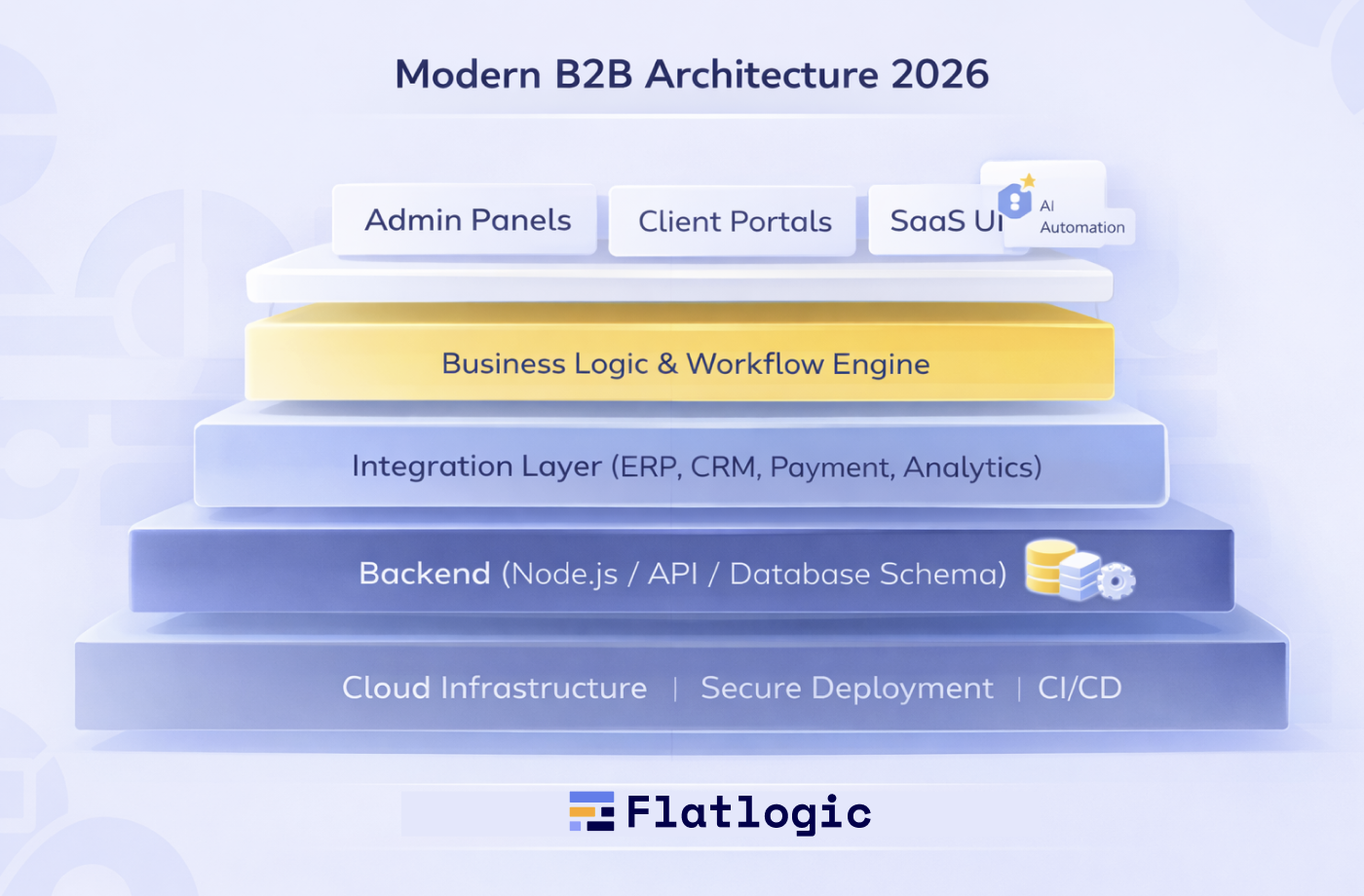
The custom web development landscape is constantly evolving. As we move through 2026, several trends are shaping how B2B software is designed and delivered.
Modular & API-Driven Architectures
Rather than monolithic systems, companies are embracing modular and service-oriented architectures that allow components to be reused, replaced, or scaled independently. This approach accelerates development and future-proofs systems.
AI-Powered Personalization and Automation
AI and machine learning are increasingly embedded in custom applications to deliver personalized user experiences, automate decision workflows, and drive predictive insights based on business data.
Enhanced Security & Compliance Features
With cyber threats evolving constantly, modern B2B platforms must provide advanced security features from role-based access control to automated compliance checks, encryption layers, and continuous monitoring.
Progressive Web Apps (PWAs) & Mobile-First Experiences
More B2B users expect mobile-optimized interfaces that deliver near-native app experiences without needing separate installations. Custom web development supports PWAs that work seamlessly across devices and offline scenarios.
Low-Code / No-Code Integration for Speed
While custom development remains vital, integrating low-code platforms can accelerate development cycles and allow business users to configure certain aspects of the software without heavy developer involvement, without compromising flexibility.
Real-World B2B Use Cases for Custom Web Development
To better appreciate the impact of custom development, let’s look at real-world examples where bespoke web solutions drive measurable business outcomes.
Enterprise Client Portals
Many B2B companies build client portals where partners can manage profiles, interact with services, view invoicing history, and access support resources. These portals unify disparate systems into a single, user-friendly interface.
B2B Marketplaces & Self-Service Platforms
Marketplaces that support bulk ordering, dynamic pricing, real-time inventory checks, and automated negotiation workflows require deep customization to meet buyer and seller expectations.
Internal Operational Dashboards
Custom web applications can unify data from multiple internal systems into dashboards that support executive decision-making, OKR tracking, revenue forecasting, and process optimization.
Sales & CRM Extensions
Where native CRM functionality limits B2B sales teams, custom modules can be built to support bespoke sales pipelines, automated contract routing, and integration with quotation generation systems.
Industry-Specific Solutions
Certain industries like logistics, healthcare, and manufacturing demand specialized features such as compliance documentation, supply chain tracking, or production optimization tools that off-the-shelf solutions cannot reliably provide.
Challenges in Custom Web Development for B2B
While custom development unlocks powerful benefits, it also introduces certain challenges that must be managed:
Higher Initial Costs
Custom software often requires a higher upfront investment compared to standard platforms due to design, development, and QA processes. However, the long-term benefits often justify this initial cost.
Longer Time to Launch
Building bespoke applications is inherently more time-intensive than deploying existing software, with complex projects potentially taking months or even over a year to complete.
Need for Skilled Talent
Successful custom development demands experienced designers, engineers, and architects who understand both technology and business needs. Finding and retaining this talent isn’t always easy.
Maintenance & Support
Once launched, custom applications require ongoing support to address security patches, feature upgrades, and technology shifts.
Scope and Requirement Management
Clear communication between stakeholders and the development team is crucial. Misalignments in expectations can lead to scope creep, delayed timelines, or additional costs.
Best Practices for Successful B2B Custom Web Development
To maximize outcomes and minimize risks, businesses should follow structured, strategic practices when building custom B2B software. Unlike simple web projects, B2B platforms often serve as core operational infrastructure, meaning architectural mistakes can become expensive long-term liabilities.
Below are essential best practices to ensure stability, scalability, and measurable business value.
Conduct Thorough Discovery & Research
A successful project begins long before development starts. Discovery should clarify:
- Core business processes and operational bottlenecks
- User roles and permission hierarchies
- Data flows between departments and systems
- Integration requirements (ERP, CRM, accounting, logistics, etc.)
- Long-term growth plans
Skipping or rushing discovery leads to misaligned features and costly revisions later. Clear documentation and stakeholder alignment reduce ambiguity and prevent scope creep.
Prioritize UX & Accessibility
B2B software is often used daily by internal teams and external partners. Poor UX directly reduces productivity.
Effective UX design in B2B should focus on:
- Role-based dashboards
- Logical workflow structures
- Minimal cognitive load
- Clear data visualization
- Responsive layouts across devices
Accessibility standards (such as WCAG compliance) are also important, especially for enterprise clients operating in regulated environments.
In B2B contexts, usability is not about visual trends – it’s about operational efficiency.
Choose the Right Tech Stack
Technology decisions determine long-term maintainability and scalability. The selected stack should align with:
- Performance requirements
- Integration complexity
- Internal team expertise
- Future hiring plans
Modern frontend frameworks such as React, Angular, or Vue enable dynamic interfaces, while backend ecosystems like Node.js, Python, or .NET provide scalable server-side logic.
More important than trends is architectural clarity. Consistency and maintainability matter more than novelty.
Adopt Agile Development Practices
Large B2B platforms benefit from iterative development rather than monolithic releases.
Agile methodologies allow teams to:
- Release incremental features
- Validate assumptions early
- Adjust priorities based on feedback
- Reduce risk through staged deployment
This approach ensures that business stakeholders remain involved throughout the project rather than seeing the product only at final delivery.
Plan for Security & Compliance Early
Security cannot be retrofitted effectively after launch. It must be embedded into the architecture from the beginning.
This includes:
- Role-based access control
- Secure authentication systems
- Encrypted data transmission
- Secure database design
- Compliance with regulations (e.g., GDPR or industry-specific requirements)
Early security planning reduces vulnerabilities and avoids costly refactoring.
Build Modular and Scalable Systems
B2B software should be designed for growth.
Modular architecture enables:
- Independent feature expansion
- Easier debugging and maintenance
- Integration of new services without system-wide rewrites
- Scaling of specific components based on load
Cloud-compatible and API-first design patterns further enhance flexibility.
Test Continuously
Continuous testing improves reliability and reduces production failures.
Best practices include:
- Automated unit and integration tests
- Manual QA for complex workflows
- Performance testing under load
- Security testing and vulnerability assessments
Testing should not be a final step – it should be integrated into every development cycle.
Provide Ongoing Maintenance & Support
Custom software requires ongoing monitoring and iteration.
Post-launch strategy should include:
- Regular performance reviews
- Security updates and patching
- Infrastructure scaling adjustments
- Feature improvements based on user feedback
- Technical documentation updates
A system that evolves with business needs remains an asset. One that is left unsupported gradually becomes a liability.
Following these best practices significantly increases the probability that a B2B custom web development project will deliver long-term operational value rather than short-term functionality.
Choosing the Right Custom Development Partner
Selecting a development partner, whether an external agency or building an in-house team, directly influences the technical stability, scalability, and long-term ROI of your B2B software project. In complex environments where integrations, data architecture, and security are critical, the wrong choice can lead to delays, budget overruns, and long-term technical debt.
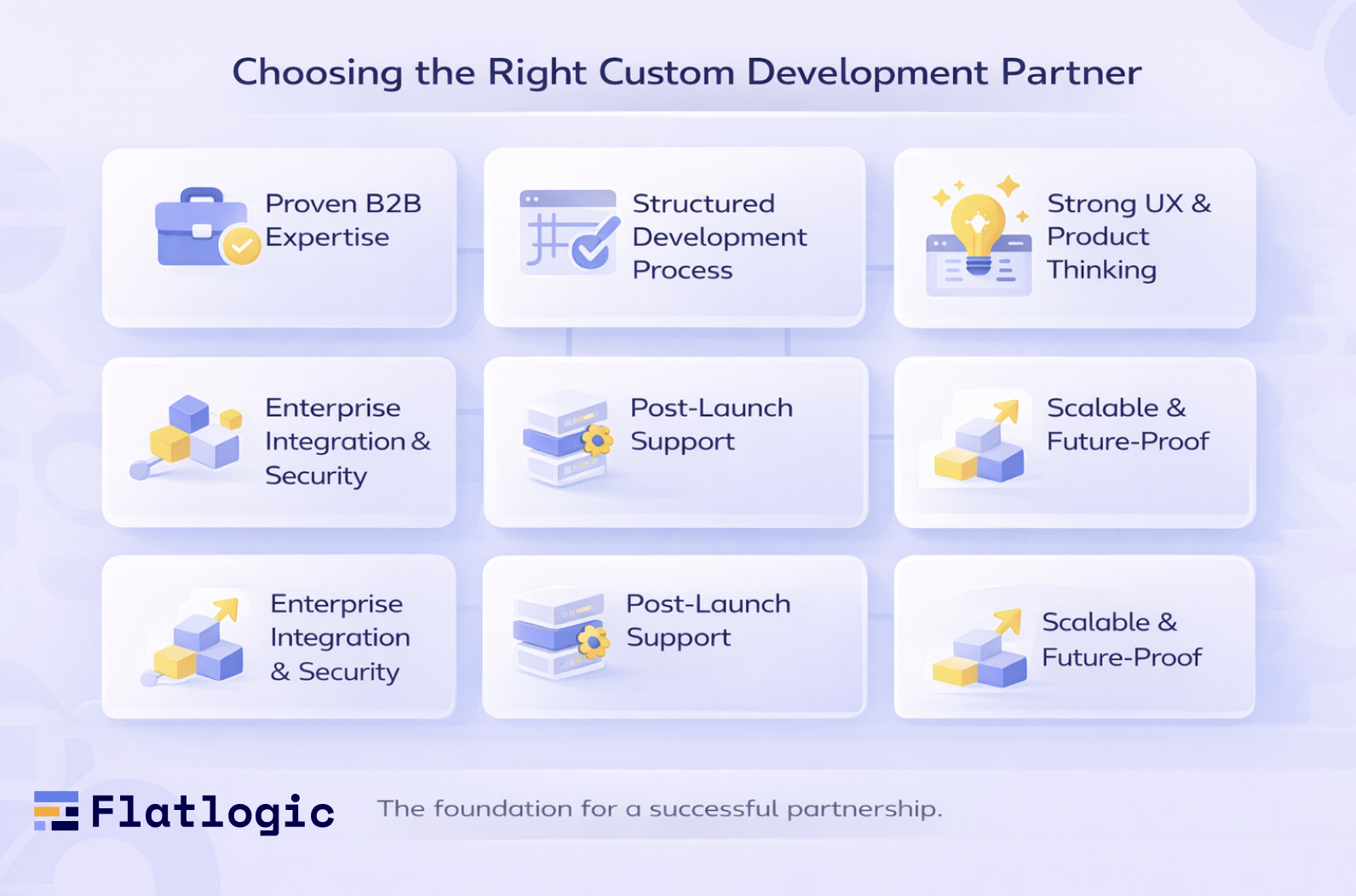
Below are the key criteria to evaluate before committing to a partner.
Proven Expertise with Similar B2B Platforms
B2B systems are fundamentally different from consumer applications. They often involve:
- Multi-role access hierarchies
- Complex workflows and approval chains
- ERP and CRM integrations
- Contract-based pricing logic
- High-volume data processing
A qualified partner should demonstrate experience building platforms with similar structural complexity, not just marketing websites or simple CRUD applications. Case studies should show backend-heavy systems, integrations, and scalable architecture.
A Clear and Structured Development Process
A reliable partner works with defined methodologies, typically Agile or hybrid frameworks, and provides:
- Transparent project scoping
- Documented technical specifications
- Sprint-based delivery cycles
- Regular progress reporting
- Clear change management procedures
Lack of process clarity often results in scope creep and missed deadlines. Structured communication and documented workflows reduce project risk significantly.
Strong UX and Product Thinking
In B2B environments, usability directly affects productivity. Poorly designed dashboards and workflows slow down internal teams and frustrate clients.
A strong development partner should:
- Conduct user flow analysis
- Design role-based interfaces
- Prioritize clarity over visual complexity
- Ensure accessibility and responsive performance
UX in B2B is less about aesthetics and more about operational efficiency.
Post-Launch Support and Maintenance
Custom software is never “finished.” It evolves with your business.
Your partner should provide:
- Ongoing technical support
- Performance monitoring
- Security updates
- Infrastructure scaling assistance
- Feature iteration planning
Without post-launch support, even well-built systems degrade over time.
Familiarity with Enterprise Integrations and Security Standards
B2B platforms rarely operate independently. They must integrate with accounting software, CRMs, ERPs, payment gateways, analytics tools, and third-party APIs.
Your development partner should demonstrate:
- API-first architecture expertise
- Secure authentication implementation (OAuth, JWT, SSO)
- Role-based access control
- Compliance awareness (GDPR and industry-specific standards)
- Data encryption and secure infrastructure design
Security and integration architecture must be considered from day one – not retrofitted later.
Technical Scalability and Architectural Thinking
Ask how the system will handle:
- 10x growth in users
- Expansion to new regions
- Increased transaction volume
- Addition of new modules
A competent partner plans architecture for long-term scalability using modular design, clean code practices, and cloud-compatible deployment strategies.
Cultural and Strategic Fit
Beyond technical skills, alignment matters. The right partner should:
- Understand your business model
- Be comfortable challenging assumptions
- Communicate clearly with both technical and non-technical stakeholders
- Align with your long-term digital strategy
Misalignment in expectations often creates more friction than technical complexity.
Polish companies and international firms alike now offer custom web development services, serving clients across industries and geographies. The key is not geography, but capability, architectural maturity, and a structured development approach.
Choosing the right partner is not just a procurement decision; it is a strategic investment in the foundation of your B2B digital ecosystem.
Conclusion: The Strategic Value of Custom Web Development for B2B
In 2026, custom web development services are more than technical resources; they’re strategic assets that empower B2B companies to:
- Align software with internal processes
- Scale with market demands
- Automate critical workflows
- Differentiate in competitive environments
- Secure sensitive data and meet regulatory requirements
- Build software that evolves alongside the business
With digital transformation accelerating and competition intensifying, businesses that embrace custom web development are positioned to lead, not just adapt.
Whether you’re transforming internal operations, launching a SaaS platform, or building scalable client portals, custom web development is a future-ready strategy that delivers measurable impact, and companies looking for a structured, scalable approach to B2B software development can explore how Flatlogic delivers custom web solutions built around real business logic and long-term maintainability.
Comments