


TL;DR
- AI web app builders can ship prototypes in minutes, but production readiness is now the real startup bottleneck.
- Scaling exposes gaps in auth, database design, security, testing, CI/CD, monitoring, and performance.
- AI speeds feature creation but often skips architecture, creating technical debt that slows growth.
- Competitive advantage is shifting from code generation to reliable deployment, maintenance, and scalability.
- Flatlogic Generator positions itself as a full-stack, production-ready foundation (frontend+backend+DB+auth+admin).
Fact Box
- McKinsey estimates generative AI could add $2.6T–$4.4T annually to the global economy.
- The article states AI can generate a web app prototype in minutes from a natural-language description.
- It claims tasks that took weeks (UI, backend, DB setup, API integrations) can now be done in hours.
- Flatlogic Generator is described as generating frontend, backend, DB schema, API layer, authentication, and an admin panel.
- The article lists production needs beyond code: CI/CD, monitoring/logging, backup & recovery, and scalable infrastructure.
AI can generate a web app in minutes, but turning that prototype into a secure, scalable, production-ready business is where most startups hit a wall. Read on to discover why production, not coding, has become the real bottleneck and how founders can overcome it.
When searching for information about AI web app builders, startup founders and developers often ask themselves:
- Which AI web app builders can create a real MVP?
- Can AI-generated applications be deployed directly to production?
- Why do AI-built apps struggle with scalability and maintainability?
- How can startups accelerate development without creating technical debt?
“The biggest risk is not taking any risk” – Mark Zuckerberg, Co-founder and CEO of Meta.
The rise of AI coding tools has dramatically lowered the barrier to creating web applications. According to McKinsey research, generative AI could add between $2.6 trillion and $4.4 trillion annually to the global economy, with software engineering among the functions expected to experience the greatest productivity gains. Meanwhile, studies by GitHub reveal that developers using AI assistants complete coding tasks significantly faster. Yet despite these advances, many teams discover that generating code is only a small part of building a successful product. Challenges such as architecture, security, database design, maintainability, and deployment continue to slow down startups and prevent prototypes from becoming production-ready products. As AI-generated applications become increasingly common, solving the production bottleneck is becoming one of the most important challenges in modern software development.
In this article, you’ll learn why AI web app builders have made application creation easier than ever, why production readiness remains the biggest obstacle for startups, and what approaches founders can use to bridge the gap between AI-generated prototypes and scalable, maintainable products that are ready for real users.
AI Has Democratized Web App Development
Not long ago, building a web application required significant technical expertise, months of development time, and often a dedicated engineering team. For many founders, software development itself was the biggest barrier to launching a business. AI has changed that equation.

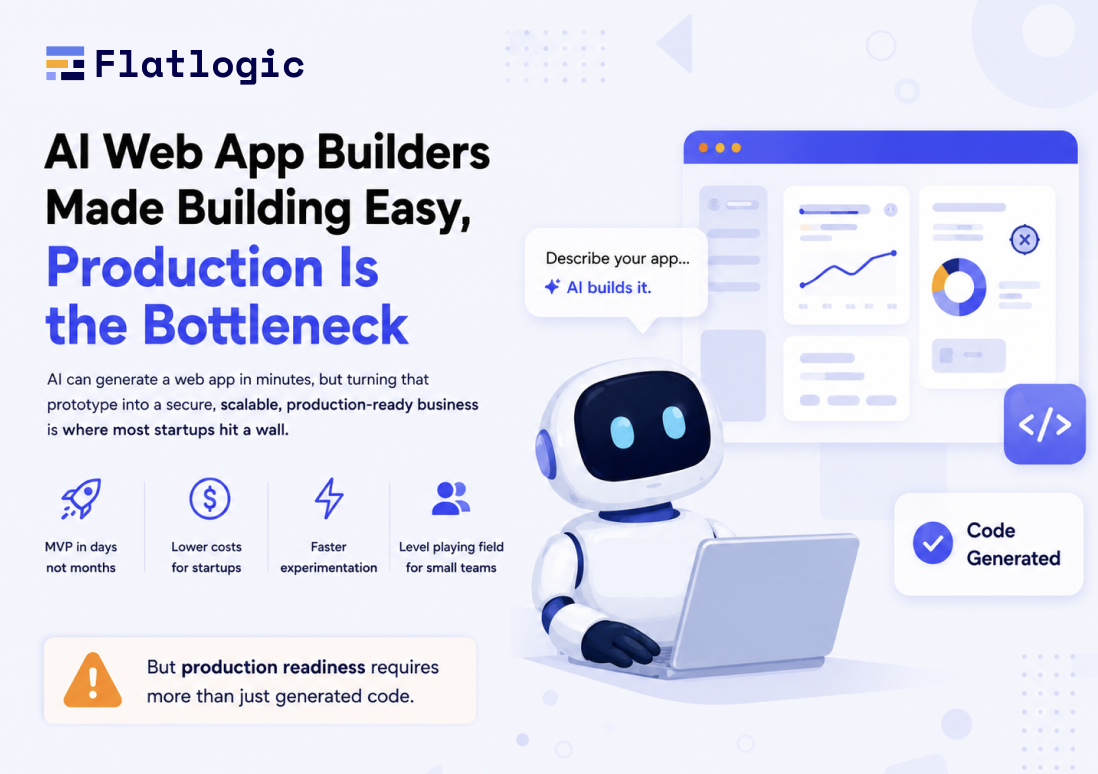
Modern AI web app builders have dramatically lowered the cost and complexity of creating software. Today, entrepreneurs can turn an idea into a working prototype simply by describing what they want in natural language. Tasks that previously took weeks, creating user interfaces, generating backend code, setting up databases, or integrating APIs, can now be completed in hours.
This shift has democratized software development in much the same way that cloud computing democratized infrastructure. Founders no longer need large teams or substantial upfront investments to validate their ideas. Instead, they can focus on what matters most: understanding customers and reaching product-market fit.
Tools such as ChatGPT, Bolt.new, Lovable, Replit, v0, and Cursor have empowered a new generation of entrepreneurs to build faster than ever before. As a result, startups can:
- Launch MVPs in days instead of months.
- Reduce development costs.
- Experiment with multiple ideas simultaneously.
- Iterate based on customer feedback more quickly.
- Compete with larger companies despite having smaller teams.
This transformation is creating a new category of builders often referred to as “vibe coders”, founders, designers, marketers, and non-technical entrepreneurs who can now create functional applications without years of programming experience.
However, while AI has made software creation remarkably accessible, generating code is only the beginning. Building a sustainable product that can support real users introduces an entirely different set of challenges, ones that AI alone has not yet solved.
Building Is No Longer the Hard Part
Ironically, the easier it becomes to create applications, the more obvious another problem becomes. Building a prototype isn’t the same as building a company.
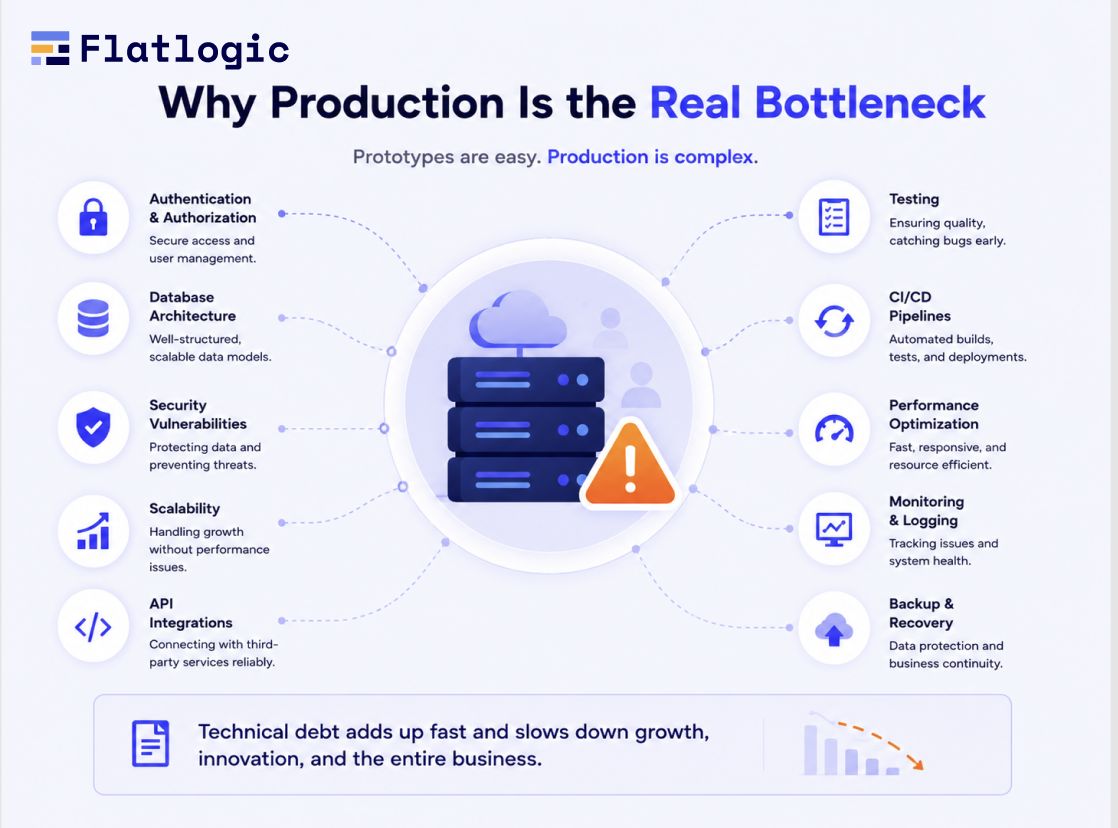
Most AI-generated applications work well for demonstrations but struggle with:
- Authentication and user management.
- Database architecture.
- Security vulnerabilities.
- Scalability.
- API integrations.
- Maintainability.
- Testing.
- CI/CD pipelines.
- Performance optimization.
Generating code is easy. Maintaining code is difficult. And startups don’t fail because they couldn’t generate a login page, they fail because they can’t reliably serve customers.
Why Production Has Become the Real Bottleneck
AI has dramatically reduced the time required to build an application. What once took months can now be accomplished in days or even hours. But while creating an MVP has become easier than ever, bringing that MVP to production remains a major challenge.
Building Is Fast, Scaling Is Hard
A prototype only needs to demonstrate that an idea works. A production application, however, must support real users, growing traffic, and changing business requirements.
As startups gain traction, they quickly discover that development speed is no longer the limiting factor. Reliability, maintainability, and scalability become far more important.
Production Requires More Than Code
Generating code is only one part of delivering a successful product. Production-ready applications require:
- Secure authentication and authorization.
- Well-designed databases.
- API integrations.
- CI/CD pipelines.
- Monitoring and logging.
- Performance optimization.
- Backup and recovery mechanisms.
- Infrastructure that can scale with demand.
These components are essential for building software that users can depend on.
Technical Debt Accumulates Quickly
AI tools excel at generating features, but they don’t always optimize for long-term maintainability. As projects evolve, teams often encounter:
- Duplicated code.
- Inconsistent architecture.
- Inefficient database queries.
- Security vulnerabilities.
- Growing complexity.
Over time, adding new functionality becomes increasingly difficult, and engineering teams spend more time fixing issues than building new features.
Growth Exposes Weaknesses
Many AI-generated applications perform well with a handful of users. The real test begins when usage increases.
Problems that are invisible during the MVP stage can become critical in production:
- Slow response times.
- Deployment failures.
- Database bottlenecks.
- Increased infrastructure costs.
- Reliability issues.
Supporting thousands of users requires a completely different level of engineering than supporting dozens.
The Bottleneck Has Shifted
In the pre-AI era, building software was expensive and time-consuming. Today, AI has compressed the development phase, exposing a bottleneck that has always existed: production.
The question for startups is no longer: How do we build this?
Instead, it has become: How do we deploy, maintain, and scale this?
Competitive Advantage Comes From Production Readiness
As AI coding tools become widely available, generating code is becoming a commodity. Competitive advantage increasingly belongs to companies that can transform AI-generated prototypes into secure, scalable, and maintainable products.
Ultimately, success in the AI era will be determined not by who builds the fastest, but by who reaches production with confidence.
AI Generates Code, Not Architecture
AI coding tools have made software development faster than ever. With a single prompt, developers can generate interfaces, APIs, and even entire applications. However, generating code and designing a scalable system are two very different challenges.
Architecture Determines Long-Term Success
While AI can create features quickly, architecture determines whether an application can support growth, adapt to changing requirements, and remain maintainable over time. Decisions around databases, authentication, API design, and infrastructure have a lasting impact on the product.
Poor architectural choices often result in performance bottlenecks, security vulnerabilities, mounting technical debt, and expensive rewrites. These issues may not be visible during the MVP stage, but they become increasingly difficult to ignore as the product and user base grow.
AI Excels at Features, Not Systems
Large language models are exceptionally good at producing code snippets and implementing functionality. However, they don’t fully understand the broader context of a business or its long-term requirements.
As a result, AI-generated applications often perform well as prototypes but may lack the structure needed for production environments. Code can be generated in seconds, but creating a maintainable and scalable system still requires architectural thinking.
Startups Need More Than Speed
For startups, speed is important, but sustainable growth requires more than fast development. Companies need reliable foundations that enable teams to iterate efficiently and support increasing demand without sacrificing stability.
Ultimately, AI is transforming how software is built, but architecture remains a competitive advantage. The winners of the AI era won’t be those who generate the most code, they’ll be those who turn that code into products that are ready to scale.
Startups Need Production Readiness From Day One
AI has made it easier than ever for startups to launch MVPs, but speed alone doesn’t guarantee long-term success. Many founders treat scalability, security, and maintainability as problems to solve later, only to discover that technical debt becomes increasingly costly as the business grows.
The decisions made during the MVP stage often shape the product for years. A strong foundation enables growth, while a weak one can lead to expensive rewrites and slower development. As startups acquire customers, technical issues quickly become business issues, affecting user trust, retention, and revenue.
In the AI era, building an app is easy. Building one that can scale is what separates successful startups from side projects.
The Rise of Full-Stack AI Platforms
We’re now entering the next stage of AI-assisted development. The first wave focused on code generation. The next wave focuses on production. Founders increasingly want platforms that provide:
- Backend generation.
- Database schemas.
- Authentication.
- API layers.
- Admin panels.
- Role management.
- Infrastructure support.
- Scalable architecture.
In other words, startups don’t want code.They want systems. This is why full-stack AI platforms are attracting attention. Instead of producing isolated files, they provide an opinionated foundation designed for long-term growth.
Why Startups Need More Than a Prompt
A prompt can create an application. But it cannot create:
- Engineering discipline.
- Software architecture.
- Security best practices.
- Maintainable codebases.
- Operational processes.
Successful startups combine AI speed with proven engineering principles. Think of AI as a powerful co-founder, not a replacement for software architecture. The winning teams won’t be those that generate the most code. They’ll be the ones that transform generated code into sustainable products.
Flatlogic Generator: From MVP to Business
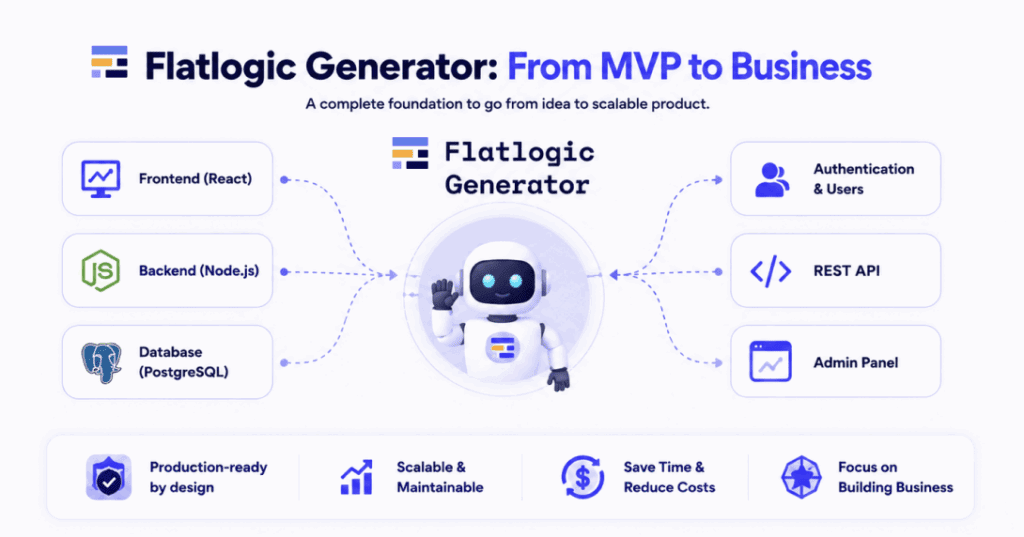
Flatlogic is an AI-powered platform for generating full-stack web applications with production-ready architecture.It helps startups accelerate development without sacrificing scalability or maintainability.
AI has made building applications faster, but getting them ready for production remains a challenge. This is where Flatlogic Generator bridges the gap between rapid development and long-term growth.
Instead of generating isolated pieces of code, Flatlogic Generator provides startups with a complete full-stack foundation, including the frontend, backend, database schema, API layer, authentication, and admin panel. This enables teams to move beyond prototypes and focus on building products that can support real users.
By combining AI-powered code generation with proven architectures and best practices, Flatlogic helps reduce technical debt and eliminate much of the repetitive work involved in setting up production-ready applications. Founders can launch faster without sacrificing reliability or future scalability.
For startups, the goal isn’t simply to create an MVP, it’s to create a business. Flatlogic Generator helps teams transform ideas into applications that are built not only to launch, but also to grow.
The Future of AI Development
AI has already transformed how software is built, and its capabilities continue to evolve rapidly. What began as code generation is gradually expanding into areas such as testing, debugging, security analysis, and infrastructure management. The focus is shifting from simply writing code to delivering production-ready applications.
As AI tools become more sophisticated, developers and startups will spend less time on repetitive engineering tasks and more time solving customer problems. Rather than replacing software engineers, AI is becoming a powerful collaborator that helps teams build faster and iterate more efficiently.
In the coming years, the distinction between AI coding assistants and full-stack application platforms will continue to blur. The winners of the AI era won’t necessarily be those who generate the most code, but those who can turn AI-generated applications into reliable, scalable businesses.
Conclusion
AI web app builders have fundamentally changed the startup landscape. What once required months of development and significant engineering resources can now be accomplished in days. Building software has never been easier, but building a business still requires more than generating code.
As AI continues to commoditize application development, competitive advantage is shifting toward production readiness. Architecture, scalability, maintainability, and reliability are becoming the factors that separate successful products from abandoned prototypes.
The future belongs to startups that combine the speed of AI with solid engineering foundations. Because in the AI era, launching an MVP is no longer the finish line, it’s just the beginning. The real challenge, and the real opportunity, lies in transforming AI-generated applications into products that are built to scale.
Comments