


TL;DR
- Custom ERP is built around your company’s workflows, data models, and rules, acting as a centralized operations hub.
- Off-the-shelf ERP deploys faster and costs less upfront, but may force process changes and limit deep customization.
- Modern custom ERPs use modular and cloud architectures to scale users, data volume, and integrations over time.
- Key modules commonly include finance, inventory/supply chain, CRM, HR, projects, and BI dashboards.
- Platforms like Flatlogic can speed delivery by generating full-stack apps with APIs, auth, and database models.
Fact Box
- A custom ERP is software designed specifically for a company’s unique operational processes and data structures.
- Off-the-shelf ERP systems are prebuilt; implementation mainly involves configuration and integration with existing tools.
- The article lists SAP, Oracle NetSuite, Microsoft Dynamics, and Odoo as examples of off-the-shelf ERP platforms.
- Custom ERP systems are described as long-term investments that may remain in use for 10 years or more.
- Building ERP systems from scratch can take months or even years, according to the article.
Every growing company eventually hits the same wall: spreadsheets stop scaling, disconnected tools create chaos, and leaders lose visibility over operations. Custom ERP development is often the turning point that transforms fragmented processes into a single, powerful operations system.
When business leaders search for information about ERP systems, they usually ask the same questions:
- Do we really need a custom ERP, or will an off-the-shelf system be enough?
- How much does custom ERP development cost?
- What features should a modern operations system include?
- How long does it take to build an ERP tailored to our company?
These questions reflect a deeper strategic concern about operational efficiency and scalability. As management expert Peter Drucker famously said: “Efficiency is doing things right, effectiveness is doing the right things”. A well-designed ERP system enables both.
The need for integrated operations systems has become increasingly critical as businesses rely on dozens of digital tools to run daily processes. Research from organizations shows that fragmented systems and manual workflows are among the main causes of operational inefficiency, costing businesses thousands of hours in lost productivity every year. Businesses that successfully implement integrated operational platforms report significant improvements in decision-making speed, cost control, and cross-department collaboration.
In this article, you’ll learn what custom ERP development is, when businesses should choose it over ready-made solutions, and how modern operations systems are built. We’ll also explore key ERP modules, development approaches, costs, implementation challenges, and the long-term benefits of building a tailored ERP platform that scales with your business.
What Is Custom ERP?
A custom ERP (Enterprise Resource Planning) system is a software platform designed and developed specifically for a company’s unique operational processes. Unlike generic ERP products that offer standardized modules for a wide range of industries, a custom ERP is tailored to the exact workflows, rules, and data structures that a particular business uses to run its operations.
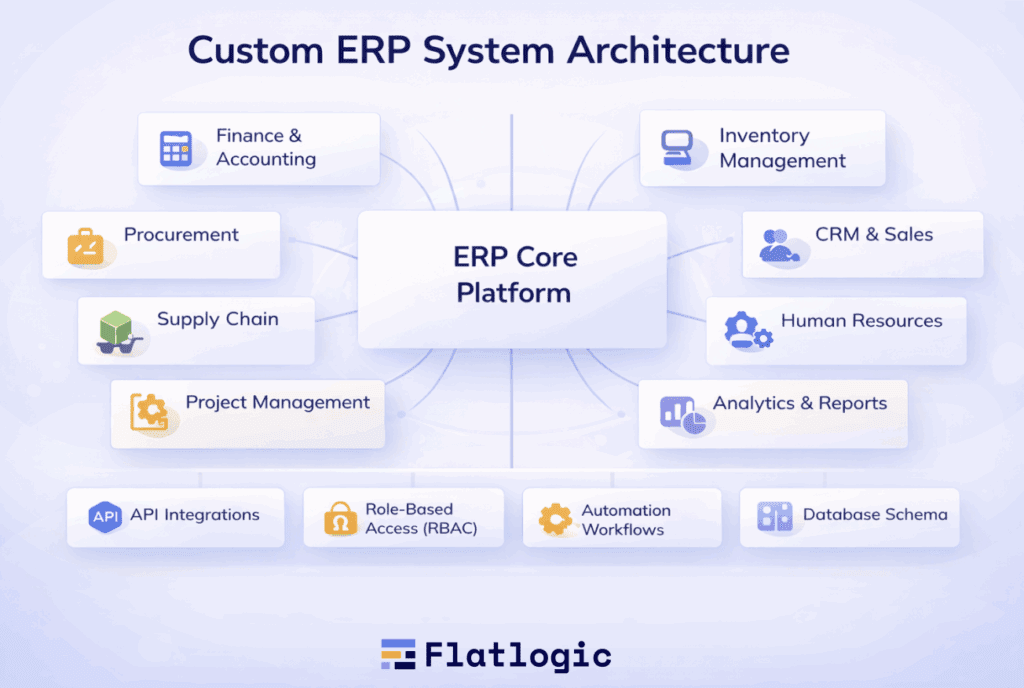
At its core, an ERP system acts as a centralized operations hub that connects multiple business functions into a single platform. Instead of using separate tools for finance, inventory, HR, procurement, sales, and analytics, businesses can manage all operational data and processes through one integrated system. This eliminates information silos and enables teams to collaborate more efficiently.
Custom ERP development focuses on building software that mirrors how a business actually works, rather than forcing the business to adapt to predefined software logic. For many organizations with complex operations or specialized workflows, this distinction becomes critical. Manufacturing businesses may need custom production tracking, logistics businesses require advanced shipment management, and SaaS businesses often need unique billing and customer lifecycle management systems.
A typical custom ERP solution may include modules such as:
- Finance and accounting management
- Inventory and supply chain management
- Customer relationship management (CRM)
- Human resource management
- Project and task tracking
- Reporting and business intelligence dashboards
Because these modules are developed specifically for the company, they can integrate seamlessly with existing tools such as internal databases, analytics platforms, or third-party services.
Another key feature of custom ERP systems is flexibility and scalability. As businesses grow, expand into new markets, or introduce new products and services, the ERP platform can evolve alongside them. New modules can be added, workflows can be updated, and integrations can be extended without the limitations that often come with prebuilt software packages.
Modern custom ERP platforms are also built using modular architectures and cloud technologies, allowing organizations to deploy systems faster and scale infrastructure as needed. Frameworks and development platforms such as Flatlogic’s full-stack solutions further accelerate development by providing ready-to-use components, authentication systems, and database management tools.
Ultimately, custom ERP development is about creating a strategic operations system that supports business processes instead of constraining them. By aligning software capabilities with operational realities, businesses gain greater visibility into their processes, automate repetitive tasks, and improve overall efficiency.
Custom ERP vs. Off-the-Shelf ERP Systems
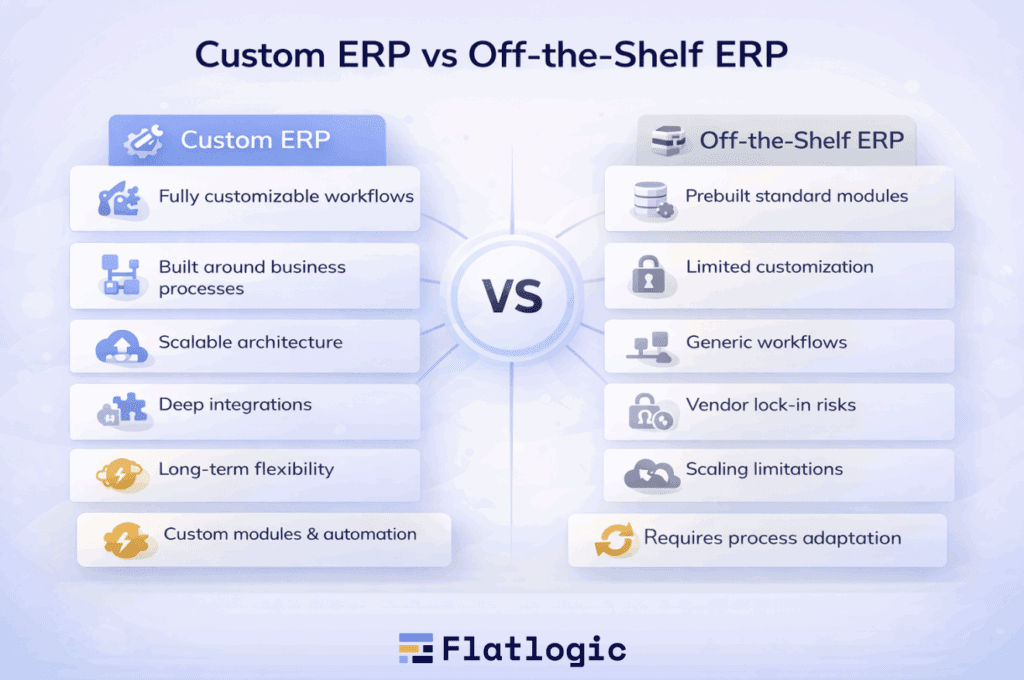
One of the most common decisions organizations face is whether to adopt a prebuilt ERP product or invest in custom ERP development. Both approaches aim to centralize business operations, but they differ significantly in terms of flexibility, cost, implementation complexity, and long-term scalability.
Off-the-Shelf ERP Systems
Off-the-shelf ERP solutions are prebuilt platforms designed to serve many businesses across different industries. Popular examples include systems like SAP, Oracle NetSuite, Microsoft Dynamics, and Odoo.
These platforms typically offer standard modules covering core business functions such as accounting, procurement, human resources, and inventory management. Businesses can configure certain features and enable or disable modules depending on their needs.
The primary advantages of off-the-shelf ERP systems include:
- Faster deployment. Since the system is already developed, implementation mainly involves configuration and integration with existing tools.
- Lower initial cost. Subscription-based pricing models allow businesses to start using ERP software without a significant upfront investment.
- Established ecosystem. Large ERP vendors offer extensive documentation, support services, and partner networks.
However, off-the-shelf ERP systems also have limitations that become more noticeable as businesses grow.
Standardized systems often require businesses to adapt their workflows to the software, rather than the other way around. Customization options may be limited, and deep modifications can be expensive or technically difficult. Over time, businesses may accumulate additional tools and workarounds to compensate for missing features, which can lead to operational fragmentation again.
Custom ERP Systems
Custom ERP systems take the opposite approach: instead of adapting business processes to software, the software is built around the business processes.
Development teams work closely with stakeholders to map operational workflows, identify inefficiencies, and design modules that directly address the organization’s needs. The resulting system reflects how the company actually operates.
The benefits of custom ERP systems include:
- Complete flexibility. Features, workflows, and integrations are designed specifically for the company.
- Scalability. The system can evolve as the organization grows or changes its operational model.
- Process optimization. Custom development allows businesses to automate complex or unique processes that generic ERP solutions cannot handle efficiently.
- Better integration. Custom systems can integrate deeply with existing tools, internal APIs, and legacy databases.
While custom ERP development usually requires higher upfront investment and longer development time, it often provides greater long-term value for businesses with complex operations or specialized requirements.
Key Differences at a Glance
| Factor | Custom ERP | Off-the-Shelf ERP |
| Flexibility | Fully customizable | Limited customization |
| Implementation time | Longer development cycle | Faster deployment |
| Initial cost | Higher upfront investment | Lower starting cost |
| Scalability | Easily adapted to business growth | May require upgrades or replacements |
| Workflow alignment | Built around business processes | Business adapts to software |
In practice, the choice between custom and off-the-shelf ERP depends on business size, operational complexity, budget, and long-term strategy.
Startups or small businesses with standard workflows may benefit from off-the-shelf systems that provide quick access to essential tools. On the other hand, businesses with unique processes, rapid growth, or complex operational structures often find that custom ERP development offers a more sustainable solution in the long run.
As digital transformation accelerates across industries, more organizations are exploring custom ERP platforms that act not just as management tools, but as centralized operations systems that power the entire business.
Best 5 ERP Tools for Building Custom Operations Systems
Modern ERP platforms allow businesses to manage complex operations through modular applications, cloud infrastructure, and integrated business tools. Many organizations combine these platforms with custom development to create ERP systems tailored to their workflows.
Below are five of the most widely used ERP tools that businesses rely on to build scalable operational systems.
Flatlogic
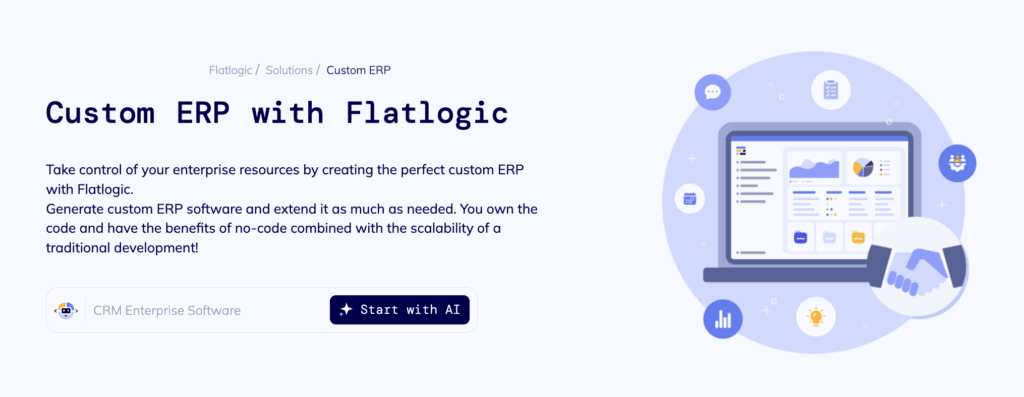
Flatlogic is a platform designed for building custom ERP systems, CRM platforms, and internal business applications. Unlike traditional ERP products, Flatlogic focuses on generating full-stack applications based on a database schema, allowing businesses to quickly build tailored operational systems.
The platform provides a ready architecture that includes frontend interfaces, backend logic, authentication, APIs, and database models. This approach significantly reduces the time required to develop custom ERP solutions.
Key features include:
- Full-stack ERP and admin panel generation
- Automatic CRUD API generation
- Role-based access control and authentication
- Integration with modern frameworks such as React and Node.js
- Flexible customization of workflows and business logic
Flatlogic is especially useful for businesses that want complete control over their ERP architecture while accelerating development time.
Odoo
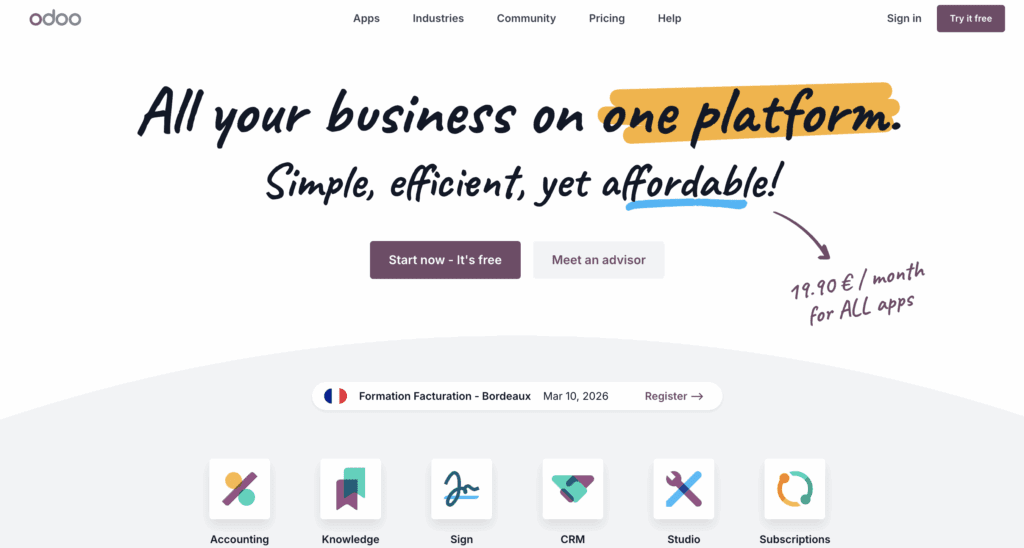
Odoo is one of the most popular ERP platforms for startups, small businesses, and mid-sized businesses. Its modular architecture allows organizations to start with a few essential applications and gradually expand their ERP system as the business grows.
The platform offers a large ecosystem of integrated modules that support many operational areas.
Core capabilities include:
- Inventory and warehouse management
- Customer relationship management (CRM)
- Accounting and financial management
- Human resource management
- Manufacturing and supply chain tools
Odoo’s flexibility and relatively affordable pricing make it a popular option for businesses looking for a customizable ERP solution without enterprise-level costs. Businesses can deploy Odoo in the cloud or host it on their own infrastructure.
Microsoft Dynamics 365
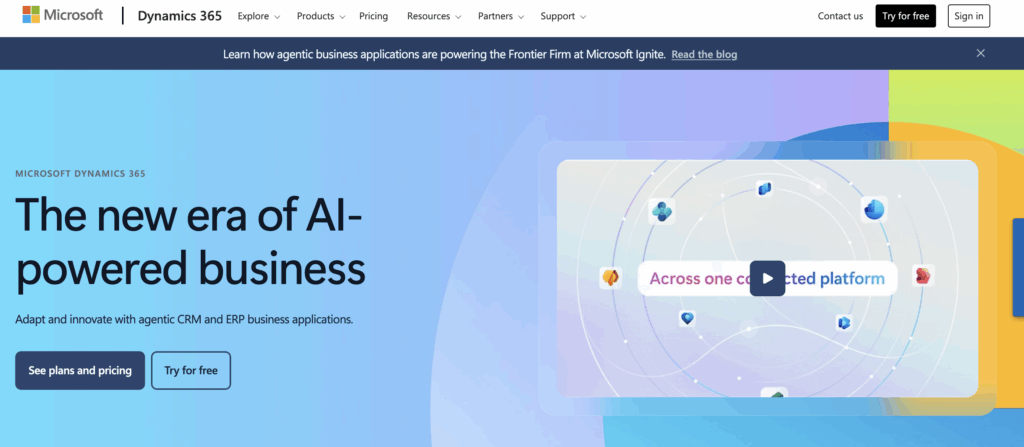
Microsoft Dynamics 365 is a comprehensive cloud-based ERP and CRM platform developed by Microsoft. It integrates seamlessly with other Microsoft tools such as Office 365, Teams, and Azure, making it especially attractive for organizations already using the Microsoft ecosystem.
The platform combines operational management with advanced analytics and automation.
Key capabilities include:
- Financial and operational management
- Sales and customer service tools
- Supply chain and inventory management
- AI-powered analytics and forecasting
- Integration with Microsoft productivity tools
Dynamics 365 is designed to support businesses of different sizes, from growing businesses to large enterprises, offering strong scalability and security.
Oracle NetSuite
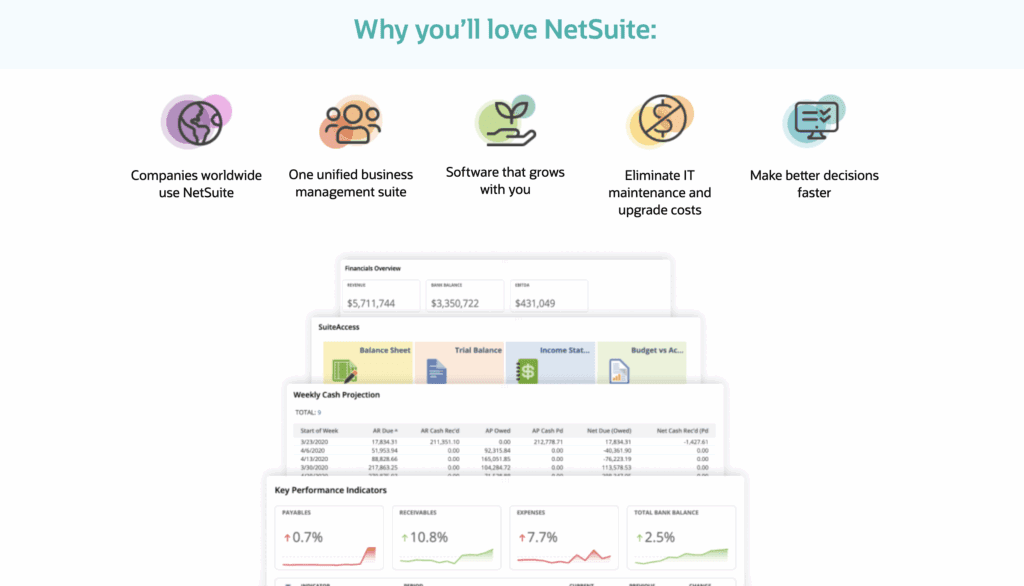
Oracle NetSuite is one of the leading cloud-based ERP platforms, particularly popular among mid-sized and rapidly growing businesses. The system provides real-time visibility into financial performance, operational processes, and customer data.
NetSuite includes a wide range of business management tools in a unified platform.
Major features include:
- Financial management and accounting
- Inventory and supply chain management
- E-commerce integration
- Business intelligence and reporting
- Multi-currency and multi-language support
Because of its strong global capabilities, NetSuite is often used by businesses operating across multiple regions that require advanced compliance and reporting tools.
SAP S/4HANA
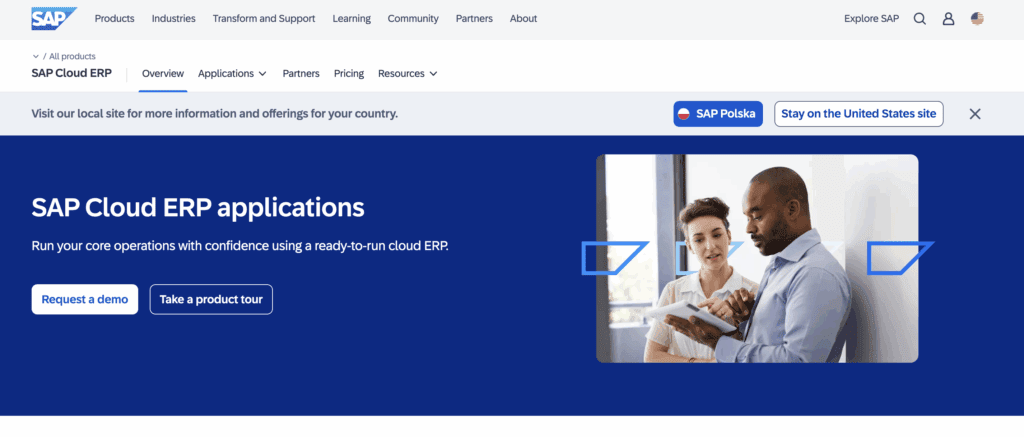
SAP S/4HANA is one of the most powerful ERP platforms used by large enterprises. Built on the SAP HANA in-memory database, it provides real-time analytics and high-performance data processing for complex business environments.
The platform is particularly strong in industries with sophisticated operational requirements.
Key capabilities include:
- Advanced manufacturing and production planning
- Supply chain and logistics management
- Real-time financial reporting
- Predictive analytics and automation
- Enterprise-scale operational management
SAP S/4HANA is widely used in industries such as manufacturing, aerospace, automotive, and logistics, where businesses require highly reliable, large-scale operational systems.
Choosing the Right Custom ERP Platform
Selecting the right platform for building a custom ERP system is one of the most critical decisions in any ERP development project. The platform you choose will directly influence development speed, scalability, integration capabilities, long-term maintenance, and overall system performance.
Because ERP systems serve as the core operational backbone of a business, the technology stack and development approach must support both current requirements and future growth. Choosing the wrong platform can lead to expensive migrations, limited flexibility, or operational bottlenecks as the company scales.
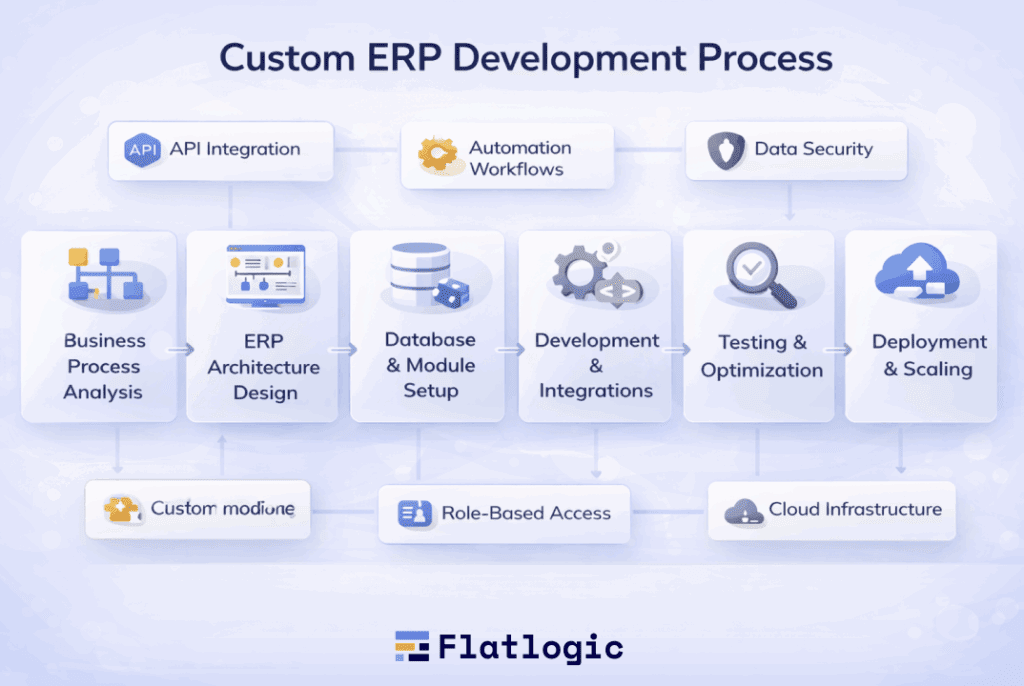
To avoid these issues, businesses should evaluate ERP development platforms based on several key criteria.
Flexibility and Customization
One of the main reasons businesses choose custom ERP development is the ability to build systems that reflect their unique operational workflows. Therefore, the platform must support deep customization.
A good custom ERP platform should allow developers to:
- Define custom data models
- Build unique workflow logic
- Add or modify modules easily
- Integrate business-specific rules and automations
Many off-the-shelf ERP tools limit how much customization is possible. Platforms designed for custom development, such as full-stack frameworks or ERP generators, offer significantly greater flexibility.
Businesses with complex processes, such as manufacturing, logistics, or SaaS operations, especially benefit from platforms that support fully customizable architectures.
Scalability and Performance
Custom ERP systems often grow alongside the organization. What starts as a small internal tool may eventually support hundreds of employees, multiple departments, and large volumes of operational data.
A reliable custom ERP platform must therefore support:
- Increasing numbers of users
- Expanding datasets and transactions
- Additional modules and integrations
- Multi-region or multi-department operations
Cloud-based architectures are commonly used for modern custom ERP systems because they allow businesses to scale infrastructure dynamically as demand grows.
Choosing scalable technologies from the beginning helps businesses avoid expensive rebuilds later.
Integration Capabilities
Most businesses already rely on multiple digital tools, such as CRM systems, payment platforms, analytics tools, or communication services. A custom ERP system should be able to integrate seamlessly with existing software ecosystems.
Key integration features to look for include:
- REST or GraphQL APIs
- Webhooks and event-based triggers
- Database integration options
- Compatibility with third-party services
Strong integration capabilities allow custom ERP development platforms to become the central operational hub that connects all business systems into one cohesive infrastructure.
Development Speed
Building ERP systems from scratch can take months or even years. Choosing a platform that accelerates development can significantly reduce both time-to-market and development costs.
Many modern custom ERP development approaches use:
- Prebuilt architectures
- Component libraries
- Database schema generators
- Automated API creation
These tools help development teams focus on business logic and workflow optimization instead of basic infrastructure setup.
Platforms that automate repetitive development tasks can shorten the custom ERP development cycle while still allowing deep customization.
Security and Access Control
Because ERP systems store critical operational data, such as financial information, employee records, and customer data, security is a top priority.
A reliable custom ERP platform should include features such as:
- Role-based access control (RBAC)
- Authentication and authorization systems
- Secure API management
- Data encryption
- Audit logs and activity tracking
Strong security architecture ensures that sensitive information is accessible only to authorized users and helps organizations comply with regulatory requirements.
Long-Term Maintainability
Custom ERP systems are long-term investments that may remain in use for 10 years or more. As a result, businesses must consider how easy it will be to maintain, update, and expand the system over time.
Important maintainability factors include:
- Clean, modular architecture
- Clear documentation
- Active development ecosystem
- Compatibility with modern technologies
Platforms built on widely adopted frameworks tend to be easier to maintain because developers are more familiar with the technologies and tools.
Cost Efficiency
Finally, businesses must balance development cost with long-term value. Custom ERP development can involve significant investment, but the right platform can reduce costs in several ways:
- Faster development cycles
- Lower infrastructure setup costs
- Easier feature expansion
- Reduced reliance on expensive licensing
Rather than focusing only on the initial development cost, organizations should evaluate the total cost of ownership (TCO) over the lifetime of the custom ERP system.
Choosing the right custom ERP platform requires a careful evaluation of both technical and business requirements. Flexibility, scalability, integration capabilities, development speed, and long-term maintainability should all play a role in the decision.
Businesses that select the right foundation for their ERP system gain more than just a software solution, they build a powerful operational platform that supports growth, automation, and better decision-making across the entire organization.
In the long run, a well-chosen custom ERP development platform becomes a strategic asset, helping businesses streamline processes, improve data visibility, and adapt quickly to changing market demands. It also enables organizations to respond faster to new opportunities, optimize resource management, and maintain operational efficiency as their business environment continues to evolve.
Conclusion
In a rapidly evolving digital landscape, businesses need more than disconnected tools and manual workflows to stay competitive. As operations grow more complex, organizations require systems that unify their processes, data, and decision-making into a single, reliable platform. This is exactly where custom ERP development becomes a powerful strategic solution.
Unlike traditional off-the-shelf systems, custom ERP platforms are designed around the way a business actually operates. They allow businesses to automate unique workflows, integrate existing tools, and build a scalable infrastructure that evolves with organizational growth. By centralizing operations such as finance, supply chain, human resources, and customer management, businesses gain greater visibility, efficiency, and control over their processes.
Throughout this article, we explored how custom ERP systems work, when businesses should choose them over standard ERP solutions, and what features modern operations systems typically include. We also reviewed some of the most widely used custom ERP development platforms that organizations rely on to build operational ecosystems tailored to their needs.
One of the key takeaways is that the right ERP platform should not only support current operations but also enable future growth. Scalability, integration capabilities, customization options, and development speed all play a crucial role in determining how effective a custom ERP system will be over time.
If your company is planning to build a custom operations platform, exploring development platforms like Flatlogic can help accelerate the process by generating full-stack custom ERP applications and reducing the complexity of building internal systems from scratch.
Ultimately, a well-designed custom ERP system becomes far more than just software. It becomes the central nervous system of a business, connecting departments, streamlining workflows, and empowering teams with the data and tools they need to make better decisions and drive long-term success.