


TL;DR
- Node.js templates provide a production-ready foundation, skipping boilerplate like auth, APIs, DB setup, and deployment config.
- For startups/SMBs, templates cut time-to-market and cost while reducing technical risk via proven architecture and standards.
- Templates are modular and customizable, making them ideal for MVPs, SaaS apps, admin panels, and API-driven products.
- Flatlogic Generator goes further by generating a full-stack app from your data model with full code ownership and no vendor lock-in.
Fact Box
- Using a template can skip about 60% of the work of building a product from scratch.
- Typical setup time: 4–12 weeks from scratch vs 1–3 weeks using a Node.js template.
- Node.js templates commonly include auth, database integration, API setup, and an admin dashboard with CRUD.
- Flatlogic Generator claims it can generate a working app in minutes instead of weeks.
- Flatlogic Generator claims full code ownership and no vendor lock-in.
Building a product from scratch is expensive, slow, and full of hidden traps, but what if you could skip 60% of that work and still ship faster than your competitors?
When founders, developers, and product teams search for solutions, they usually ask:
- Do I really need a Node.js template, or should I build everything from scratch?
- Will using a template limit my flexibility later on?
- How much time and money can I realistically save?
- Is a template secure and scalable enough for a real business?
As Martin Fowler, a well-known software architect, once said: “Any fool can write code that a computer can understand. Good programmers write code that humans can understand”.
Modern businesses face a growing challenge: building high-quality software quickly without sacrificing maintainability. According to multiple industry reports (such as Stack Overflow Developer Surveys and McKinsey’s research on developer productivity), development time, technical debt, and scalability issues are among the top concerns for startups and SMBs. Teams often reinvent the wheel, setting up authentication, dashboards, APIs, and infrastructure from scratch, wasting valuable resources that could be spent on building unique product features.
In this article, you’ll learn what a Node.js template is, what it’s actually good for, and how startups and SMBs can use it to accelerate development, reduce costs, and improve product quality. We’ll also break down real use cases, benefits, limitations, and how to choose the right template for your business.
What Is a Node.js Template?
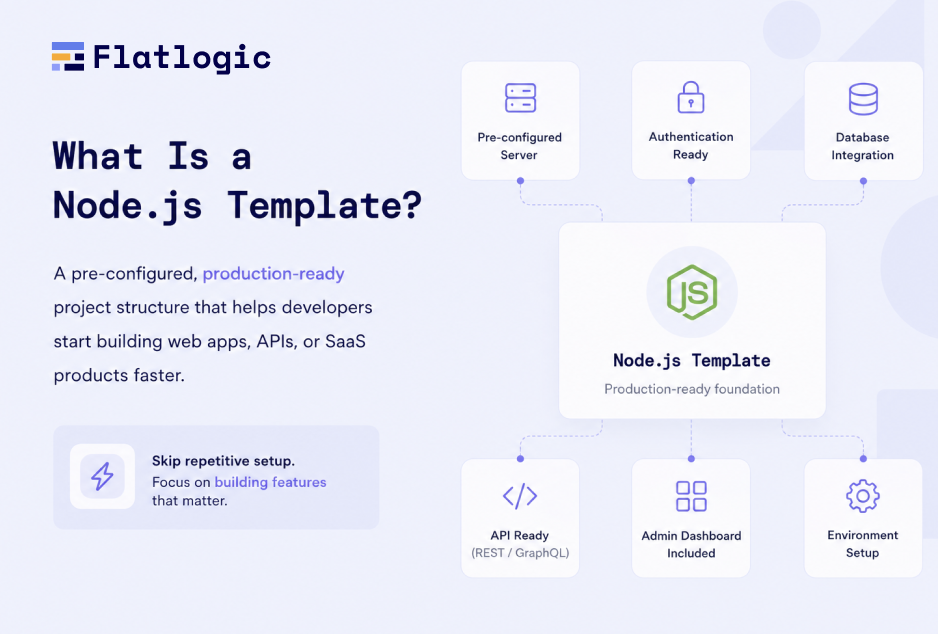
A Node.js template is a pre-configured, production-ready project structure that helps developers quickly start building web applications, APIs, or SaaS products without setting everything up from scratch. Instead of spending days or weeks on boilerplate tasks, like configuring the server, setting up authentication, structuring the database, or organizing files, you begin with a solid foundation that already follows best practices.

In the context of the Flatlogic Generator, a Node.js template goes beyond a simple starter kit. It’s a fully integrated full-stack solution that combines backend logic, database models, API layers, and often a ready-to-use admin panel. This means you’re not just getting code scaffolding, you’re getting a working application framework that can be customized to match your business needs.
Typically, a Node.js template includes:
- A structured backend architecture (controllers, services, models)
- Pre-built authentication and authorization (e.g., JWT, role-based access)
- Database integration (PostgreSQL, MySQL, MongoDB, etc.)
- REST or GraphQL API setup
- Admin dashboard with CRUD operations
- Environment configuration and deployment setup
Flatlogic takes this further by generating applications based on your chosen stack and schema. You define your data models and preferences, and the platform produces a consistent, scalable codebase tailored to your requirements. This approach significantly reduces manual coding while maintaining flexibility and control.
In simple terms, a Node.js template in Flatlogic is not just a starting point. It’s an accelerator that lets you skip repetitive setup work and focus directly on building features that deliver value to your users.
Why Node.js Templates Matter for SMBs and Startups
For SMBs and startups, every decision comes down to one thing: efficiency. Limited budgets, small teams, and high pressure to deliver make it impractical to build everything from scratch. This is exactly where Node.js templates become a strategic advantage, not just a developer convenience.
Speed as a Competitive Edge
Startups don’t compete on perfection. They compete on speed. The ability to launch early and iterate quickly often determines whether a product succeeds or disappears.
Node.js templates dramatically shorten development time by eliminating repetitive setup tasks. Instead of spending weeks configuring authentication, APIs, and database connections, teams can start building core features almost immediately. This means:
- Faster MVP launches
- Earlier user feedback
- Quicker product-market fit validation
In fast-moving markets, saving even a few weeks can make a real difference.
Doing More with Less
Most SMBs don’t have the luxury of large engineering teams or extensive funding. Hiring developers, managing infrastructure, and maintaining codebases all come at a cost.
Templates help optimize resources by:
- Reducing development hours
- Lowering initial engineering costs
- Minimizing the need for senior-level architectural decisions early on
This allows smaller teams to deliver results that would normally require significantly more manpower.
Reducing Technical Risk
Building from scratch introduces a range of risks:
- Poor architectural decisions
- Security vulnerabilities
- Scalability issues
- Inconsistent code structure
Node.js templates, especially those built with proven best practices, help mitigate these risks. They provide a stable, tested foundation that follows modern development standards, making it easier to build reliable and maintainable applications from day one.
Focus on What Actually Matters
Your product’s value isn’t in its login system or CRUD operations. It’s in the unique problem it solves.
Templates allow teams to shift focus away from generic functionality and toward:
- Core business logic
- User experience
- Differentiating features
Instead of reinventing common components, you invest your time where it has the highest impact.
Easier Scaling and Iteration
As your product grows, so do your technical requirements. A well-designed Node.js template provides a scalable architecture that supports:
- Adding new features without breaking existing ones
- Expanding teams with a clear code structure
- Integrating third-party services
This makes it easier to evolve your product over time without costly rewrites.
Node.js templates matter because they align perfectly with the realities of SMBs and startups: limited resources, high uncertainty, and the need to move fast. They reduce friction at every stage of development, helping teams turn ideas into working products with far less effort and risk.
What Is a Node.js Template Good For?
A Node.js template is best suited for accelerating the development of common application types without sacrificing quality. It’s particularly useful for building MVPs, SaaS platforms, admin panels, and API-driven products where speed and structure matter most.
Instead of starting from scratch, teams can use a template to quickly set up authentication, database models, APIs, and dashboards, allowing them to focus on core business features. This makes it ideal for startups validating ideas, SMBs building internal tools, or any team looking to reduce development time and costs.
Key Advantages
- Faster development, skip boilerplate setup, and start building features immediately
- Lower costs, reduce engineering hours, and infrastructure effort
- Built-in best practices, benefit from proven architecture, and clean code structure
- Pre-configured features, authentication, APIs, and admin panels included
- Scalability and modular structure make it easier to grow your application
- Reduced technical risk avoid common mistakes in early-stage development
In practice, a Node.js template is good for turning ideas into working products faster, with fewer resources and lower technical risk.
Key Benefits of Using a Node.js Template
Using a Node.js template isn’t just about saving time. It’s about building smarter from the very beginning. For SMBs and startups, templates provide a practical way to accelerate development while maintaining quality and scalability.
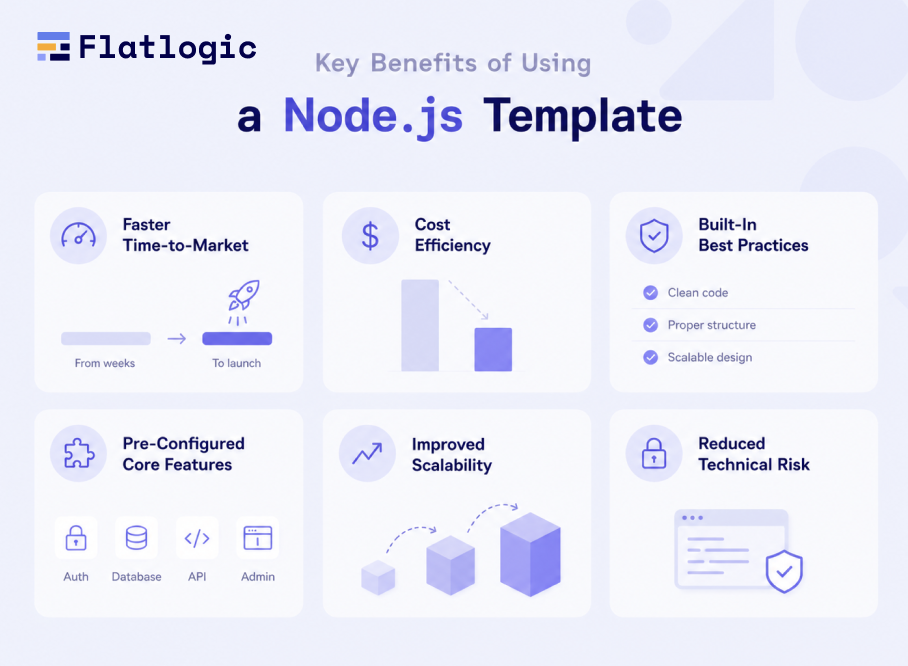
Faster Time-to-Market
One of the biggest advantages is speed. A Node.js template removes the need to set up core infrastructure from scratch, allowing teams to move directly into feature development. This can cut weeks, or even months, from your development timeline and help you launch sooner.
Cost Efficiency
Less development time means lower costs. By reducing the amount of boilerplate work, templates minimize the number of engineering hours required, making them especially valuable for teams with limited budgets.
Built-In Best Practices
High-quality templates are designed using proven architectural patterns and coding standards. This ensures your application starts with:
- Clean and maintainable code
- Proper project structure
- Scalable design principles
This foundation reduces the likelihood of costly refactoring later.
Pre-Configured Core Features
Most Node.js templates come with essential functionality already implemented, such as:
- User authentication and authorization
- Database integration
- API structure
- Admin dashboards
This allows teams to focus on building unique features instead of reinventing common ones.
Improved Scalability
Templates are typically built with modular architecture, making it easier to:
- Add new features
- Scale your application
- Maintain code as your team grows
This is critical for startups planning to evolve quickly.
Reduced Technical Risk
Starting from scratch increases the chance of architectural mistakes and security issues. Templates help mitigate these risks by providing a tested and structured starting point, often including security best practices and standardized workflows.
Common Misconceptions About Node.js Templates
Node.js templates are often misunderstood, especially by teams that haven’t used them in real projects. These misconceptions can prevent businesses from taking advantage of a tool that significantly speeds up development.
- “Templates are too rigid”. In reality, most templates are modular and customizable
- “They’re only for beginners”. Experienced teams use them to save time and standardize development
- “Templates aren’t secure”. Quality templates follow modern security practices and standards
- “You’ll end up with generic products”. Templates handle the foundation, while your business logic remains unique
In practice, a good Node.js template provides structure without limiting flexibility, making it a powerful tool for teams of all levels.
Real Impact: Build vs Template
Choosing between building from scratch and using a Node.js template has a direct and measurable impact on your product’s timeline, budget, and long-term maintainability. For SMBs and startups operating under tight constraints, this decision is not just technical. It’s a business strategy that influences how quickly you can validate ideas and grow.
- Development time, building from scratch often requires weeks or months just to set up authentication, database structure, APIs, and admin tools, while templates let you start feature development almost immediately
- Cost efficiency, fewer hours spent on boilerplate, means lower costs and less dependency on large engineering teams
- Technical risk, templates reduce the likelihood of architectural mistakes and security issues by relying on proven patterns
- Flexibility and control, custom builds offer full control, but modern templates are modular and can be adapted as your product evolves
- Speed of iteration, faster updates, and releases make it easier to test ideas and respond to user feedback
- Scalability, templates provide a structured foundation that supports growth without major rewrites
Build vs Template Comparison
| Aspect | Building from Scratch | Using a Node.js Template |
| Setup Time | 4-12 weeks | 1-3 weeks |
| Development Cost | High | Lower |
| Time to Market | Slower | Faster |
| Technical Risk | Higher (more unknowns) | Lower (proven structure) |
| Flexibility | Maximum | High (with some constraints) |
| Scalability | Depends on implementation | Built-in best practices |
| Focus Area | Infrastructure + features | Primarily business logic |
In practice, building from scratch makes sense for highly specialized systems. However, for most SMBs and startups, templates provide a faster, safer, and more cost-effective path to launching and scaling a product.
Why Choose Flatlogic Generator
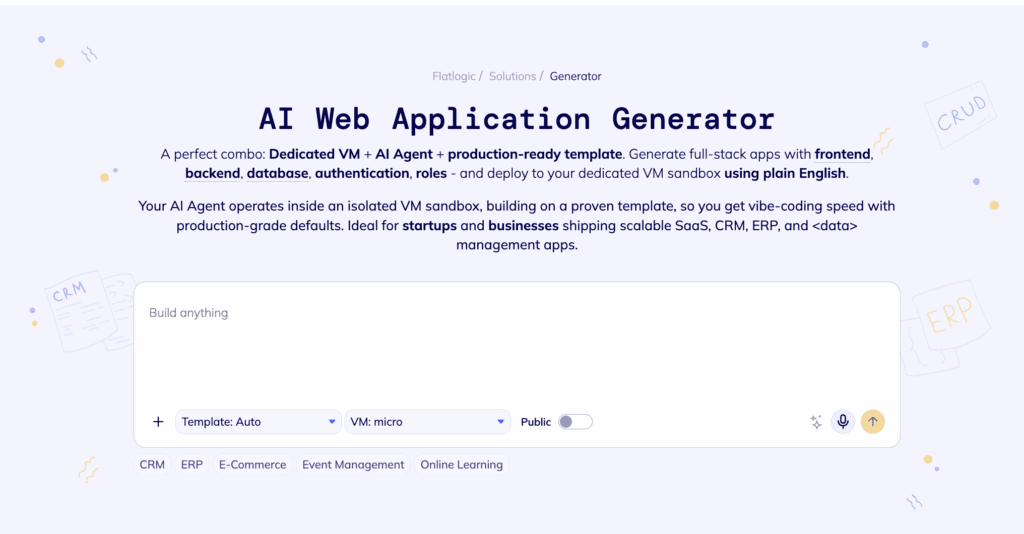
The Flatlogic Generator enhances the idea of Node.js templates by generating full-stack, production-ready applications tailored to your business needs. Instead of starting with a fixed structure, you define your data model, and the platform builds a scalable application around it, saving time while keeping full flexibility.
Key Advantages
- Custom-generated architecture, built around your specific data model, not a generic template
- Full-stack out of the box, backend, frontend, database, and admin panel included
- Faster development, generate a working app in minutes instead of weeks
- Scalable and clean codebase, follows modern best practices
- Full code ownership, no vendor lock-in, complete control over your application
In practice, Flatlogic Generator combines the speed of templates with the flexibility of custom development, making it a strong choice for startups and SMBs.
Conclusion
Building software from scratch will always give you maximum control, but for most SMBs and startups, it comes at a cost that’s hard to justify. Time, budget, and focus are limited, and spending them on repetitive infrastructure instead of real product value is rarely the winning strategy.
Node.js templates change that equation. They allow teams to move faster, reduce technical risk, and focus on what actually matters, building features that solve real problems for users. Instead of reinventing authentication systems, APIs, and dashboards, you start with a solid foundation and build on top of it.
More importantly, templates don’t limit innovation. They enable it. By removing friction in the early stages, they give teams the freedom to experiment, iterate, and scale without being slowed down by unnecessary complexity.
For startups validating ideas, SMBs optimizing resources, or teams looking to accelerate development, Node.js templates are not just a shortcut. They’re a smarter way to build.
And if you take it a step further with tools like Flatlogic Generator, you’re no longer just starting faster. You’re generating production-ready applications tailored to your needs from day one.
In the end, the goal isn’t to write more code. It’s to build better products, faster, and that’s exactly what Node.js templates are good for.
Comments