


TL;DR
- Templates made free and open-source; Flatlogic shifts from templates to an AI-assisted platform focus.
- Launched AppWizzy with investment and Kevin McKeand as advisor, clarifying platform vs services roles.
- Published ~70 posts; introduced Professional Vibe-Coding to stress code ownership and deterministic generation.
- Backed 27 hackathons; Discord grew to 278+ members; webinars showcased live, unscripted builds.
- 2026 roadmap: SaaS and WordPress templates, verticals, partnerships, education, and more live sessions.
Fact Box
- In 2025, Flatlogic made all templates free and open-source. Source
- Flatlogic published around 70 blog articles in 2025.
- Flatlogic supported 27 hackathons across the USA, Canada, the UK, and the UAE in 2025.
- The Flatlogic Discord grew to 278+ members in its first months in 2025.
- AppWizzy secured strategic investment and appointed Kevin McKeand as strategic advisor in 2025. Source
2025 was a pivotal year for Flatlogic. Not because of a single launch or announcement but because of a deeper shift in how software is built, how developers work, and how teams think about speed, ownership, and sustainability in an AI-first world.
It was the year when AI-assisted development stopped being a curiosity and became mainstream. It was also the year when vibe-coding went from an informal meme to an actual category people could name, compare, and adopt.
For Flatlogic, 2025 was about clarity:
- clarity in positioning,
- clarity in product direction,
- clarity in what we are and what we are not.
This article summarizes the most important milestones of the year, the lessons learned along the way, and what lies ahead in 2026.
2025 at a glance
Before diving into details, a few high-level numbers:
- ~70 blog articles published
Covering AI software development, agentic workflows, vibe-coding, research, platform updates, comparisons, tutorials, and case studies. - 27 hackathons supported across the USA, Canada, the UK, and the UAE.
- 278+ members joined the Flatlogic Discord community in its first months.
- A full transition from template-centric positioning to platform-centric and AI-assisted development.
These numbers matter, but the real story of 2025 is about direction, not volume.
Closing a 12-year chapter: all templates are now free
One of the most symbolic decisions of 2025 was making all Flatlogic templates free and open-source. For more than a decade, templates were the foundation of Flatlogic:
- admin dashboards,
- CRUD generators,
- starter kits,
- production-ready scaffolding for business applications.
They shaped the company’s early growth and helped thousands of developers ship faster. In 2025, Flatlogic made a clear decision: templates should no longer be the product.
Instead of slowly deprecating them or keeping them behind a paywall, all templates were released for free permanently.
This was not just a pricing decision. It was a strategic signal. Templates belong to the community. Flatlogic’s future lies in platforms, workflows, and AI-assisted software generation.
The full background and reasoning behind this move are documented here:
https://flatlogic.com/blog/flatlogic-templates-are-now-free-forever-a-12-year-journey/
This step allowed Flatlogic to fully focus on what comes next without maintaining two competing narratives.
Publishing with intent: ~70 articles in one year
Throughout 2025, Flatlogic published around 70 blog articles. This was not accidental. The blog evolved into:
- a public research notebook,
- a place to test language and positioning,
- a long-form explanation of how modern software is actually built in 2025.
The content broadly fell into five categories:
- AI software development & agents
Covering agentic workflows, AI engineers, chat-based development, and automation boundaries. - Vibe-coding and comparisons
Honest evaluations of new tools, platforms, and emerging categories, including their limitations. - Research and market analysis
Especially the recurring Starting Web App research series. - Product updates and platform features
Explaining what changed, why it changed, and how it affects real users. - Practical tutorials and real builds
Showing how to build actual applications using Flatlogic and AppWizzy tooling.
Rather than chasing short-term traffic spikes, the goal was to build a coherent body of knowledge around AI-assisted, production-grade software development.
Research: how web apps are actually built in 2025
Flatlogic continued its annual Starting Web App research in 2025. The goal of this research has always been simple: to understand how founders and teams really build software, not how they say they do in marketing materials.
The 2025 edition revealed several clear trends:
- Traditional custom development remains relevant, but is no longer the default starting point.
- Classic low-code tools are losing momentum for anything beyond basic internal tools.
- AI-assisted workflows, chat-driven interfaces, and agent-based tooling are rapidly gaining adoption.
- Speed is expected, but not at the cost of ownership or scalability.
Perhaps the most important insight was this:
The market is no longer choosing between fast and correct.
It is demanding both.
These findings heavily influenced Flatlogic’s product decisions and positioning throughout the year.
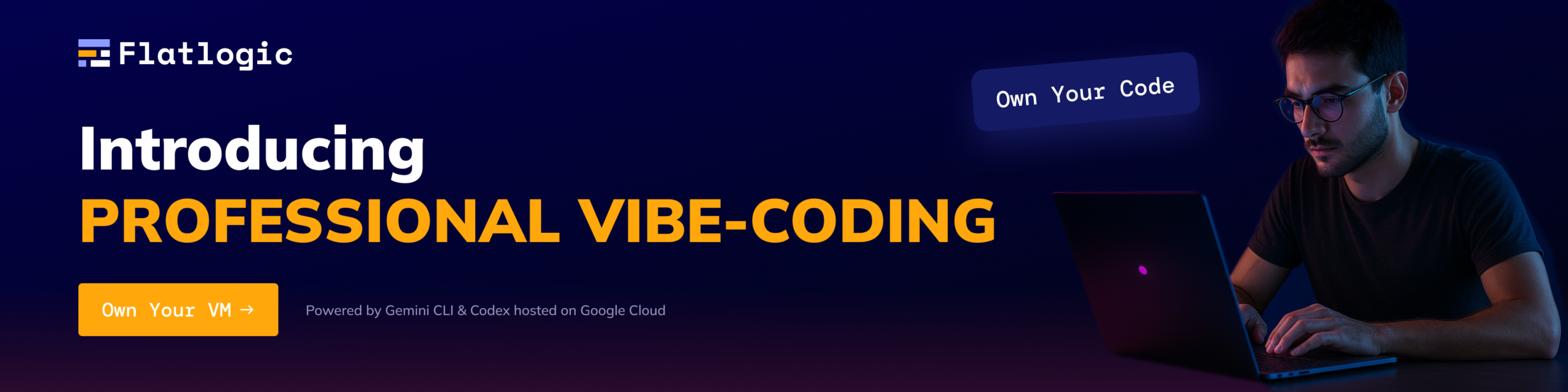
A new name for an old problem: Professional Vibe-Coding
For years, Flatlogic built systems that allowed users to:
- describe applications at a higher level,
- generate real code,
- deploy and iterate without losing control.
However, explaining this clearly was always difficult. In 2025, the broader market introduced a word that finally stuck: vibe-coding. Initially informal, the term quickly gained traction as tools like Lovable, Replit, and bolt.new, base44, and others popularized chat-based software creation.
But as adoption grew, so did confusion. Many platforms focused on:
- demos that looked impressive,
- locked environments,
- outputs that were difficult to maintain or extend.
Flatlogic responded by introducing a more precise concept: Professional Vibe-Coding.
This positioning emphasizes:
- real source-code ownership,
- production-grade infrastructure,
- deterministic generation layered with AI,
- workflows that survive real-world changes.
The formal introduction of this concept is outlined here:
https://flatlogic.com/blog/introducing-professional-vibe-coding-lamp-template/
This language shift proved critical. Once the category had a name, it became easier for teams to evaluate tools, understand trade-offs, and choose intentionally.
AppWizzy: a new platform direction
The most significant milestone of 2025 was the launch of AppWizzy as a standalone platform direction. AppWizzy represents the evolution of Flatlogic’s generator technology into a dedicated AI-assisted, vibe-coding platform.
Key characteristics of AppWizzy include:
- AI-driven requirement extraction,
- structured schema generation,
- deterministic code generation,
- full code ownership,
- real hosting and deployment workflows.
In 2025, AppWizzy also secured strategic investment and appointed Kevin McKeand as a strategic advisor, strengthening the U.S. go-to-market strategy and partnerships.
Announcement details:
https://flatlogic.com/blog/appwizzy-announces-strategic-investment-and-appoints-kevin-mckeand-as-strategic-advisor/
This launch also clarified internal structure:
- Flatlogic focuses on services, consulting, and custom delivery.
- AppWizzy focuses on the generator platform and professional vibe-coding.
This separation allowed each direction to evolve independently while reinforcing the other.
Building a real community
In 2025, Flatlogic launched its official Discord community. Rather than aiming for rapid growth, the goal was simple: create a space for real builders. The community now includes:
- developers using Flatlogic templates,
- teams experimenting with AppWizzy,
- founders exploring AI-assisted workflows.
With 278+ members and steady growth, the Discord has become a place for:
- sharing progress,
- asking practical questions,
- discussing real-world issues that don’t fit into documentation.
Community link: https://discord.gg/flatlogic-community
This community-first approach will continue into 2026.
Webinars: showing real work, live
2025 marked the first year of Flatlogic and AppWizzy webinars. The focus was deliberately different from typical product demos:
- live building instead of slides,
- real questions instead of scripted flows,
- realistic timelines instead of polished outcomes.
These sessions proved valuable not only for users but also internally, highlighting where tooling excels and where it needs improvement. More live sessions are planned for 2026.
Hackathons and education
Flatlogic supported 27 hackathons in 2025 across multiple regions. These events involved:
- universities,
- high schools,
- nonprofit initiatives.
Through partnerships like Code4Hope, students built applications for charitable causes, with finalists presenting projects at Microsoft’s Times Square office in New York.
Notably, one Canadian hackathon was won with an application built using Flatlogic Generator, demonstrating that the tooling works not just in theory, but in competitive, time-constrained environments.
Education and early-stage builder support remain a core part of Flatlogic’s mission.
Platform evolution and AI tooling
Throughout the year, Flatlogic continued to invest heavily in platform capabilities. Two articles capture this direction particularly well:
- A curated overview of AI Software Development Agents, highlighting the ecosystem and Flatlogic’s approach:
https://flatlogic.com/blog/awesome-ai-software-development-agents-list-by-flatlogic-is-live/ - A deep technical explanation of how Flatlogic built its own AI Software Engineer, combining AI with deterministic systems:
https://flatlogic.com/blog/how-we-invented-our-own-ai-software-engineer/
The underlying philosophy remained consistent: AI should augment structured systems, not replace them.
Key lessons from 2025
Several lessons became clear by the end of the year.
Naming creates markets
For years, Flatlogic built capabilities that were difficult to explain succinctly. Once vibe-coding entered the common language, the conversation changed. Naming enabled understanding, comparison, and adoption.
Speed is expected, trust is earned
In 2025, speed stopped being a differentiator. The new standard is trustworthy speed: fast development that preserves ownership, maintainability, and scalability.
Funnels are engineering systems
User journeys behave like software systems:
- inputs,
- states,
- drop-offs,
- feedback loops.
Applying engineering discipline to funnels proved as impactful as applying it to code.
What’s coming in 2026
Looking ahead, Flatlogic and AppWizzy plan to deliver:
- A full-stack SaaS template (production-grade)
- A WordPress template
- More vertical templates (CRM, ERP, and others)
- New first-party templates aligned with professional vibe-coding
- A rewards program
- A Product Hunt launch
- Google partnerships
- Expanded educational content (articles and video)
The focus remains unchanged: help teams build real software faster without shortcuts that break later.
Conclusion
2025 marked an important transition for Flatlogic. It was the year when the company moved decisively away from its template-driven past and fully embraced platform-first, AI-assisted software development. The industry matured, the language caught up with reality, and concepts like vibe-coding became part of everyday conversations, not experiments on the margins.
Over the course of the year, Flatlogic clarified its positioning, expanded its research, launched new community initiatives, and introduced AppWizzy as a dedicated platform for professional vibe-coding. The focus shifted from isolated features to complete workflows from speed alone to speed combined with ownership, reliability, and long-term maintainability.
The lessons from 2025 are clear: modern software teams expect fast iteration, but they also expect transparency, control, and infrastructure that works beyond a demo. Tools that ignore either side of that equation struggle to scale.
Looking ahead to 2026, Flatlogic will continue building on this foundation, expanding platform capabilities, releasing new templates and integrations, strengthening partnerships, and investing in education and community. The goal remains unchanged: to help teams build real software faster, without sacrificing quality or ownership.
2025 sets the direction. 2026 is about execution.