


TL;DR
- Vibe-coding lets founders build apps via conversation, but tools split: toys vs professional platforms
- Deterministic generators tame AI chaos, yielding stable code, Git, real backends, and code ownership
- Done right, MVPs drop from months to days and costs fall 10-30x; speed and iteration are the wins
- Limits remain: complex logic, real-time/perf, compliance, drift, and unclear vision still need engineers
- Use mature platforms (e.g., AppWizzy) for dedicated VMs and production code; avoid demo-only exports
Fact Box
- HBR reports 67% of early-stage startups fail primarily due to execution speed.
- McKinsey Digital says 85% of digital projects miss deadlines or ship reduced scope.
- Gartner: IT backlogs span 6-18 months for routine internal tools.
- With proper vibe-coding, MVP timelines drop from 2-3 months to 2-3 days.
- Vibe-coding can cut early build costs by 10-30x, per the article's analysis.
Most founders don’t fail because they had no idea. They fail because turning that idea into software takes longer, costs more, and burns more energy than expected. Vibe-coding claims to change that… but can it really?
Whenever a founder searches for articles like this one, the same anxieties show up behind the query:
- Can AI actually build something real, or is this just hype?
- Is vibe-coding fast enough and reliable enough for a real MVP?
- Will I own the code, and can I scale it later?
- Is this better than no-code… or just another startup toy that breaks under pressure?
As Marc Andreessen famously put it: Software is eating the world – but creating software is still too damn hard.
Vibe-coding promises to make it easier. The question is whether it delivers.
There’s a reason vibe-coding exists at all. A massive and well-documented bottleneck has been building for years: the widening gap between how fast founders need to build and how slowly traditional software development moves.
Harvard Business Review reports that 67% of early-stage startups fail primarily because of execution speed – not the quality of the idea. McKinsey Digital adds that 85% of digital projects miss deadlines or ship reduced scope due to engineering bottlenecks.
And this doesn’t just affect early-stage founders. Enterprises, too, are collapsing under complexity: Gartner reports that IT backlogs now stretch from 6 to 18 months for even routine internal tools.
Meanwhile, AI accelerates everything except… software creation. We can brainstorm faster. We can outline faster. We can research faster. But actually turning an idea into software – with a backend, a database, roles, permissions, an API layer, deployment, testing, and all the messy glue – hasn’t changed much in 20 years. Vibe-coding is a direct response to this pressure.
By the end, you’ll have a simple framework to decide if vibe-coding is a toy… or a tactical weapon for your startup.

Terminology & Definitions
Before we dive deeper, it’s important to clarify a few terms. When people say “AI builds software,” they often mean completely different things – from simple prompt-based code generation to full-stack application assembly. Understanding these distinctions helps founders choose the right tools and avoid expensive dead ends.
Vibe-Coding
Vibe-coding is the practice of building software by talking to an AI in plain language – while the platform updates real code, in a real repository, running on real infrastructure. It combines the creativity and speed of no-code with the stability of traditional engineering.
In true vibe-coding:
- You describe what you want your app to do,
- The AI modifies real project files,
- Changes appear instantly in a running environment,
- The app lives on an actual VM or server,
- And you fully own the resulting codebase.
The key idea, vibe-coding, isn’t a mockup generator or a toy. It’s conversational access to a genuine engineering workflow.
AI Code Generation (LLM-as-Compiler Tools)
This includes tools like GPT-4, Replit AI, Lovable, Cursor, Claude Projects, Codeium, and similar assistants.
These systems generate code from prompts, but they work in a very “guessing” manner:
- They don’t maintain a global architectural plan,
- They can overwrite or break earlier work,
- They may hallucinate files, imports, or dependencies,
- And they struggle to keep a project consistent over time.
They’re excellent copilots – great for small tasks, refactoring, or feature stubs – but they are not reliable as primary builders of a full, evolving application.
Deterministic Code Generators
These are hybrid systems such as Flatlogic Generator and AppWizzy, which blend AI with deterministic engineering.
Here’s how they work:
- AI interprets your instructions and turns them into structured intent (schemas, models, roles, permissions, pages).
- A deterministic generator then converts that intent into consistent, production-quality code using well-defined templates and rules.
This approach gives you:
- stable architecture
- predictable file structure
- clean database models and routing
- reliable iteration without drift
- maintainable code that engineers can work with long-term
In short, deterministic generators solve the “AI chaos problem” by ensuring that every change follows the same patterns and conventions.
The Promise vs. Reality of Vibe-Coding
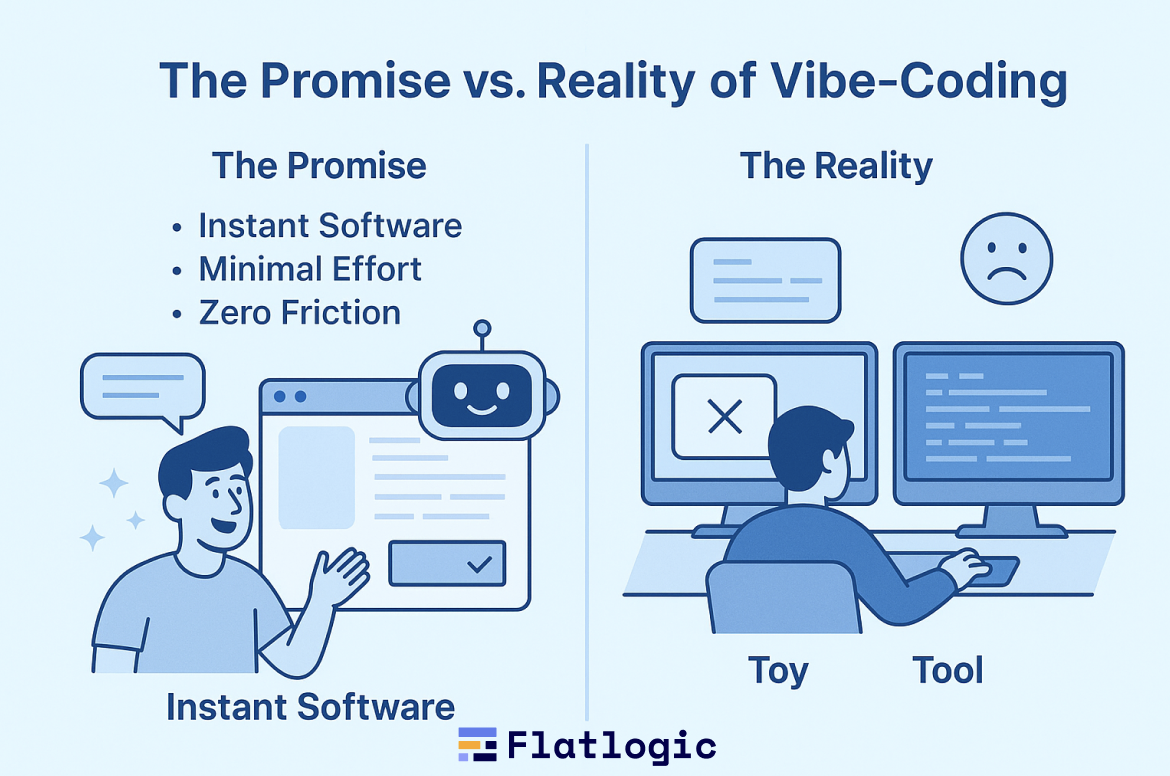
Vibe-coding comes with a powerful promise: the idea that anyone, especially founders, can build software simply by describing what they want. It suggests that the painful parts of development are finally dissolving into a simple conversation with an intelligent assistant. And on the surface, the demos appear miraculous: type a sentence, get an app; upload a screenshot, and it comes to life; describe a workflow, and it appears seconds later.
It’s no surprise that many founders look at vibe-coding and see a direct solution to the oldest startup barrier: “I know what I want to build – I just can’t build it fast enough.”
But the reality is more nuanced. Not all vibe-coding platforms are created equal, and the gap between what they promise and what they actually deliver can be massive.
The Promise: Instant Software, Minimal Effort, Zero Friction
Vibe-coding tools promise three main benefits:
- Speed that feels unfair
You can build screens, flows, and backend logic in minutes instead of days or weeks. For founders racing against time, this velocity is transformative. - Creativity without technical barriers
You no longer need to write technical specs or understand frameworks. You just describe what the product should do in natural language. - Continuous iteration
Instead of long development cycles, vibe-coding creates an environment where you can change anything instantly: new fields, new pages, new logic, new UI.
At its best, vibe-coding feels like “live co-founding with an engineer who never sleeps.”
The Reality: A Split Between Toys and Tools
The hype hides a critical divide: half of the vibe-coding platforms are fun toys, and the other half are legitimate engineering tools. This distinction determines whether vibe-coding accelerates your startup – or slows it down.
❌ Toy Vibe-Coding Platforms
These platforms look impressive in controlled demos but collapse under real startup pressure. Their limitations are severe:
- ephemeral servers that vanish after sessions
- no real backend or database
- messy, AI-generated code with no structure
- broken exports (or no export at all)
- zero version control
- inability to handle iterative changes
- unsuitable for scaling, security, or team handoff
They’re perfect for prototypes and landing page demos, but terrible as foundations for a serious MVP. The promise is there – but the execution is shallow.
✔️ Professional Vibe-Coding Platforms
This is the category that delivers on the dream. Professional platforms combine the conversational flow of vibe-coding with real engineering principles:
- dedicated VM/server per project
- real source code, not pseudo-code
- deterministic generators that maintain architecture
- Git version control and observable changes
- working backend + database + API
- deployment you can control and move elsewhere
- extensibility for future developers
Here, vibe-coding isn’t a shortcut – it’s a force multiplier. The promise becomes operational reality.
Where Vibe-Coding Overdelivers
When done properly, vibe-coding’s strengths are undeniable:
- Building at conversational speed
MVPs that took 2-3 months now take 2-3 days. - Founder-led development
Technical bottlenecks shrink; founders stay close to the product. - 10-30× lower cost
Early engineering hiring becomes optional instead of mandatory. - Instant visual feedback
You see the product evolving in real time, not in weekly sprint reviews. - Higher iteration velocity
More experiments → faster product-market fit.
For early-stage teams, this is game-changing.
Where Vibe-Coding Falls Short
Even the best platforms have limits:
- Complex business logic may require real engineering
- Real-time systems need a deeper architecture
- Regulated industries demand compliance-level code quality
- Poor AI agents can introduce silent errors
- Founders without product clarity struggle regardless of tools
The dream is powerful – but not magic.
So… Is Vibe-Coding the Future?
The honest answer: Yes – but not in the way most people think.
Vibe-coding won’t replace developers. It replaces the slow parts of development:
- boilerplate
- setup
- scaffolding
- CRUD
- repetitive UI
- deployments
- prototypes
- refactoring
- schema updates
It becomes the engine that powers early-stage execution and frees developers to focus on the high-value logic. In real, production-grade platforms, vibe-coding is not a toy – it’s a competitive advantage. In toy platforms, it’s entertainment. Knowing the difference determines whether you sprint ahead… or waste weeks rebuilding your product from scratch.
Why Founders Adopt Vibe-Coding Faster Than Developers
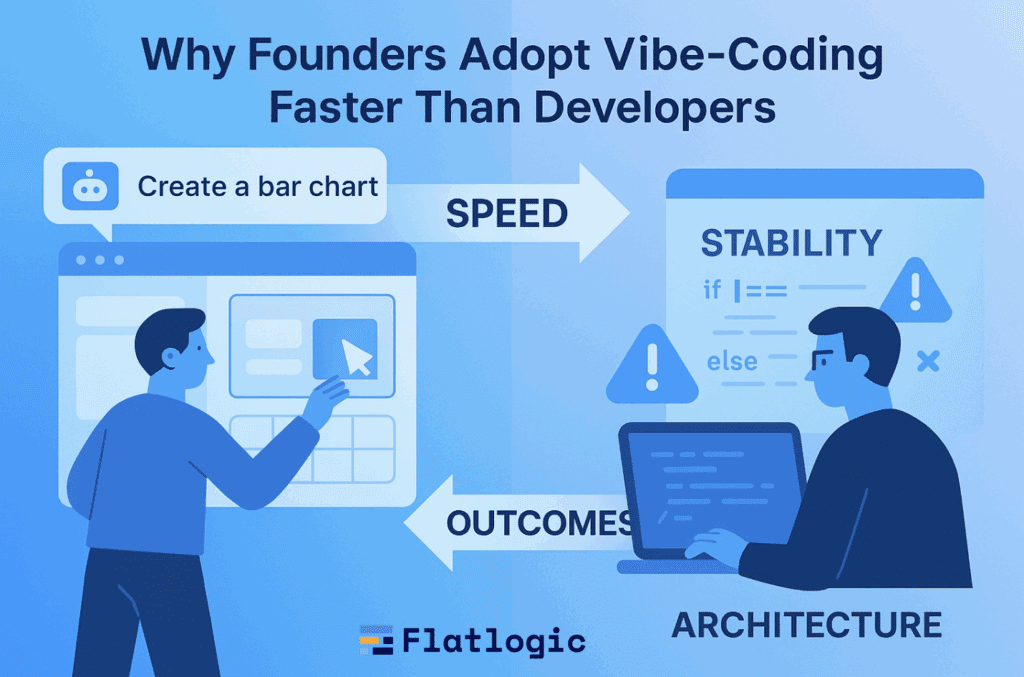
Founders adopt vibe-coding more quickly because it directly solves their biggest constraint: speed. Early-stage teams feel every delay as lost momentum, missed customer feedback, and slipping investor interest. When vibe-coding turns a written idea into a working feature in seconds, founders immediately understand the competitive advantage. For them, fast execution matters more than perfect architecture.
Developers approach vibe-coding differently because their role is rooted in long-term technical stability. They naturally focus on structure, patterns, and maintainability, and they worry that rapid AI-generated changes may introduce problems they’ll later be responsible for fixing. What feels liberating to a founder can feel risky to a developer who thinks in terms of technical debt rather than market timing.
Another reason founders adopt vibe-coding faster is that it matches how they think. Founders speak in outcomes and workflows-how the product should behave, how users interact, and what business rules matter. Vibe-coding speaks that same language, translating intent into code without forcing non-technical people to think like engineers. This removes friction and gives founders direct control over the product for the first time.
Finally, vibe-coding dramatically lowers early costs, allowing founders to build meaningful prototypes or MVPs without hiring a full engineering team. Developers don’t feel this financial pressure in the same way, so they focus on code quality while founders focus on progress, validation, and survival. Vibe-coding aligns naturally with the founder mindset, fast, flexible, and outcome-driven.
The Limitations – Where Vibe-Coding Breaks
Vibe-coding shines when the goal is to move quickly, iterate rapidly, and turn ideas into functional software with minimal friction. But its strengths naturally expose several limitations, especially as a product grows more complex.
1. When Products Move Beyond Simple Features
Vibe-coding excels at generating CRUD features, dashboards, onboarding flows, and basic application logic. But as soon as a product demands deeper domain modeling or highly specific business rules, its limitations become visible. Complex workflows, multi-step interactions, approval chains, and systems with tightly interdependent components require deliberate architectural decisions. These are areas where conversational prompts alone cannot capture the nuance, and where human engineers must intervene to maintain coherence and long-term stability.
2. When Real-Time or Performance-Critical Systems Are Needed
There are entire categories of software that require extreme precision and optimization: multiplayer collaboration tools, streaming platforms, live analytics dashboards, trading engines, logistics systems, and anything with millisecond-level performance requirements. Vibe-coding can generate the scaffolding for these applications, but fine-grained performance tuning still belongs to experienced engineers. AI can accelerate the start, but it cannot fully deliver the predictability these systems need.
3. When Operating in Regulated or High-Security Environments
Industries like finance, healthcare, insurance, aerospace, and government impose strict standards around compliance, security, audit trails, data retention, and reliability. While vibe-coding can speed up early development, it cannot independently guarantee compliance with standards such as HIPAA, SOC 2, PCI DSS, or GDPR. Meeting these requirements demands manual review, structured processes, and careful engineering beyond what conversational AI can safely automate.
4. When Structural Drift Accumulates Over Time
Even the best AI-driven tools occasionally introduce inconsistencies-such as slightly misaligned database schema updates, subtle naming variations, or logic placed in less-than-ideal locations. Over multiple iterations, these small discrepancies can compound and make the project harder to maintain. Deterministic generators significantly reduce this risk, but no system is fully immune. Periodic human review remains essential for long-term health and clarity within the codebase.
5. When Product Vision Is Unclear
Perhaps the most common breaking point is not technical at all. Vibe-coding accelerates execution, but it cannot compensate for a lack of direction. If a founder is unclear about user behavior, feature priorities, or the core problem the product solves, the AI cannot fill those strategic gaps. It will produce software quickly, but that software may not reflect a coherent or valuable product. Vibe-coding sharpens clarity-but it also exposes confusion.
6. When Engineering Judgment Matters More Than Speed
Software development contains moments where trade-offs define the future: choices around architecture, performance boundaries, data flows, and long-term scalability. These decisions require experience, context, and intention. Vibe-coding tools can propose solutions, but they cannot replace human judgment in moments where a single choice can shape the next decade of the product.
Top 5+ Professional Vibe-Coding Tools
The vibe-coding landscape looks crowded from the outside, but only a handful of platforms genuinely aim to turn natural-language instructions into production-ready applications. Most tools promising “AI-built apps” are either demos, UI-only toys, or code snippet generators. Below is a breakdown of the leading professional vibe-coding tools, the ones that actually try to bridge conversation and real software.
These summaries focus on the key factors founders care about: how the tool works, who it’s for, what it does well, where it breaks, and how much it costs.
AppWizzy
AppWizzy is currently the only vibe-coding platform that gives each app its own dedicated cloud VM and generates real full-stack code (LAMP, Node/Next, Django, etc.) while letting users interact through conversational AI. It blends a chat-based workflow with deterministic code generation, ensuring output remains consistent and structurally clean. Unlike many competitors that focus on visual prototypes or single-repo experiments, AppWizzy provides a deployable environment, a live URL, and a Git-tracked codebase from day one. It is built for founders who want AI speed without sacrificing control, flexibility, or engineering-grade reliability.
Target audience
Founders, solo entrepreneurs, agencies, and technical PMs validating new product ideas or building real SaaS MVPs, internal tools, or production-ready prototypes.
Key features
App-per-VM architecture, deterministic code generation, full code ownership, real-time editing through Gemini CLI, one-click deployments, image-to-app workflows, professional templates, and Git integration.
Pitfalls
Complex domain logic or specialized workflows may still require manual engineering; vibe-coding accelerates the 0→1 phase but doesn’t eliminate the need for thoughtful architecture in advanced stages.
Pricing
Free to start; AI agent calls billed by usage; VM runtime billed in credits (low cost); full source code included at no extra charge.
Lovable
Lovable gained rapid popularity by promising full apps from a single prompt. It generates a working prototype in one go and provides a visual editor where the AI can adjust files and structure on request. Its value lies in immediacy: founders can see something functional almost instantly. However, the generated apps often require careful review due to inconsistency or unreliable architectural decisions, and exports don’t always behave like standard production projects. The platform shines for demos and quick iterations, but can become fragile as complexity grows.
Target audience
Founders needing visually impressive, quick prototypes, product teams preparing demos, and early-stage builders exploring concepts rapidly.
Key features
Instant MVP generation, visual UI editor, AI-assisted file modifications, app previews, and quick iteration loops.
Pitfalls
Exports are not always production-ready; long-term maintainability is limited; advanced workflows or large apps can lead to structural drift.
Pricing
Subscription-based plans with project limits; additional charges for higher compute usage.
Replit AI
Replit AI combines an online IDE, hosted dev environment, and AI code agents to produce and modify code in real time. It doesn’t attempt full app generation automatically but instead acts like an always-on pair programmer who can scaffold, edit, or refactor code on demand. Because Replit AI operates inside a cloud-based IDE, users still need a basic understanding of development, but the platform removes friction from setup, deployment, and collaboration. It’s less “generate my whole app” and more “help me build it faster.”
Target audience
Technical founders, indie developers, students, and early-stage engineers who want assistance, not automation.
Key features
AI-assisted coding, cloud development environment, one-click deployment, instant hosting, and collaborative editing.
Pitfalls
Not a true vibe-coder, requires coding knowledge; no deterministic structure; AI outputs vary heavily based on prompts and context.
Pricing
Free tier with limited compute; paid “Replit Pro” with more resources, GPU time, and AI credits.
Cursor
Cursor is a desktop code editor built around LLM-assisted development. Instead of generating entire applications, it improves development speed through intelligent file edits, refactoring, test generation, and context-aware modifications. Cursor provides a strong developer experience by aligning closely with real-world coding workflows. While not an app builder in the vibe-coding sense, it’s one of the strongest “AI engineering accelerators,” particularly for teams that want to code but want to code faster.
Target audience
Developers, technical founders, and engineering teams who prefer full manual control but want AI speed.
Key features
Full-codebase context window, automated refactoring, test generation, large context editing, and prompt-to-code workflows.
Pitfalls
Not suitable for non-technical founders; cannot bootstrap an application without developer input; relies on the user’s architectural understanding.
Pricing
Subscription-based; different tiers depending on model access and context window size.
Builder.io
Builder.io is a visual development platform that focuses on creating front-end experiences using a drag-and-drop editor, custom components, and AI-assisted generation. It accelerates UI development by allowing teams to visually assemble pages and export them as real React or Next.js code. Unlike full vibe-coding tools, it doesn’t generate entire apps or handle backend logic, but it significantly speeds up interface creation and iteration.
Target audience
Designers, frontend developers, and startups need fast UI work, landing pages, marketing sites, or component-driven product interfaces.
Key features
Visual editor, integration with modern frameworks, AI-powered UI/content generation, code export, and a built-in headless CMS.
Pitfalls
Not a full-stack builder; limited backend capabilities; still requires engineering for logic, state, and complex workflows.
Pricing
Tiered plans based on usage and features; more expensive at scale or in enterprise configurations.
Conclusion
Vibe-coding emerged because founders are tired of waiting. The old approach to building software, long timelines, big budgets, endless handoffs, simply no longer matches the speed at which ideas need to move. The promise of vibe-coding is simple: describe what you want, and watch the product take shape. And while not every platform lives up to that vision, the best ones genuinely close the gap between concept and working software.
Tools like AppWizzy, which combine conversational input with deterministic, production-grade code generation, show what vibe-coding looks like when it actually works. They give founders real infrastructure, real code ownership, and an immediate way to turn clarity into progress. If you’ve ever wanted to build faster without sacrificing long-term stability, this is where the technology becomes more than a gimmick. It becomes a strategic advantage.
Still, vibe-coding isn’t perfect. It won’t replace thoughtful architecture, it won’t make complex business logic magically correct, and it won’t fix unclear product vision. But in the early stages, where speed matters more than polish, it changes the rhythm of execution. It reduces the cost of experimentation, compresses iteration cycles, and gives non-technical founders a way to create momentum instead of waiting for it.
So is vibe-coding a toy or a real tool? It’s both, depending on what you use. In weak systems, it’s a novelty. In mature ones, it’s a force multiplier that helps founders ship sooner, learn faster, and compete on pace rather than headcount. For anyone building in 2025, that difference is everything.
Comments