


TL;DR
- December users built production-focused internal tools, not experiments
- CMS/Admin and ERP apps led; dashboards and analytics stayed strong
- AI acted as infrastructure inside apps, not the product
- CRUD, roles, and permissions remained the core foundation
- Feature demand centered on auth, data integrity, analytics, logs, files, and integrations
Fact Box
- Top 5 archetypes: CMS/Admin, ERP/Business Apps, AI-powered apps, Admin Dashboards, Analytics & BI Dashboards.
- AI features are embedded in apps; standalone chatbot-style products are rare in serious usage.
- Apps now generate in minutes; complexity shifts upstream to structure, data models, and workflows.
- CRUD-based, role- and permission-heavy systems dominate and are expected to live for years.
- Top requested features: auth and roles; CRUD/data management; analytics/logs/reporting; file handling; integrations.
Every month, hundreds of applications are created on Flatlogic. Not landing pages. Not demos. Not proof-of-concepts designed to be abandoned after a pitch deck is sent. These are real internal tools, SaaS MVPs, and business systems intended to be used, maintained, and extended.
December 2025 is a particularly revealing moment to analyze this data. December is not a month for curiosity-driven building. It’s a month of constraint. Budgets are closing. Teams are under delivery pressure. Loose ideas get postponed, while necessary systems get finished. What people choose to build under these conditions tells us far more about real demand than what they build during periods of hype.
What follows is a breakdown of the most popular app archetypes and requested features based purely on actual user activity inside Flatlogic. No surveys. No interpretation filtered through marketing narratives. Just what people actually did when they needed software to exist.
Top App Archetypes in December 2025
Before examining individual categories, it’s important to understand the context in which this software is being built. December compresses decision-making. There is little tolerance for waste. Teams don’t explore what might be interesting; they focus on what must work.
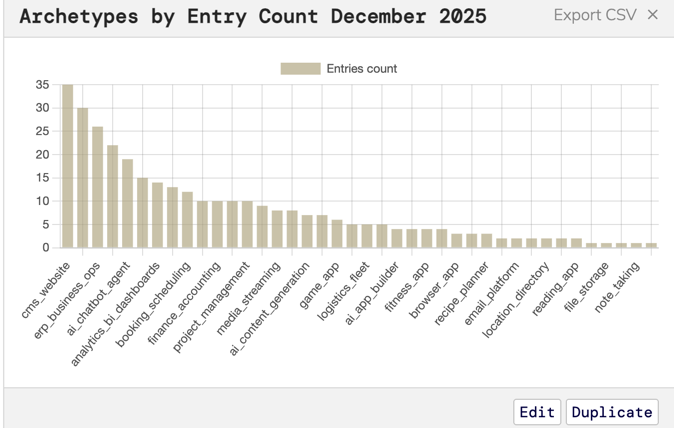
That’s why this data is unusually honest. The chart tells a clear story: boring business apps win.
🏆 Top 5 Archetypes
- CMS / Web Admin Tools
- ERP / Business Apps
- AI-powered Apps
- Admin Dashboards
- Analytics & BI Dashboards
The most common archetypes were CMS and web admin tools, ERP-style business applications, AI-powered apps, internal dashboards, and analytics or BI systems. These are not experimental categories. They are the operational backbone of modern organizations.
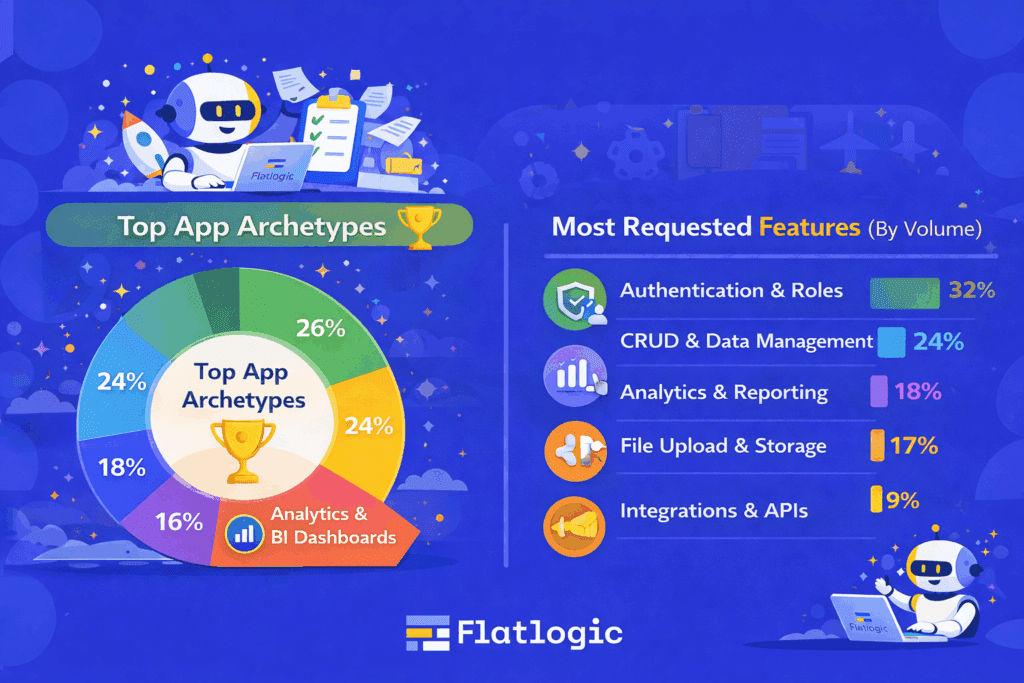

This matters because it reframes the role of AI in practice. People are not coming to Flatlogic to experiment with prompts or generate disposable prototypes. They are using AI as leverage, a way to compress time, reduce setup cost, and remove friction from building software that already has a clear owner and purpose.
Why CMS and Admin Tools Remain the Default Starting Point
CMS and web admin tools sit at the top of the list for a simple reason: every organization eventually becomes a data operator. Users, content, configurations, transactions, internal resources, all of it needs to be viewed, edited, approved, and controlled somewhere.
What’s important is that these are rarely public-facing CMSs. They are internal control systems. They exist to replace spreadsheets, shared folders, and email-based workflows that stopped scaling long ago.
Historically, these tools were postponed because building just an admin panel felt too expensive relative to its perceived value. AI-assisted generation has changed that calculus. The cost of starting has dropped enough that teams now choose to build proper systems instead of patching broken processes.
This is not innovation for its own sake. It is delayed maintenance finally becoming affordable.
ERP and Business Apps: Custom Beats Generic
ERP and broader business applications rank just behind CMS tools, and their presence is remarkably consistent. These apps span operations tracking, internal finance, inventory management, HR workflows, and industry-specific processes that off-the-shelf software never fits perfectly.
What stands out here is not novelty but intent. These apps are rarely attempts to replace large enterprise platforms wholesale. Instead, they fill gaps with lightweight systems tailored to how a specific organization actually works.
AI-assisted app generation enables something that was previously rare: pragmatic customization. Teams can now generate a strong baseline quickly and evolve it incrementally, rather than forcing their processes to fit rigid software.
This is a quiet but meaningful shift in how business software is conceived.
AI-Powered Apps: Presence Without Dominance
AI-powered apps rank high, but not at the top. That detail matters.
Despite the broader AI hype cycle, users are not primarily building AI-first products. Instead, AI is being embedded into familiar structures: dashboards with AI insights, admin tools with AI-assisted moderation, business systems with predictive or summarization features.
Very few apps are “AI-only.” Most treat AI as a capability inside a system rather than the system itself.
This suggests that AI builders have moved past novelty. AI is no longer the point. It’s an accelerant. The surrounding architecture still determines whether the app is usable, trustworthy, and maintainable.
Dashboards and Analytics: Visibility as a Bottleneck
Internal dashboards and analytics tools remain highly popular because visibility is often the first thing to break as organizations grow. Data exists, but it’s scattered. Decisions are made based on partial information. Teams don’t trust numbers because they come from too many sources.
These apps are built to restore clarity. They consolidate metrics, expose trends, and provide role-specific views into what is actually happening inside a business.
Their popularity reinforces an important point: software doesn’t need to be novel to be valuable. It needs to reduce uncertainty.
What This Pattern Really Means
Taken together, these archetypes point to a broader reality. When speed, cost, and accountability matter simultaneously, internal software wins over consumer apps.
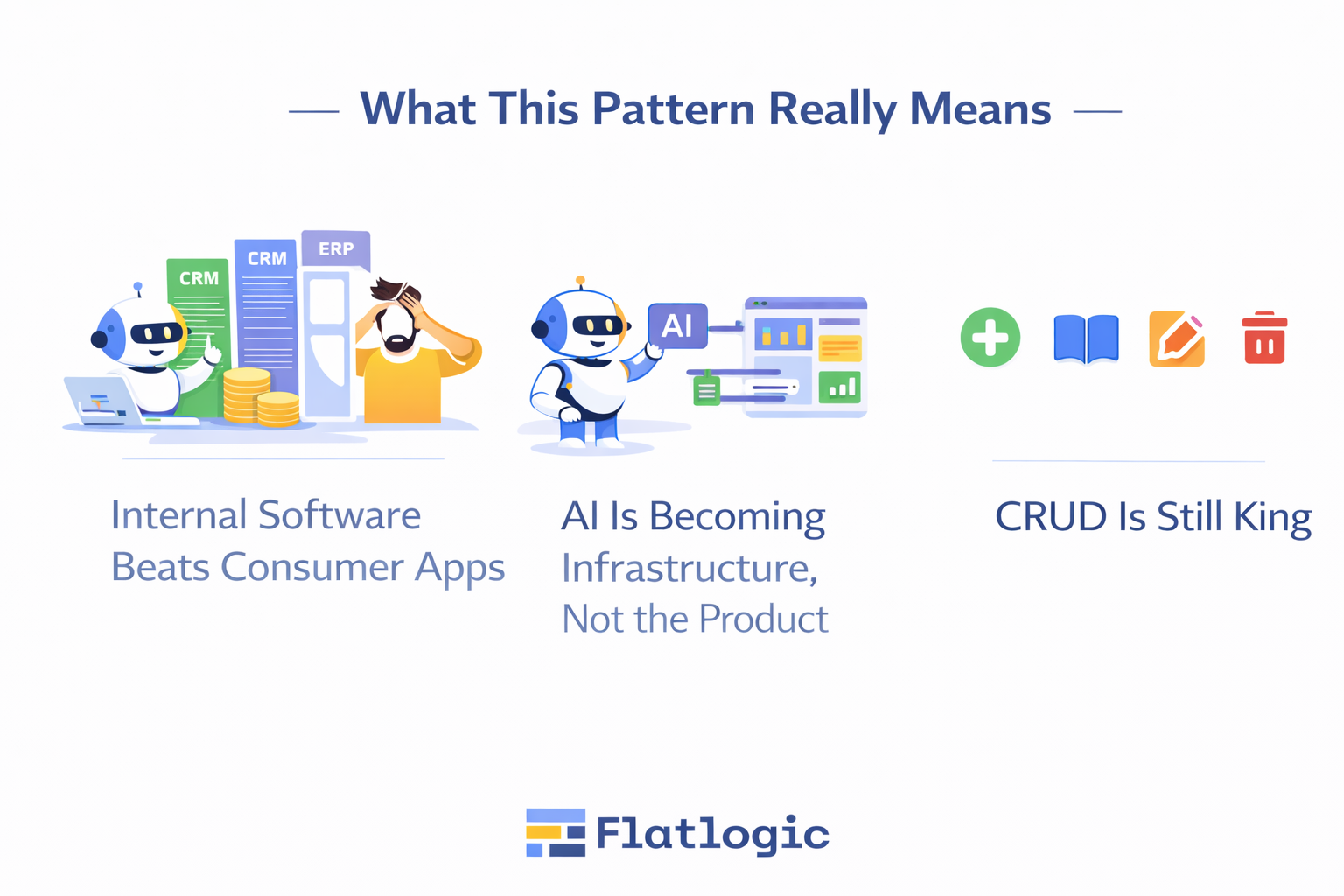
Internal Software Beats Consumer Apps
CRMs, ERPs, dashboards, and back-office tools dominate because demand already exists. There is no need to convince users. Someone inside the organization already feels the pain.
The ROI is immediate. There are no distribution challenges, no marketing funnels, and no external approvals. The success criteria are clear: does this tool reduce friction or not?
This is exactly how Flatlogic is used in practice as a way to eliminate delays between identifying a problem and having a working system.
AI Is Becoming Infrastructure, Not the Product
AI-powered apps ranking high might look like hype validation, but the positioning tells a different story.
AI is rarely the headline feature. It is embedded, combined with dashboards, and integrated into workflows. Standalone chatbot-style products are rare in serious usage.
AI is the engine, not the vehicle. And engines are only useful when the rest of the machine is well-designed.
CRUD Is Still King (and That’s a Compliment)
Across all archetypes, the same foundation appears again and again: CRUD-based systems.
Admin panels, resource management tools, booking systems, project trackers – different surfaces, same core. These systems are data-heavy, role-based, permission-sensitive, and expected to live for years.
CRUD persists not because AI builders lack imagination, but because reality demands structure. Long-living software accumulates edge cases. Systems without solid foundations collapse under their own flexibility.
Most Requested Features: Where Builders Feel Risk
Feature requests reveal anxiety more than ambition. They show where teams expect problems once an app leaves “demo mode.”
Authentication and roles dominate because access control failures are catastrophic. CRUD and data management matter because data integrity underpins trust. Analytics, logs, and reporting exist because someone will eventually ask, “What happened?”
File handling and integrations appear because software rarely exists in isolation. It must connect to other systems and manage real assets.
Again, no surprises but strong confirmation. Builders don’t want magic. They want predictability, control, and speed at the same time.
A Hidden Insight: Complexity Is Moving Earlier
One of the most important shifts visible in this data is timing.
Many of these applications used to take weeks just to scaffold. Teams delayed hard decisions, wrote boilerplate by hand, and promised themselves they would refactor later.
Now, apps are generated in minutes. Schemas evolve iteratively. AI handles repetitive groundwork. Humans focus earlier on structure, data models, and workflows.
Complexity hasn’t disappeared. It has moved upstream, where it can be handled deliberately instead of reactively.
This is not a trend. It’s a structural change in how software is built.
What to Expect Next
December often previews what becomes standard in the following year. Based on this data, several trajectories are clear.
Expect more AI-augmented internal tools and fewer throwaway MVPs. Expect higher expectations for production readiness from day one. Expect growing demand for systems that can evolve safely over time, rather than one-off generation.
Prompt-to-app is no longer about speed alone. It’s becoming build-and-operate.
Why We Share This Monthly
We’re publishing these breakdowns regularly for one simple reason. To show what people actually build, not what marketing decks promise. If you’re building software in 2026, this data is a mirror:
- For founders: validation
- For teams: prioritization
- For product: builders, focus
And yes, we’ll keep sharing the raw reality.
Summing Up
December 2025 strips away noise and wishful thinking. When deadlines are real and expectations are high, builders don’t chase novelty. They reach for tools that solve concrete problems. What people built with Flatlogic during this period makes that unmistakably clear.
The demand is not for flashy consumer apps or AI demos. It is for internal systems, admin tools, ERPs, dashboards, and analytics, software that runs businesses day after day. AI is present, but not as a gimmick. It acts as infrastructure, accelerating delivery while the underlying structure, data models, and permissions remain central.
Feature demand reinforces the same message. Authentication, roles, CRUD operations, analytics, integrations, these are the pressure points of real software. Builders care less about magic and more about reliability, control, and the ability to evolve safely over time.
The deeper shift is timing. Complexity is no longer postponed. Teams are building production-ready foundations earlier, letting AI handle repetitive groundwork while humans focus on decisions that matter. This isn’t a trend driven by hype; it’s a structural change in how software is created.
In short, prompt-to-app is growing. It’s becoming build-and-operate.
That’s why we share this data monthly, not to predict the future, but to document what’s already happening. If you’re building software in 2026, this isn’t inspiration. It’s a reflection.