


TL;DR
- Worldsphere.ai uses computer vision on infrared satellite imagery to estimate 2D hurricane surface wind fields for risk and weather analysis.
- Flatlogic has worked with Worldsphere since 2023 to build a web platform for hurricane tracking and weather risk management.
- Product stack: React + Next.js frontend, Node.js backend, with AI integration (including OpenAI) and Flatlogic Generator for faster scaffolding.
- Teams collaborated in 2-week sprints with demos every Friday to iterate on dashboards, workflows, and predictive features.
- Worldsphere reports wind-field prediction errors as low as 3 m/s RMSE in an updated Satellite-to-Wind model.
Fact Box
- Flatlogic has worked with Worldsphere.ai on a hurricane tracking web app since 2023.
- Worldsphere presented Pix2Pix GAN wind-field diagnosis at NeurIPS 2025.
- The NeurIPS results reported pixel-wise wind-speed errors of 6.7 knots and 7.3 knots in two test setups.
- Worldsphere later reported a 3 m/s average wind-speed prediction error (RMSE) for an updated Satellite-to-Wind model.
- Development ran in two-week sprints with a scheduled demo every Friday.
What if satellite images could reveal much more about a hurricane than its visible size, shape, and movement?
For meteorologists, insurance companies, emergency management teams, and businesses operating in weather-sensitive industries, understanding a hurricane’s wind structure is essential. Yet collecting, processing, and interpreting detailed weather information is a complex task. Traditional approaches often rely on limited observations and analytical methods that cannot always capture the full structure of a developing storm.
Artificial intelligence is opening new possibilities for solving this problem. By combining satellite imagery, computer vision, and predictive models, AI systems can extract detailed weather information and transform it into insights that support better risk assessment and decision-making.
One example is Worldsphere.ai, a climate technology company developing AI-powered solutions for hurricane prediction and weather intelligence.
Since 2023, Flatlogic has worked with Worldsphere on developing a web application for hurricane tracking and weather risk management. The project demonstrates how specialized AI capabilities can become part of a practical software product through thoughtful application development, data processing, and user-focused design.
In this case study, we’ll explore the technology behind the project, how Flatlogic approached its development, and what founders of AI and vertical SaaS startups can learn from it when deciding which AI capabilities are worth building.
The Business Problem: Turning Complex Weather Data Into Actionable Intelligence
Hurricanes generate enormous amounts of meteorological data. Satellite imagery, wind measurements, atmospheric observations, and weather models all provide information about how a storm develops. However, having access to data doesn’t automatically make it useful. Organizations need to understand what that information means for their operations, assets, customers, and risk exposure.
For example:
- Insurance companies need better information to assess potential exposure and evaluate weather-related risks.
- Emergency management organizations need timely information to support preparedness and response planning.
- Businesses operating in hurricane-prone regions need to understand potential disruptions to their operations and infrastructure.
- Meteorologists need detailed information about storm structure to improve their analysis.

One particularly important challenge is understanding the wind field of a tropical cyclone.
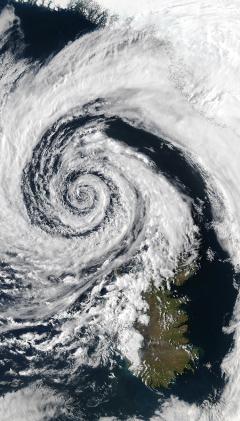
A hurricane is not simply a point on a map with a category and a wind-speed estimate. Its wind field has a complex spatial structure, including the inner core and surrounding rainbands. The distribution of wind speeds can vary significantly across different parts of the storm.
Traditional approaches to estimating this structure can rely on indirect observations, satellite image interpretation, and parametric models.
This creates an opportunity for AI: extract more detailed information from satellite imagery and make it available through tools that support weather analysis and risk assessment.
The AI Solution: Turning Satellite Imagery Into Hurricane Wind Fields
One of Worldsphere’s core technological initiatives is its Satellite-to-Wind approach.
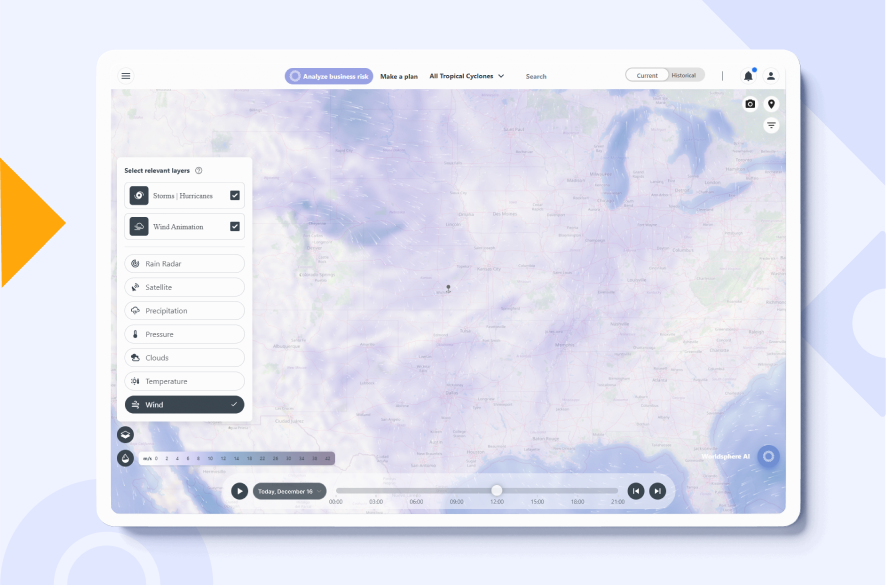
The idea is relatively straightforward: instead of relying exclusively on conventional weather observations, use computer vision models to translate satellite images into detailed representations of a hurricane’s surface wind field.
How Satellite-to-Wind Technology Works
The process starts with infrared satellite imagery. These images capture information about cloud-top brightness temperatures and the structure of a tropical cyclone. On their own, they do not provide a complete picture of the surface wind field.
Worldsphere’s AI research explores how computer vision models can learn the relationship between satellite imagery and corresponding wind-field data.
At a high level, the process involves:
- Collecting satellite imagery: Infrared images provide visual information about the structure of a tropical cyclone.
- Preparing training data: Satellite images are paired with corresponding wind-field information to create datasets for model training.
- Training computer vision models: AI learns patterns connecting visible storm structures with their associated wind distributions.
- Generating wind-field predictions: The model processes satellite imagery and produces a spatial representation of estimated surface wind speeds.
- Evaluating predictions: Generated wind fields are compared with reference data to measure model performance.
The output is a two-dimensional wind-field representation that provides more detailed information about the storm’s structure.
This is particularly valuable because wind conditions are not distributed uniformly across a hurricane. Understanding their spatial distribution can provide additional context for weather analysis and risk assessment.
What Makes This AI Capability Interesting?
Worldsphere’s research demonstrates how computer vision can be applied to a highly specialized problem outside traditional image recognition. Rather than identifying objects or classifying photographs, the model learns to transform one type of visual information into another scientifically meaningful representation.
The research presented by the Worldsphere team at NeurIPS 2025 explored image-to-image tropical cyclone wind-field diagnosis using Pix2Pix generative adversarial networks (GANs). The research described two complementary datasets containing simulated and observed satellite imagery paired with wind-field information.
The models generated detailed wind-field representations, with the research reporting pixel-wise wind-speed errors of 6.7 knots and 7.3 knots for the respective test configurations. More recently, Worldsphere reported a 3 m/s average wind-speed prediction error (RMSE) for its updated Satellite-to-Wind model, demonstrating further progress in this area.
These results illustrate the potential of AI-based weather intelligence, although model performance must always be interpreted in the context of the dataset, evaluation method, and intended operational use.
Building the Product: How Flatlogic Helped Develop Worldsphere.ai
Developing an AI model is only one part of creating a successful AI-powered product. Users also need an application that makes the technology accessible, processes information reliably, and presents results in a way that supports their workflows. This was the challenge behind the Worldsphere.ai web application.
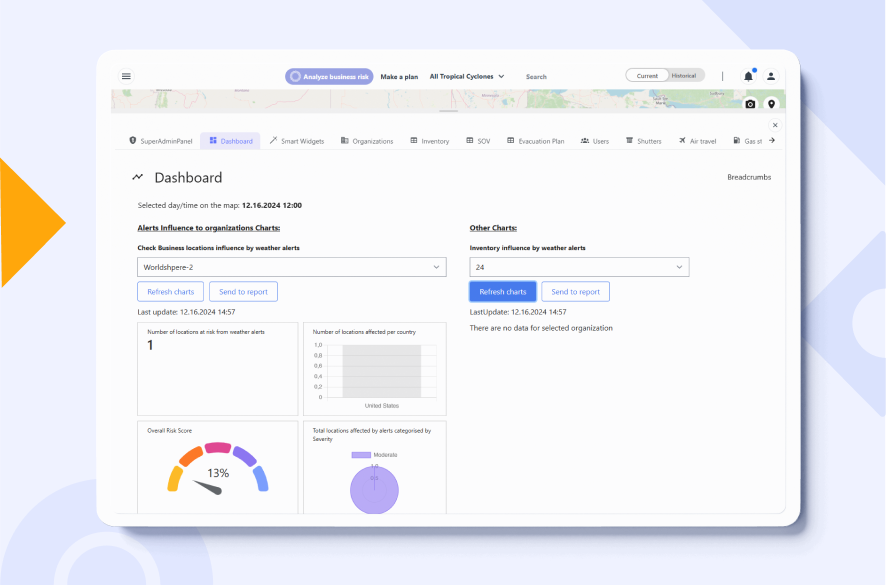
Flatlogic partnered with Worldsphere to develop a web-based platform for hurricane tracking and weather risk management. The objective was to create an intuitive and robust application capable of processing complex weather information while presenting it through an accessible interface. The development focused on several key areas.
1. Creating an Intuitive Application Interface
Weather intelligence involves complex information that can be difficult to interpret without specialized knowledge. The platform needed an interface that would make hurricane-related information easier to explore and understand.
Flatlogic developed a responsive frontend using React and Next.js, supporting dynamic interfaces and interactive application components. The application included interactive dashboards and visualizations designed to make weather information more accessible.
For data-intensive SaaS products, interface design is particularly important. Even highly sophisticated analytical capabilities have limited value if users cannot understand or navigate their results.
2. Developing the Backend Foundation
The application also required a backend capable of supporting its data processing and application functionality. Flatlogic used Node.js for backend development. The resulting architecture provided the foundation for connecting application components, supporting data workflows, and implementing the platform’s functionality.
The project used the Flatlogic Generator to establish the initial application foundation and accelerate development. This allowed the team to focus on the product-specific requirements rather than building every application component from scratch.
3. Integrating AI Capabilities
AI integration was central to the platform’s functionality. The application was designed to support predictive hurricane tracking and real-time risk analysis, connecting AI-powered capabilities with the broader user experience. The technology stack included OpenAI among the listed technologies, alongside React, Next.js, and Node.js.
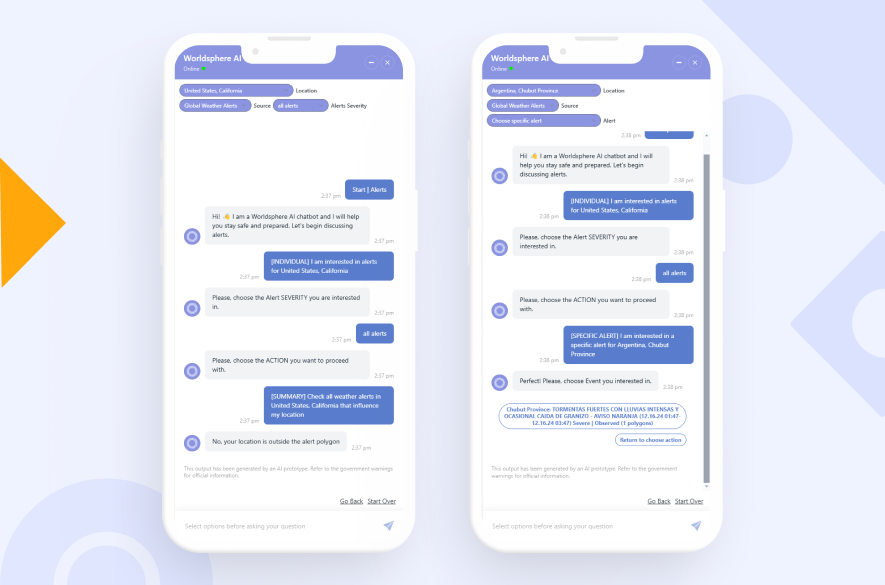
Importantly, the platform’s hurricane prediction capabilities and Worldsphere’s specialized Satellite-to-Wind research should be understood as related parts of the broader product ecosystem, rather than assuming that every predictive model was developed using the same AI technology.
4. Supporting Security and Scalability
Weather intelligence platforms need to handle complex information while maintaining reliable application performance. Worldsphere required secure data handling practices and an architecture that could support the application’s evolving functionality.
Flatlogic incorporated security-conscious development practices and established a scalable foundation for the web application. These considerations are especially important for vertical SaaS products, where application reliability and data integrity directly influence user confidence.
The Technology Stack
The Worldsphere.ai web application was developed using a modern JavaScript technology stack.
| Technology | Application |
| React | Interactive frontend development |
| Next.js | Web application framework |
| Node.js | Backend processing |
| OpenAI | AI integration |
| Flatlogic Generator | Application foundation and accelerated development |
This combination provided the flexibility needed to build a data-intensive application while maintaining a modern and extensible software architecture.
The choice of technologies was driven by the application’s requirements: dynamic interfaces, backend processing, AI integration, and the ability to evolve as the product developed.
How Flatlogic and Worldsphere Collaborated
The development process followed an agile approach based on regular communication and incremental delivery. Flatlogic and Worldsphere worked in two-week sprints, with a scheduled demonstration every Friday.
During each session, the teams reviewed the latest application build, discussed feedback, and adjusted priorities for the following sprint. This working model offered several advantages:
Continuous feedback. Worldsphere could review working functionality rather than waiting until the end of development to evaluate the product.
Early identification of issues. Regular demonstrations helped the teams identify edge cases and potential improvements earlier.
Flexible prioritization. Requirements could be refined as the application evolved and new feedback became available.
Incremental development. The product progressed through functional improvements, from interactive dashboards to predictive analytics.
This approach is particularly useful for AI-powered products, where requirements can change as teams evaluate model capabilities, data quality, and user expectations.
What AI Startup Founders Can Learn From Worldsphere
Worldsphere provides an interesting example of a broader principle: the value of AI comes from solving a specific problem, not simply integrating an advanced model into an application. For founders building vertical SaaS products, this distinction is essential.
A sophisticated AI capability does not automatically translate into a commercially successful product. The technology must address a problem that matters to a clearly defined audience.
Here are four lessons worth considering before starting your own AI development project.
1. Start With a Problem, Not a Model
It can be tempting to begin product development by choosing an AI model or experimenting with the latest technology.
However, the more important question is:
What problem are your customers trying to solve, and why are existing solutions insufficient?
Worldsphere focuses on a specific challenge: extracting detailed hurricane wind-field information from satellite imagery.
This is a much clearer starting point than simply building an AI-powered weather application.
The narrower the problem, the easier it becomes to identify the relevant users, define the required data, and determine what the first version of the product should accomplish.
2. Identify the Customer Who Benefits From the AI Capability
Different users can value the same AI technology for completely different reasons.
For example, an insurance analyst might be interested in better information for exposure assessment, while a meteorologist might value more detailed storm structure.
Both users could benefit from hurricane wind-field predictions, but their workflows and purchasing decisions may be very different.
This is why founders should distinguish between the person experiencing the problem, the person using the software, and the person paying for it.
A clear ideal customer profile (ICP) helps determine which features deserve priority and how the product should be positioned.
3. Turn AI Outputs Into Useful Workflows
An AI model generates an output. A successful SaaS product helps someone use that output. Consider the difference:
- An AI model generates a wind-field prediction.
- A software platform presents the prediction in an interactive visualization.
- A business user interprets the information in the context of their assets, exposure, and operational decisions.
The third step is where the technology becomes part of a business workflow. When designing an AI product, founders should consider the entire user journey, including data inputs, processing, results, visualization, and the actions users take afterward.
4. Validate Commercial Demand Before Expanding Development
AI development can become expensive, especially when products require custom models, specialized datasets, integrations, and complex application infrastructure. Not every promising technical capability deserves a large development investment.
Before building additional functionality, founders should investigate:
- Whether the target audience experiences the problem frequently.
- How users currently solve it.
- What limitations they encounter with existing tools.
- Whether the AI capability produces a meaningful improvement.
- Whether customers would pay for that improvement.
- What evidence would demonstrate that the solution is valuable.
These questions help prevent a common startup mistake: spending months developing technically impressive features without establishing whether customers actually need them.
A Practical AI Use Case Validation Framework for SaaS Founders
You can apply the following framework before investing in your own AI-powered product. The Worldsphere example illustrates how to translate a technical capability into a potential business opportunity.
| Discovery area | Questions to ask | Worldsphere example |
| Target customer | Who experiences the problem? | Insurance professionals, meteorologists, and organizations exposed to extreme weather |
| Customer problem | What is difficult or inefficient today? | Obtaining detailed information about hurricane wind structures |
| AI capability | What can AI do differently? | Transform satellite imagery into estimated wind-field representations |
| Product output | What does the user actually receive? | Detailed two-dimensional wind-field information and weather intelligence |
| Business value | What decision or workflow could improve? | Weather analysis, risk assessment, and preparedness |
| Commercial validation | Would customers pay for this capability? | Validate through interviews, workflow demonstrations, and willingness-to-pay discussions |
Note: The customer groups and potential commercial applications above describe relevant use cases for this technology. They should not be interpreted as verified Worldsphere customer segments or confirmed purchasing behavior.
Five Questions to Ask Before Building an AI Feature
If you’re developing an AI SaaS product, start with these five questions:
- Who is the specific user experiencing the problem?
- What decision or task currently takes too much time, money, or effort?
- What information would help this user make a better decision?
- Can AI provide that information more effectively than the current approach?
- What evidence would convince the customer to pay for the solution?
The answers should guide your initial product scope.
You don’t necessarily need a sophisticated AI platform from day one. Sometimes a focused workflow, a small AI integration, or a working prototype is enough to test whether the idea has commercial potential.
From AI Idea to Production-Ready SaaS: How Flatlogic Can Help
Worldsphere demonstrates what happens when specialized AI capabilities are connected to a purpose-built software application. But every AI startup has a different starting point.
Some founders already have a trained model but need an application to bring it to customers. Others have identified an operational problem but aren’t sure whether AI is the right solution. Some need help validating their idea before committing to a full development project.
This is where AI consulting and discovery become valuable.
At Flatlogic, we help founders and businesses identify practical AI opportunities and turn them into working software. Our approach starts with understanding the business problem, target users, existing workflows, and available data.
Depending on the project, this can include:
- AI use case discovery: Identifying where AI can create measurable value within a specific business process.
- Product and technical discovery: Defining requirements, user workflows, application architecture, and the scope of an initial release.
- AI integration: Connecting suitable AI models and services to real application workflows.
- Custom SaaS development: Building web applications, dashboards, backend systems, and integrations.
- Production engineering: Preparing applications for real users through security, testing, deployment, and ongoing improvements.
The goal isn’t to introduce AI simply because it’s available. It’s to determine where AI can solve a meaningful problem and build the software needed to deliver that value.
Have an AI Product Idea? Let’s Validate It Before You Build.
You don’t need to spend months developing an AI platform before understanding whether its core capability is valuable.
Start by identifying the customer problem, validating the use case, and defining the smallest meaningful solution.
Talk to Flatlogic about your AI product idea. We’ll help you explore the opportunity, assess the technical requirements, and determine a practical path from discovery to development.
Book an AI consulting call with Flatlogic.
Related project: Explore the Worldsphere.ai case study.
Frequently Asked Questions
What is an AI-powered hurricane tracking platform?
An AI-powered hurricane tracking platform uses artificial intelligence, weather data, and predictive analytics to help users monitor tropical cyclones and understand potential weather-related risks. Advanced solutions can use computer vision to analyze satellite imagery and generate detailed representations of hurricane wind fields.
How does AI help with hurricane prediction?
AI can identify patterns in historical and real-time weather data, analyze satellite imagery, and generate predictions about different characteristics of tropical cyclones. Computer vision models can also estimate wind-field structures from satellite images, providing additional information for meteorological analysis.
What technologies are used to build AI-powered weather applications?
The technology stack depends on the product requirements. A typical application may combine frontend frameworks such as React and Next.js, backend technologies such as Node.js, AI models, data processing pipelines, APIs, and visualization tools.
How can startups identify valuable AI use cases?
Start by identifying a specific customer problem, understanding the existing workflow, and determining whether AI can improve the outcome. Validate the proposed capability with potential users before investing in extensive development.
Does every SaaS product need custom AI models?
No. Many SaaS products can create value by integrating existing AI models and services. Custom model development makes sense when the problem requires specialized data, domain-specific predictions, or capabilities that existing solutions cannot provide adequately.
Why is AI consulting important before development?
AI consulting helps founders assess the business opportunity, identify suitable AI capabilities, understand data and integration requirements, and define a realistic development scope. This reduces the risk of investing in technically complex features that do not solve a meaningful customer problem.
Comments