


TL;DR
- AI web app builders turn plain-English prompts into full apps, slashing timelines from months to days.
- This guide profiles leading tools, pricing, strengths, weaknesses, and ideal use cases.
- Flatlogic offers full code ownership, multi-stack options, and ~300 hours saved per project.
- Balance speed and cost with limits: deep customization, scalability, and security need oversight.
Fact Box
- By 2026, nearly 70% of new apps will be built outside IT departments.
- AppWizzy saves ~300 hours per project. Source
- Bubble pricing: Free; Starter $29/mo, Growth $119/mo, Team $349/mo.
- Capacity Core is $25/mo with 150 credits; free plan offers 5 credits.
- UI Bakery Pro starts at $10/mo; free tier and Enterprise plans available.
AI web app builders let you skip months of slow coding – launch your app in days or even minutes instead. Curious how? Keep reading.
When searching for AI web app builders, you might be asking:
- Which AI web app builder is best for my needs?
- How do AI web app builders compare to traditional development?
- Can I scale an AI-generated app to millions of users?
As Steve Jobs once said, “Innovation distinguishes between a leader and a follower.“ In 2026, AI web app builders are that innovation, helping businesses leap ahead in digital transformation
The challenge is clear – traditional software development is expensive, slow, and often inaccessible to those without technical expertise. Studies show that nearly 70% of new apps will be built outside of IT departments by 2026. The rise of AI in software development is a response to the need for faster, more efficient solutions.
Why trust this guide? Flatlogic has been at the forefront of AI software development, building tools that generate production-ready applications in minutes. Our expertise in full-stack solutions, AI-assisted automation, and enterprise software places us in a unique position to evaluate and compare the best AI web app builders available today.
By the end of this article, you’ll understand:
- The top 10 AI web app builders and their strengths
- How AI is reshaping the software development landscape
- Key considerations when choosing the right AI web app builder
- Whether AI-generated apps are right for your business or project
Let’s dive into the future of app development!

How AI is Used in Web App Builders
Modern app builder platforms leverage AI to streamline development, automate complex processes, and optimize applications. AI assists in transforming natural language inputs into functional components, generating UI designs, automating backend development, and optimizing workflows. It enables both technical and non-technical users to build apps faster by handling repetitive coding, database structuring, and workflow automation. Additionally, AI-driven insights continuously improve app performance, ensuring better user experience and efficiency over time.
- Natural Language to App: AI web app builders use NLP to turn plain English descriptions into functional app components. Users describe their app (e.g., “a task tracker with login and analytics”), and AI generates screens, data models, and workflows. This makes app creation accessible, with AI acting as a “co-pilot” for development.
- Automated UI Design: AI handles interface design by generating layouts, color schemes, and placeholders based on a prompt. Non-designers get professional-looking UIs without starting from scratch. Similarly, an AI logo tool can help early-stage brands create a clean visual identity that matches the style of their product interface. This speeds up the design process and ensures a polished look.
- Database Schema Generation: AI accelerates backend setup by generating database tables and relationships from app descriptions. Tools like Backendless and Flatlogic AI Software Agent automate schema creation, CRUD logic, and API generation, saving developers time.
- Workflow Automation: AI translates natural language descriptions into automated workflows (e.g., “Send a confirmation email when an order is placed”). It can also use predictive models to optimize processes, such as assigning leads based on AI scoring.
- AI-Driven Optimizations: AI continuously improves apps by analyzing performance and user behavior. It suggests optimizations like database indexing, UI adjustments, or predictive insights (e.g., forecasting sales trends). The more apps are built, the smarter AI recommendations become.
- Code Generation & Extension: AI-generated code enables complex features beyond no-code limits. It writes JavaScript, SQL, or other snippets based on user input. Tools like Retool help developers by generating code for custom functions, boosting productivity.
AI Web App Builder Landscape in 2026
How today’s AI tools differ in autonomy, abstraction, and code ownership
From AI coding assistants to agentic app builders that own the whole lifecycle
AppWizzy (by Flatlogic)
Agentic AI for long-living SaaS, CRM, and ERP applications
Full source code ownership, multi-stack (React, Vue, Angular)
AI autonomously plans, builds, and iterates-from concept to production
In essence, AI is embedded throughout the app development lifecycle in these platforms – from initial app creation via prompts, to UI/UX design, to backend data structures, to automating workflows, and even ongoing maintenance and improvements. By handling heavy lifting and offering intelligent suggestions, AI empowers users to build richer applications with far less effort and expertise than traditionally required.
Best AI Web App Builders in 2026
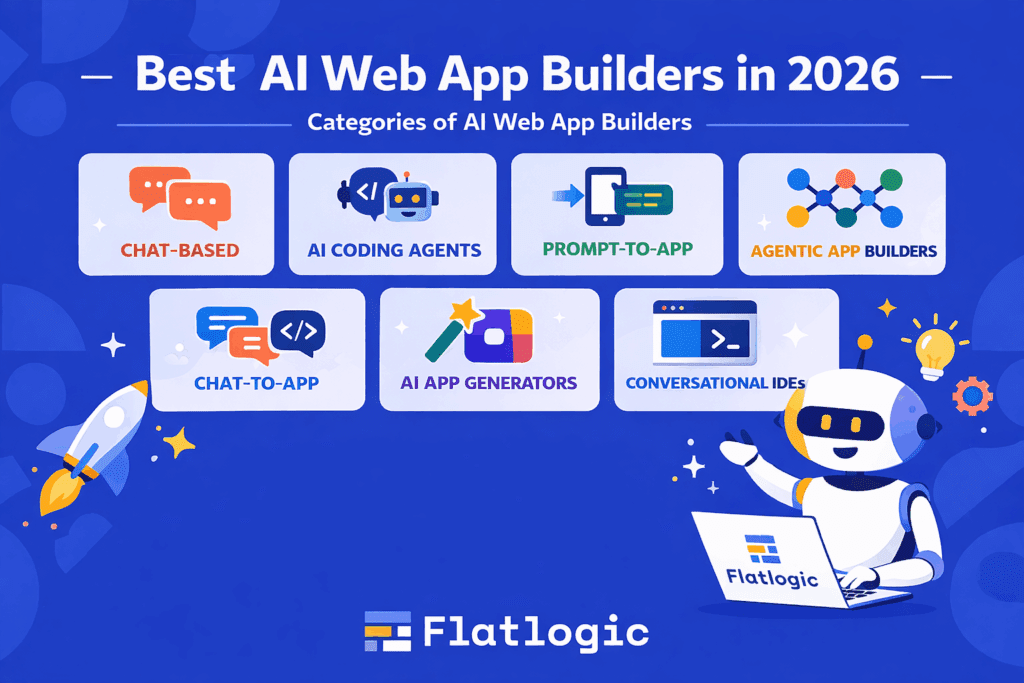
Not all AI web app builders work the same way. In 2026, the ecosystem has clearly split into several distinct categories, each solving a different part of the app-creation problem. Understanding these categories is essential before choosing a tool. Otherwise, it’s easy to compare apples to oranges.
Below, we break down AI web app builders into six practical categories, with real tools placed where they actually belong:
- AI Web App Builders (Chat-Based)
- AI Coding Agents Prompt-to-App Builders
- Chat-to-App Platforms
- AI App Generators
- Agentic App Builders
- Conversational IDEs (Browser-Based)
| Tool | Category | What It’s Best At | AI Capabilities | Code Ownership | Best For |
|---|---|---|---|---|---|
| AppWizzy | Agentic App Builder | Long-living, evolving applications | Agentic AI plans, generates, iterates, and updates apps over time | ✅ Full ownership | Teams building complex SaaS products that continuously evolve |
| Builder.io | Agentic App Builder | Managed app development without engineers | AI-assisted planning, scoping, and delivery orchestration | ⚠️ Limited | Businesses without in-house engineering teams |
| Bubble | Chat-Assisted No-Code Builder | Fast MVPs and no-code experimentation | AI guidance for workflows and app structure | ❌ No | Entrepreneurs validating ideas quickly |
| Replit | AI Coding Agent | AI-accelerated coding inside an IDE | AI code generation, debugging, explanations | ✅ Yes | Developers who want AI help, not abstraction |
| Bolt.new | Conversational IDE | Rapid full-stack prototyping in browser | Chat-driven code generation + deploy | ⚠️ Partial | Technical founders prototyping end-to-end apps fast |
AI Web App Builders (Chat-Based)
These platforms rely on ongoing natural language conversations as the main way to define and evolve an application. Users describe requirements step by step, and the AI continuously refines the app structure.
AppWizzy
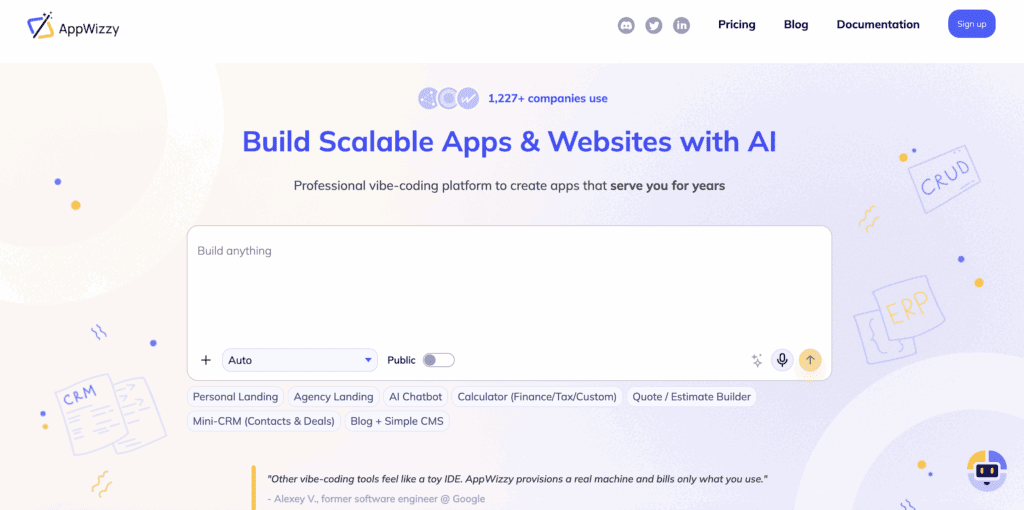
AppWizzy is an agentic AI app builder designed to function as an AI software engineer rather than a one-time code generator. It enables users to create, modify, and evolve full-stack web applications through ongoing interaction, combining AI-driven intent extraction with deterministic, production-grade generation.
AI Capabilities: AppWizzy uses conversational AI to translate high-level requirements into structured application schemas and then applies an agentic workflow to iteratively generate, validate, and update the application at the schema, data, and code levels. The AI assists not only in initial app creation but also in continuous changes, refactoring, and feature expansion over time.
Key Features:
- Agentic, conversation-driven app evolution
- Structured schema-first application generation
- Full-stack output (frontend, backend, database)
- Version-controlled changes with rollback support
- Production-ready code with full ownership
Pricing: Subscription-based (usage and infrastructure dependent)
Strengths:
- Designed for long-living, evolving applications
- No vendor lock-in with full code ownership
- Strong balance between AI automation and engineering discipline
Target Audience: Startups, technical founders, and teams building scalable SaaS, CRM, ERP, or other business-critical web applications that evolve continuously.
Lovable
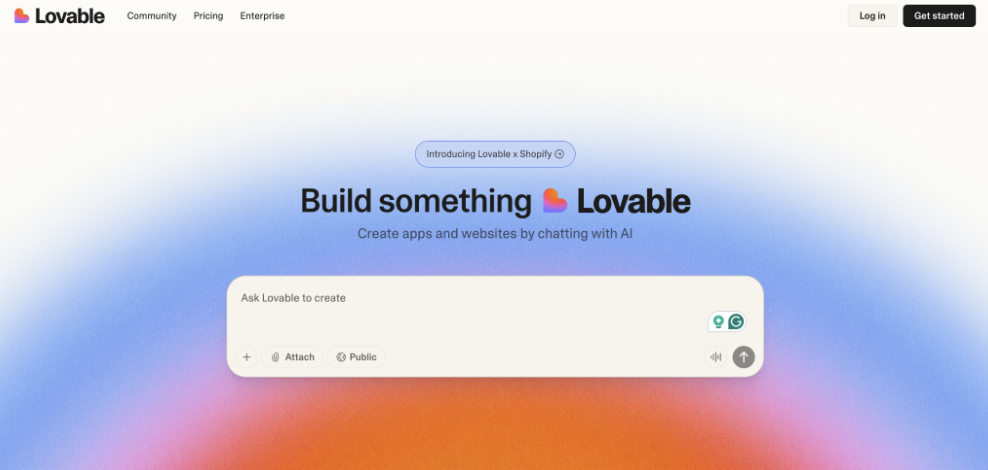
Lovable is a chat-based AI platform focused on creating user-friendly web applications through conversational input, with a strong emphasis on UX and interface design.
AI Capabilities: Conversational AI translates product ideas into UI layouts and interactive components, prioritizing usability and design flow.
Key Features:
- Chat-driven UI generation
- Real-time preview and iteration
- UX-focused components
Pricing: Subscription-based
Strengths:
- Very fast MVP creation
- Accessible to non-technical users
Weaknesses:
- Limited backend depth
Target Audience: Founders and designers building UX-driven MVPs.
Bubble
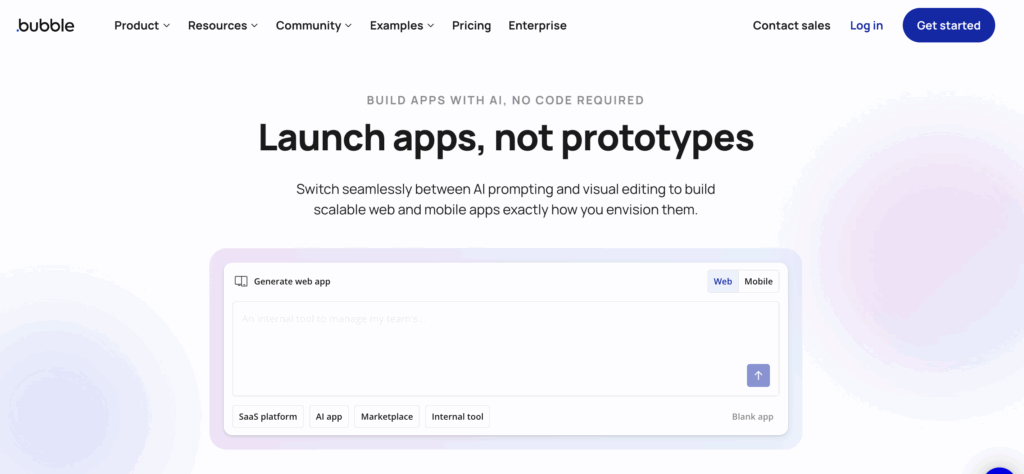
Bubble is a no-code web app builder enhanced with AI-assisted guidance, allowing users to define applications through semi-conversational flows combined with visual editors.
AI Capabilities: AI assists with app planning, workflow suggestions, and feature scaffolding based on user intent.
Key Features:
- Visual UI and workflow builder
- Built-in database
- Plugin ecosystem
Pricing: Free + paid plans
Strengths:
- Flexible for MVPs
- Large ecosystem
Weaknesses:
- Vendor lock-in
- Performance tuning can be difficult
Target Audience: Entrepreneurs and no-code builders.
Memex Tech
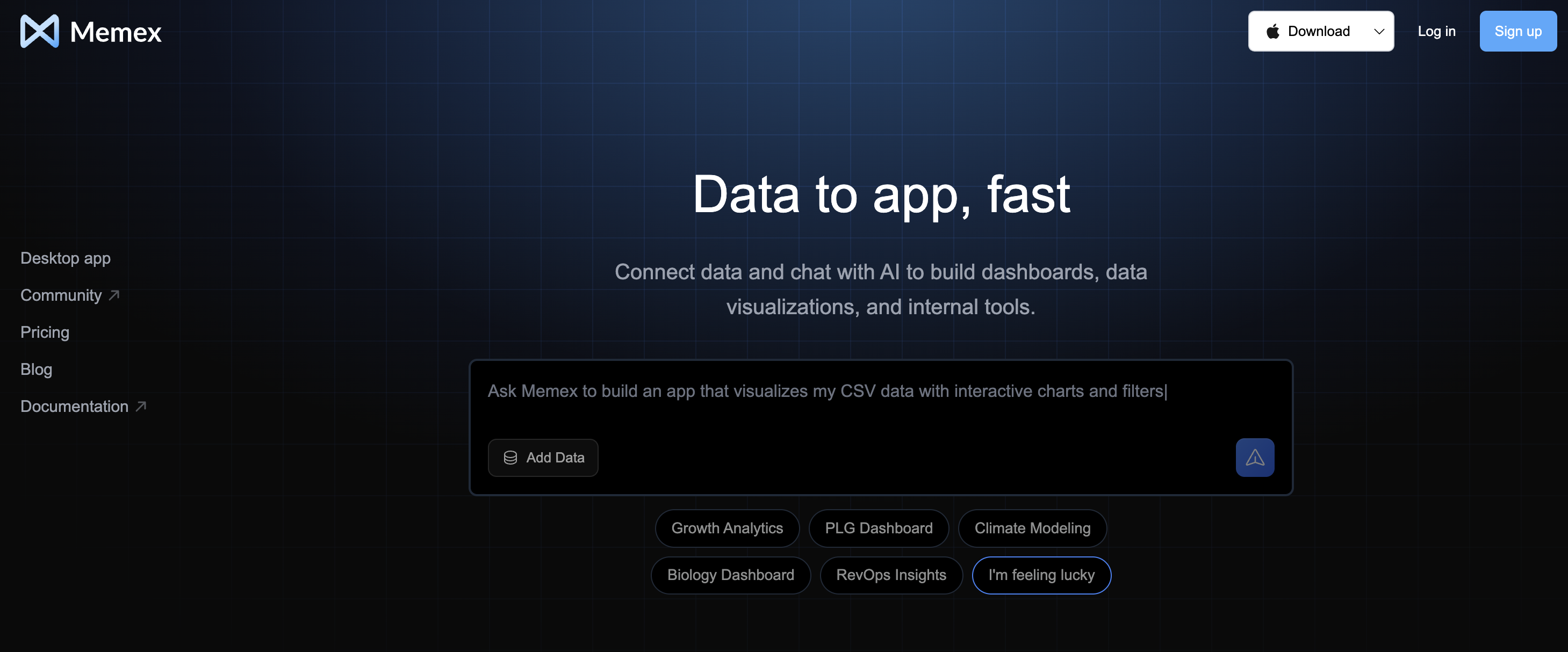
Memex Tech is a local, privacy-focused AI development tool that allows users to generate applications through conversational prompts, running entirely on the user’s machine.
AI Capabilities: Natural language input is converted into application code locally without sending data to external servers.
Key Features:
- Local execution
- Offline support
- Privacy-first architecture
Pricing: Free + Premium
Strengths:
- Strong data privacy
- Offline development
Weaknesses:
- Limited scalability
Target Audience: Developers prioritizing privacy and local workflows.
Agentic App Builders
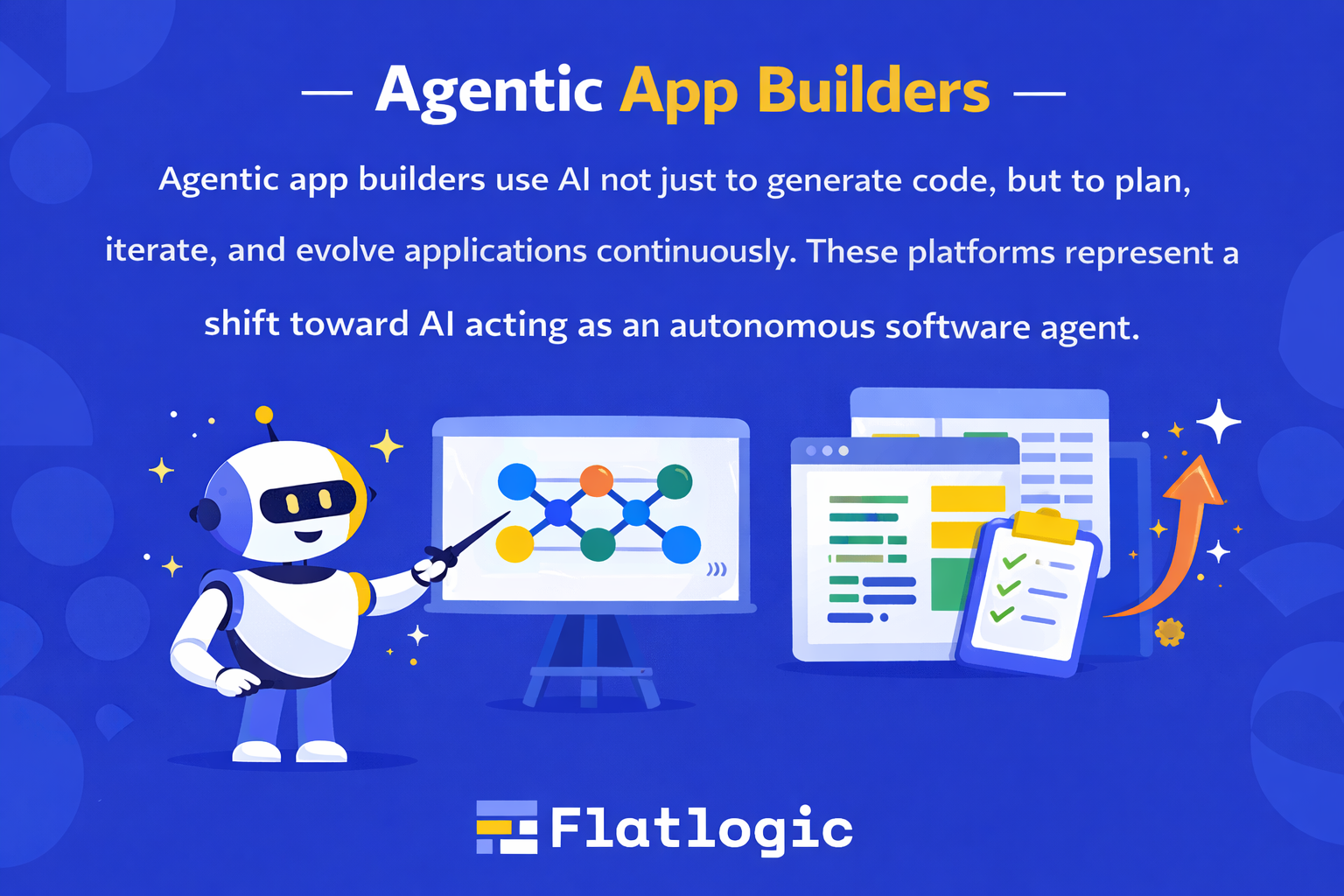
Agentic app builders use AI not just to generate code, but to plan, iterate, and evolve applications continuously. These platforms represent a shift toward AI acting as an autonomous software agent.
Builder.io
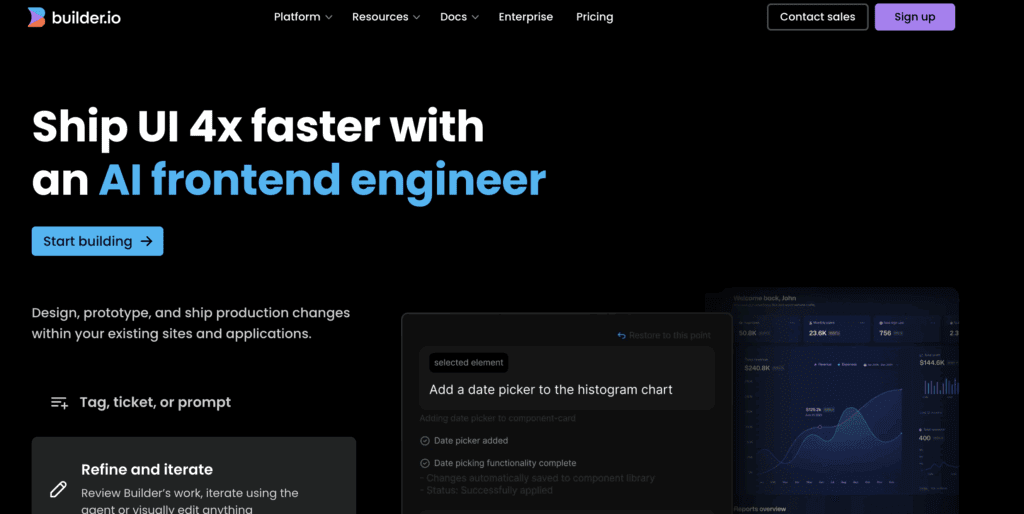
Builder.io positions itself as an AI-managed software development platform offering end-to-end delivery.
AI Capabilities: AI assists with requirement analysis, feature selection, and project coordination across the development lifecycle.
Key Features:
- AI-assisted planning
- Managed development workflow
- Feature-based pricing
Pricing: Feature-based
Strengths:
- End-to-end service
- Suitable for non-technical teams
Weaknesses:
- Limited code transparency
Target Audience: Businesses without in-house engineering teams.
Pythagora
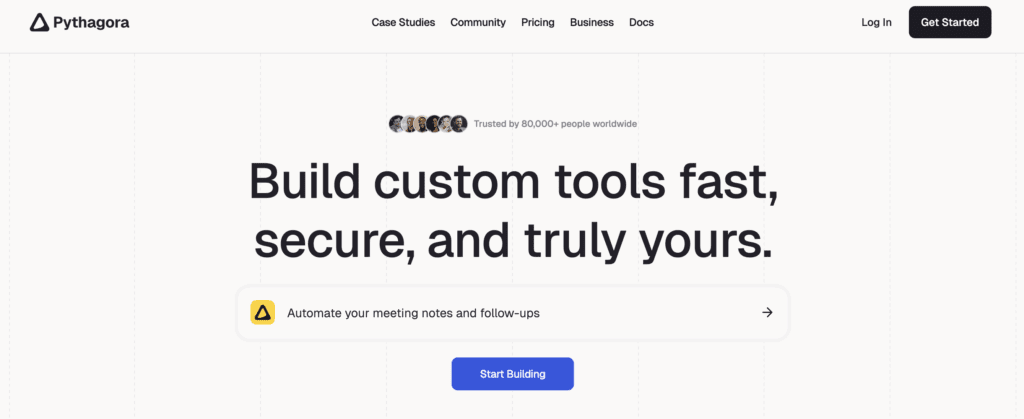
Pythagora is an agentic AI tool that builds applications iteratively, validating and refining outputs across development stages.
AI Capabilities: AI plans, generates, tests, and refines application code in cycles.
Key Features:
- Iterative code generation
- Autonomous refinement loops
- Developer-in-the-loop design
Pricing: Paid plans
Strengths:
- Strong agentic workflow
- Reduced manual iteration
Weaknesses:
- Still experimental
Target Audience: Developers exploring autonomous AI development.
Sweep AI
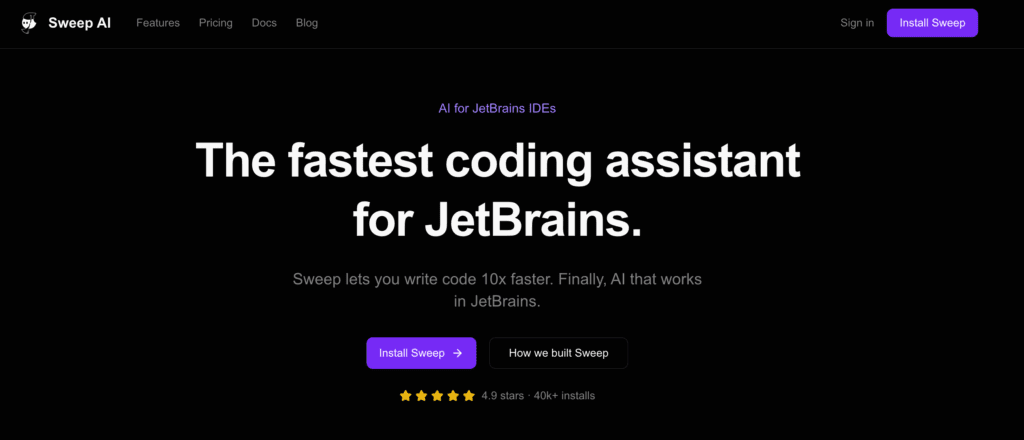
Sweep AI focuses on automated code changes and refactoring through agent-driven workflows.
AI Capabilities: AI autonomously modifies codebases based on high-level instructions.
Key Features:
- Automated code refactoring
- GitHub integration
- Issue-to-code workflows
Pricing: Paid plans
Strengths:
- Reduces maintenance effort
Weaknesses:
- Not a full app builder
Target Audience: Engineering teams managing large codebases.
AutoDev
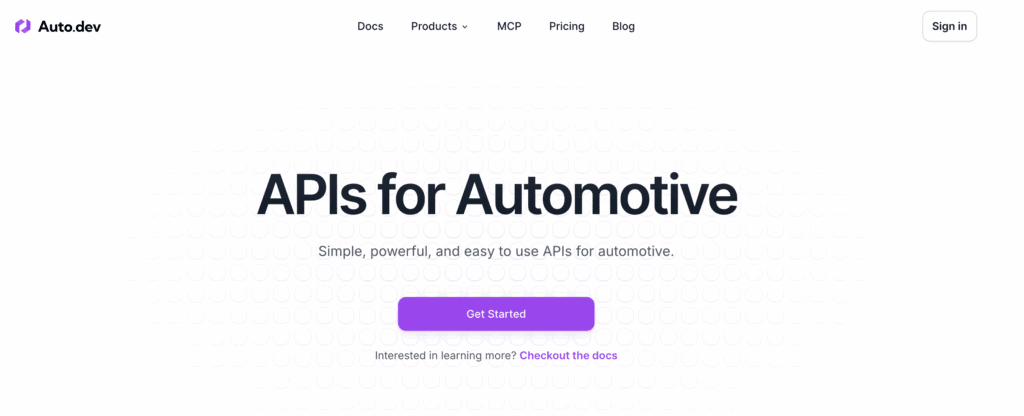
AutoDev is an AI-driven development agent focused on automating software lifecycle tasks.
AI Capabilities: AI plans and executes development tasks with minimal human intervention.
Key Features:
- Task automation
- Code generation and testing
Pricing: Paid plans
Strengths:
- High automation potential
Weaknesses:
- Limited production adoption
Target Audience: Advanced engineering teams.
Cognition (Devin)
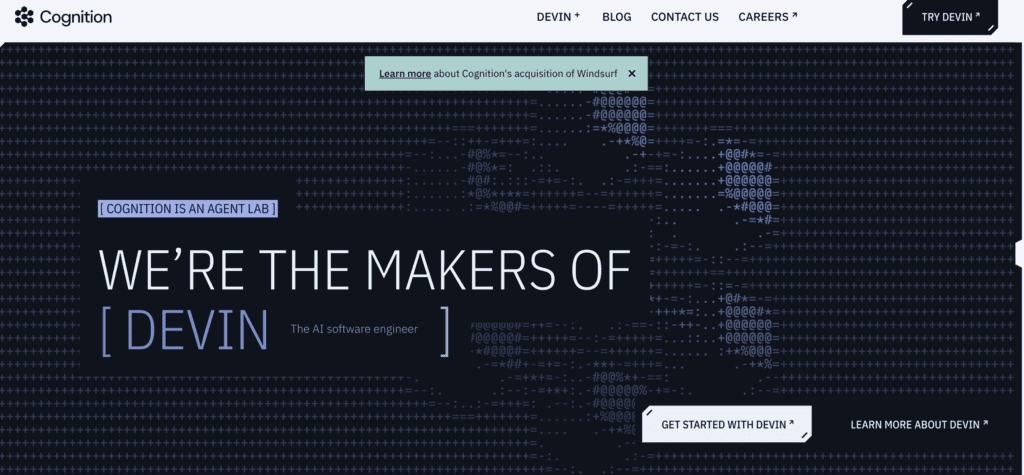
Cognition’s Devin is an autonomous AI software engineer designed to complete end-to-end development tasks.
AI Capabilities: AI autonomously plans, codes, debugs, and deploys applications.
Key Features:
- Autonomous development
- Long-horizon task execution
Pricing: Enterprise pricing
Strengths:
- Breakthrough agentic capabilities
Weaknesses:
- Early-stage and expensive
Target Audience: Research teams and large enterprises.
Prompt-to-App Builders
Prompt-to-app builders generate applications from a single prompt or minimal input, prioritizing speed over iterative refinement.
Capacity
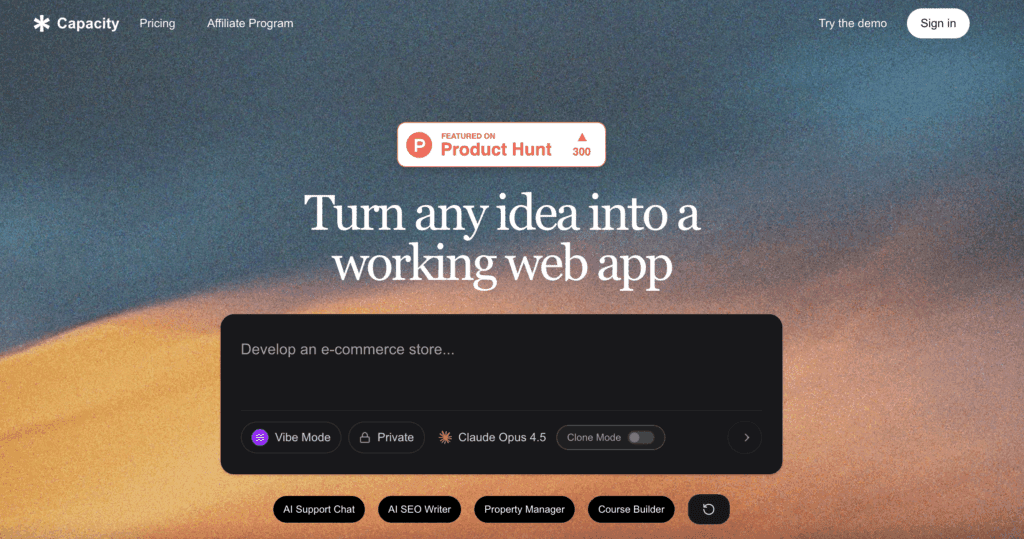
Capacity allows users to generate full-stack web applications from a single textual prompt, focusing on simplicity and accessibility.
AI Capabilities: AI converts one prompt into a functional frontend, backend, and database.
Key Features:
- One-prompt generation
- No-code environment
- Prebuilt templates
Pricing: Free + paid plans
Strengths:
- Extremely fast setup
Weaknesses:
- Limited flexibility
Target Audience: Non-technical founders.
Debuild
Debuild is a prompt-based platform focused on rapidly generating web application UIs and logic blocks.
AI Capabilities: AI generates components and screens from text descriptions.
Key Features:
- Prompt-based UI generation
- Component editing
Pricing: Subscription-based
Strengths:
- Fast UI scaffolding
Weaknesses:
- Backend limitations
Target Audience: Founders prototyping interfaces.
DhiWise

DhiWise is an AI-powered platform that converts prompts and designs into structured application code.
AI Capabilities: AI translates requirements into code-ready structures and APIs.
Key Features:
- Prompt-to-code workflows
- API generation
Pricing: Paid plans
Strengths:
- Structured output
Weaknesses:
- Requires technical validation
Target Audience: Developers accelerating delivery.
Backendless
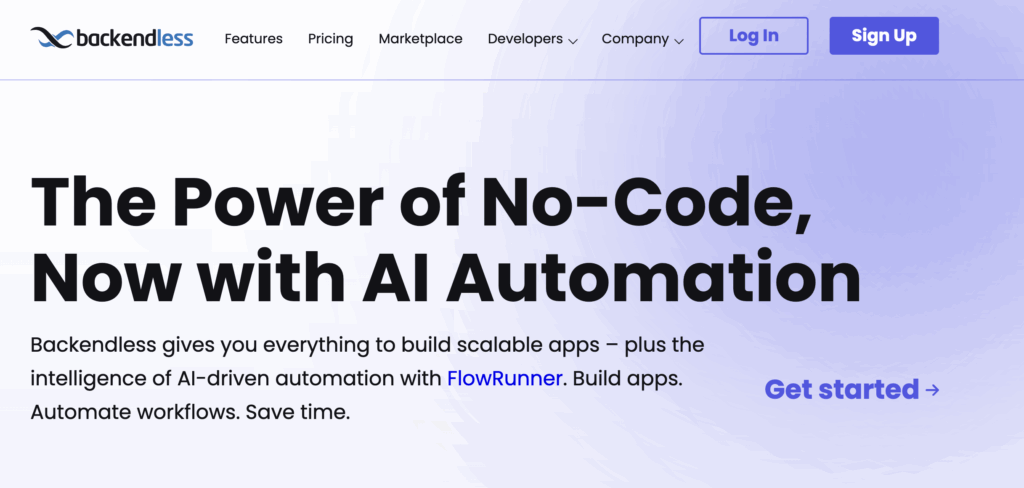
Backendless provides prompt-based backend generation for apps with database and API automation.
AI Capabilities: AI creates database schemas and APIs from text descriptions.
Key Features:
- Backend-first generation
- API automation
Pricing: Free + paid tiers
Strengths:
- Strong backend tooling
Weaknesses:
- Limited frontend
Target Audience: Backend-focused teams.
AI App Generators
AI app generators focus on structured, end-to-end application generation. Unlike simple prompt-based tools, they combine AI-driven intent extraction with deterministic engines that produce consistent, maintainable applications.
UI Bakery AI App Generator
UI Bakery is a low-code platform enhanced with AI to accelerate the creation of internal tools, dashboards, and admin panels. It balances automation with developer control, making it suitable for production use.
AI Capabilities: AI transforms text prompts into CRUD applications, dashboards, and workflows, automatically generating schemas, UI bindings, and business logic.
Key Features:
- AI-powered CRUD and dashboard generation
- Visual low-code editor
- Database and API integrations
- Role-based access control
- Self-hosting support
Pricing: Free + paid plans
Strengths:
- Developer-friendly
- Secure and enterprise-ready
- Transparent, editable output
Weaknesses:
- Focused mainly on internal tools
Target Audience: Developers and enterprises building internal business applications.
ToolJet
ToolJet is an AI-enhanced low-code platform designed for building internal tools quickly while maintaining flexibility and control.
AI Capabilities: AI assists in generating database schemas, queries, and UI components from natural language descriptions.
Key Features:
- Visual builder with AI assistance
- Multiple database and API integrations
- Built-in deployment
- Open-source option
Pricing: Free + paid plans
Strengths:
- Rapid internal tool development
- Strong data integration support
Weaknesses:
- Limited for consumer-facing apps
Target Audience: Teams building operational dashboards and internal tools.
Budibase
Budibase is an open-source app generator that enables fast creation of internal tools with database connectivity and automation.
AI Capabilities: AI assists with schema creation, automation flows, and UI scaffolding.
Key Features:
- Open-source platform
- Built-in database and automation
- Self-hosting support
Pricing: Free + paid plans
Strengths:
- Open-source flexibility
- Strong internal tooling focus
Weaknesses:
- UI customization limitations
Target Audience: Engineering teams need self-hosted internal tools.
Retool
Retool is a developer-focused platform for building internal tools, enhanced with AI-assisted code generation and workflow creation.
AI Capabilities: AI generates code snippets, queries, and UI components based on developer input.
Key Features:
- Drag-and-drop UI builder
- SQL and API integrations
- Custom code support
Pricing: Paid plans
Strengths:
- High flexibility
- Strong developer adoption
Weaknesses:
- Requires technical expertise
Target Audience: Developers building internal business tools
OutSystems
OutSystems is an enterprise-grade low-code platform with AI-assisted development capabilities for large-scale applications.
AI Capabilities: AI supports architecture decisions, performance optimization, and application scaffolding.
Key Features:
- Enterprise low-code platform
- AI-assisted optimization
- Cloud and on-prem deployment
Pricing: Enterprise pricing
Strengths:
- Highly scalable
- Enterprise-ready
Weaknesses:
- High cost
- Complex onboarding
Target Audience: Large enterprises building mission-critical applications.
AI Coding Agents
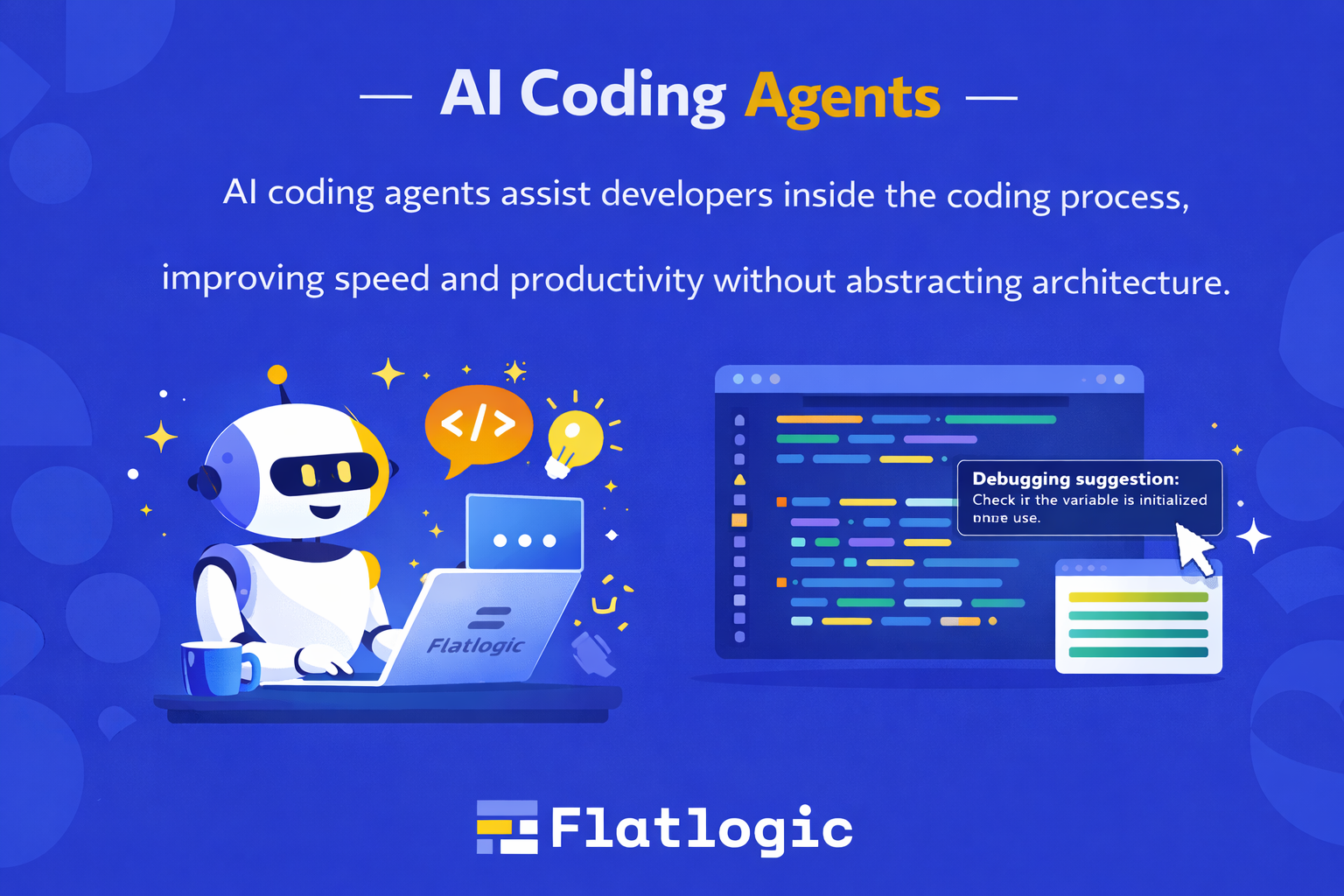
AI coding agents assist developers inside the coding process, improving speed and productivity without abstracting architecture.
Replit
Replit is a browser-based IDE with integrated AI coding agents.
AI Capabilities: AI assists with code generation, debugging, and explanations.
Key Features:
- Browser-based IDE
- Real-time collaboration
- AI-assisted coding
Pricing: Free + paid plans
Target Audience: Developers and teams.
Cursor
Cursor is an AI-first code editor designed to accelerate professional software development.
AI Capabilities: AI deeply understands codebases and assists with refactoring and navigation.
Key Features:
- AI-native editor
- Codebase-aware assistance
Pricing: Paid plans
Target Audience: Professional developers.
GitHub Copilot Workspace
GitHub Copilot Workspace extends Copilot into a task-oriented development assistant.
AI Capabilities: AI helps plan, generate, and review code changes.
Key Features:
- GitHub-native integration
- Task-based workflows
Pricing: Paid plans
Target Audience: Teams working in GitHub-centric workflows.
Codeium
Codeium is an AI coding assistant focused on speed and privacy.
AI Capabilities: AI provides code completion and generation.
Key Features:
- IDE integrations
- Fast inference
Pricing: Free + paid plans
Target Audience: Developers seeking lightweight AI assistance.
Tabnine
Tabnine is an AI code completion tool optimized for enterprise environments.
AI Capabilities: AI predicts and completes code securely.
Key Features:
- Enterprise security
- Multiple IDE support
Pricing: Paid plans
Target Audience: Enterprise development teams.
Conversational IDEs (Browser-Based)
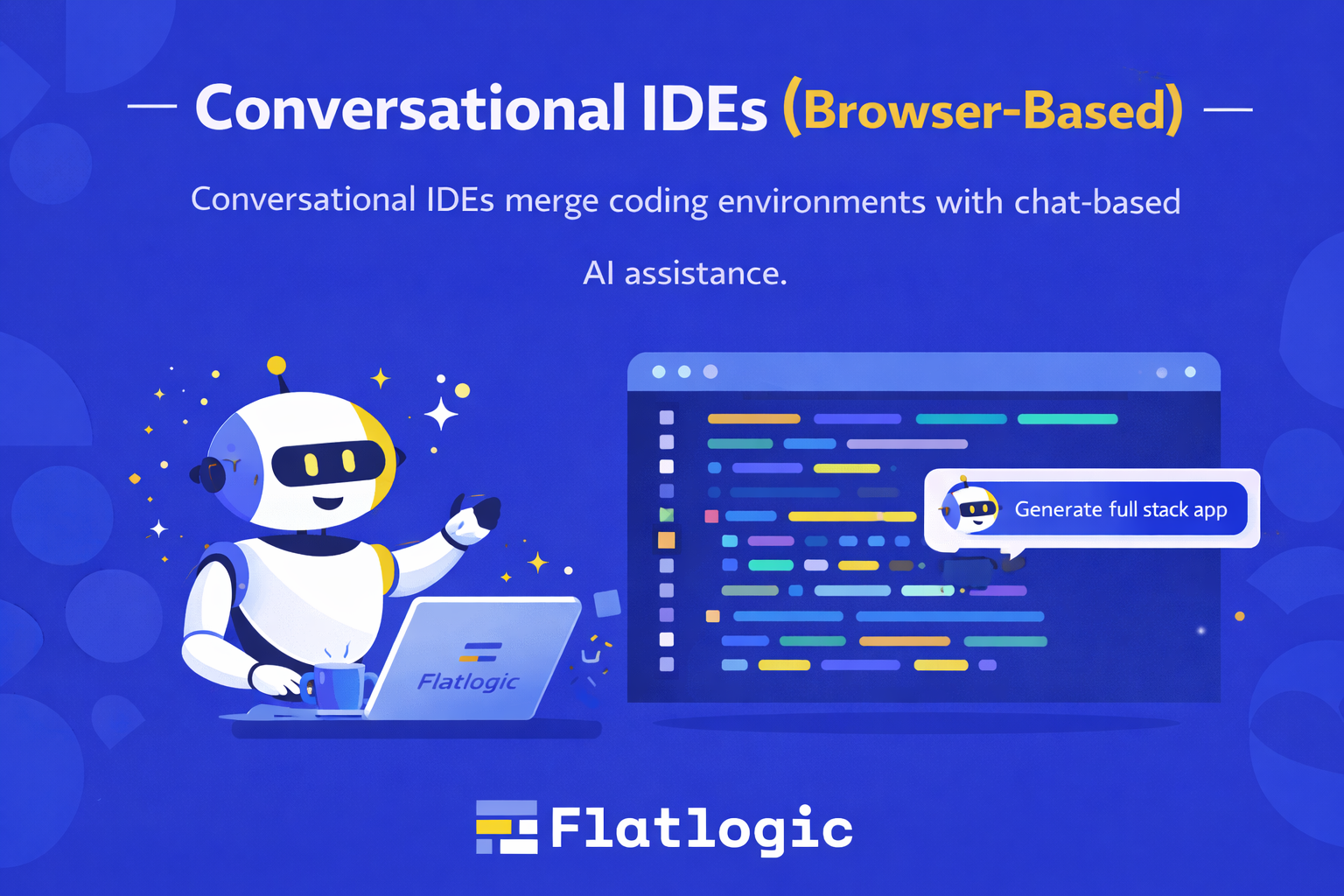
Conversational IDEs merge coding environments with chat-based AI assistance.
Bolt.new
Bolt.new is a browser-based full-stack IDE powered by conversational AI.
AI Capabilities: AI converts instructions into executable code and deployment flows.
Key Features:
- Full-stack IDE
- Chat-driven development
Pricing: Free + paid plans
Target Audience: Technical founders and developers.
v0.dev
v0.dev focuses on AI-powered frontend generation for React and Next.js.
AI Capabilities: AI generates UI components from text prompts.
Key Features:
- React and Next.js support
- Component-based output
Pricing: Free + paid plans
Target Audience: Frontend developers.
StackBlitz AI
StackBlitz AI enhances the StackBlitz IDE with AI-assisted coding.
AI Capabilities: AI helps generate and debug code in-browser.
Key Features:
- Instant dev environments
- AI-assisted editing
Pricing: Free + paid plans
Target Audience: Web developers.
CodeSandbox AI
CodeSandbox AI integrates AI assistance into collaborative browser-based development.
AI Capabilities: AI supports code generation and debugging.
Key Features:
- Collaborative IDE
- Cloud-based workflows
Pricing: Free + paid plans
Target Audience: Frontend teams.
Comparison of AI Web App Builders
Here’s a concise comparison of popular AI web app builders designed to streamline web app and software development.
| Tool | Category | Best For | Code Ownership | Pricing (Typical) | Main Trade-off |
|---|---|---|---|---|---|
| AppWizzy | Agentic App Builders | Long-living apps that evolve via iterative AI changes | ✅ Full | Subscription-based | Not “toy MVP”; best when you’ll iterate seriously |
| Lovable | AI Web App Builders (Chat-Based) | UX-first MVPs from conversation | ⚠️ Partial/depends | Subscription | Backend depth and complex logic are limited |
| Bubble | AI Web App Builders (Chat-Based) | No-code MVPs with workflows + plugins | ❌ No (lock-in) | Free + paid plans | Vendor lock-in + performance tuning can be painful |
| Probz AI | AI Web App Builders (Chat-Based) | CRUD/internal tools without coding | ⚠️ Partial/depends | Paid | Customization depth is limited |
| Builder.io | Agentic App Builders | Managed app delivery for non-technical orgs | ⚠️ Limited | Feature-based | Less transparency/control vs DIY platforms |
| Pythagora | Agentic App Builders | Iterative agentic building + validation loops | ✅ Yes | Paid | Still experimental vs mature platforms |
| Sweep AI | Agentic App Builders | Agent-driven code changes/refactoring | ✅ Yes | Paid | Not a full app builder end-to-end |
| AutoDev | Agentic App Builders | Automating SDLC tasks (generate/test/iterate) | ✅ Yes | Paid | Limited mainstream production adoption |
| Cognition (Devin) | Agentic App Builders | Long-horizon autonomous software tasks | ⚠️ Depends | Enterprise | Expensive + early-stage for many teams |
| Capacity | Prompt-to-App Builders | Fast “one prompt → full-stack app” | ⚠️ Partial/depends | Free + paid | Flexibility drops as complexity grows |
| Debuild | Prompt-to-App Builders | Quick UI scaffolding from prompts | ⚠️ Partial/depends | Subscription | Backend/production depth can be limited |
| DhiWise | Prompt-to-App Builders | Prompt/design → structured code workflows | ✅ Yes | Paid | Requires technical validation & integration |
| AppGyver | Prompt-to-App Builders | Visual logic + assisted creation | ⚠️ Partial/depends | Free + Enterprise | Learning curve, and enterprise fit varies |
| Backendless | Prompt-to-App Builders | Prompt-driven backend (DB + APIs) | ⚠️ Partial/depends | Free + paid | Frontend is not the core strength |
| UI Bakery AI App Generator | AI App Generators | Internal tools/admin panels with AI scaffolding | ⚠️ Partial/depends | Free + paid | Mostly internal tools, not consumer apps |
| ToolJet | AI App Generators | Internal apps with data integrations | ✅ Yes (esp. OSS/self-host) | Free + paid | Consumer SaaS apps are not the sweet spot |
| Budibase | AI App Generators | Self-hosted internal tools fast | ✅ Yes (open-source) | Free + paid | UI flexibility and polish can be limited |
| Retool | AI App Generators | Developer-driven internal tools | ✅ Yes (your code) | Paid | Requires technical skills; pricing can scale up |
| OutSystems | AI App Generators | Enterprise-grade low-code at scale | ⚠️ Limited/depends | Enterprise | High cost + complex onboarding |
| Replit | AI Coding Agents | AI-assisted coding in browser | ✅ Yes | Free + paid | Not a “builder”; you still engineer the app |
| Cursor | AI Coding Agents | AI-first coding for pros | ✅ Yes | Paid | Requires dev skills; not a no-code tool |
| GitHub Copilot Workspace | AI Coding Agents | Task-oriented AI help in GitHub workflows | ✅ Yes | Paid | Best if your team is GitHub-centric |
| Codeium | AI Coding Agents | Lightweight AI completion + generation | ✅ Yes | Free + paid | Less “agentic”; more assistant-like |
| Tabnine | AI Coding Agents | Enterprise-friendly code completion | ✅ Yes | Paid | Primarily completion; not full app creation |
| Bolt.new | Conversational IDEs (Browser-Based) | Rapid full-stack prototyping via chat | ⚠️ Partial/depends | Free tier | Advanced customization + stacks may be limited |
| v0.dev | Conversational IDEs (Browser-Based) | Fast React/Next UI generation | ✅ Yes (UI code) | Free tier | Frontend-only; backend integration needed |
| StackBlitz AI | Conversational IDEs (Browser-Based) | In-browser dev environments + AI assist | ✅ Yes | Free + paid | More “IDE + AI”, not a full builder |
| CodeSandbox AI | Conversational IDEs (Browser-Based) | Collaborative browser dev + AI | ✅ Yes | Free + paid | Best for dev teams, not non-technical users |
Limitations & Challenges of AI Web App Builders
While AI web app builders offer significant efficiency and rapid development capabilities, they come with notable limitations and challenges that developers and businesses must consider:
- Limited Customization Depth
AI app builders are efficient at generating standard, repetitive components, but struggle with complex, unique business logic. Custom workflows or highly specialized integrations often require manual intervention, diminishing their advantage. - Dependence on Training Data
AI-generated outputs depend heavily on the quality and scope of training data. Poorly structured or incomplete data can lead to inaccuracies, misinterpretations, and functional bugs, resulting in suboptimal app performance. - Inflexibility for Edge Cases
While AI handles common scenarios adeptly, it frequently falls short in addressing nuanced or rare edge cases. Such scenarios typically need manual coding, diminishing the value proposition of AI-generated apps. - Risk of ‘Black-Box’ Behavior
AI systems can exhibit “black-box” behaviors, where developers have limited visibility into how specific functionalities were implemented, complicating debugging, customization, and long-term maintenance. - Scalability and Optimization Issues
AI-generated code might initially work well but often lacks the optimization needed for large-scale applications. This can lead to increased resource usage, slower performance, and higher costs at scale. - Security Vulnerabilities
AI models may unintentionally introduce security flaws due to outdated libraries, poor practices, or oversights not caught during automated code generation. These risks require thorough security audits and manual reviews. - Difficulty in Migrating Legacy Systems
AI web app builders currently excel in new applications but often struggle with accurately capturing legacy data structures and migrating complex legacy systems. This limitation restricts their effectiveness in enterprise environments with significant existing infrastructure.
In summary, AI web app builders immensely speed up development and broaden who can create software, but they don’t eliminate all software development challenges. One must still practice good design, be mindful of limitations, and involve professional developers or IT for critical applications. Knowing when an AI web app builders is “good enough” and when to invest in custom development is key (we discuss that next). As the saying goes, with great power comes great responsibility – the power to build quickly with AI must be paired with careful consideration of these challenges.
Future Trends in AI Web App Development
The future of AI in web app development points to even more automation and intelligence in software creation. The role of human developers will evolve to define goals, constraints, and creative vision, while AI handles more of the assembly and iteration. Software development might become more of a high-level design activity – telling smart systems what you need in broad strokes and polishing the results – rather than writing low-level code. As these trends unfold, we expect building software to become increasingly like working with a very knowledgeable assistant who can handle grunt work and let humans focus on innovation and user experience.
AI Web App Builders vs. Traditional Development
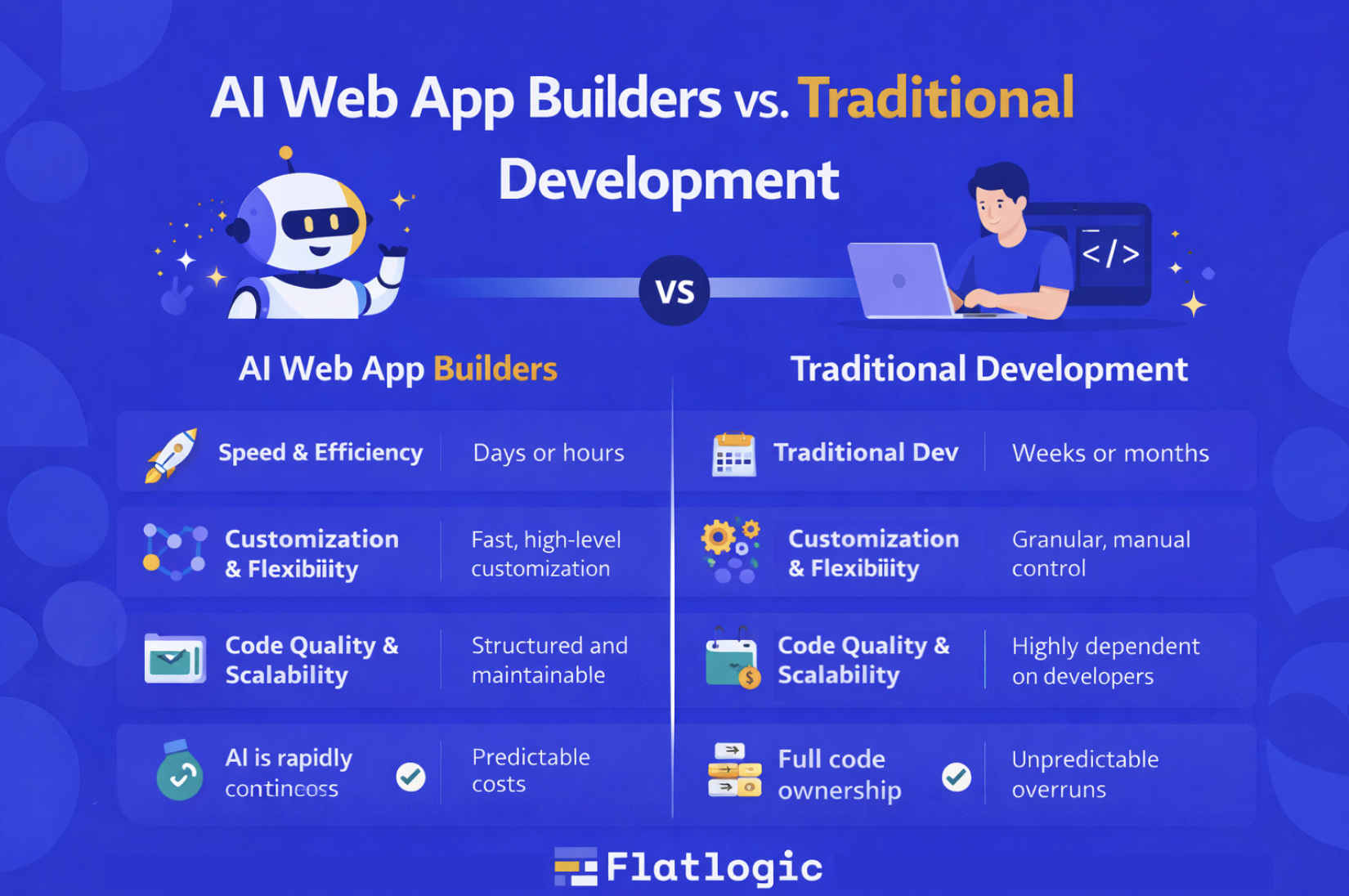
In today’s fast-paced digital landscape, choosing the right development approach can significantly impact your project’s success. Here’s a no-nonsense comparison between AI web app builders and traditional development methods.
Speed & Efficiency:
- AI web app builders: Generate functional apps (CRM, ERP, SaaS) in days, sometimes hours.
- Traditional Dev: Weeks or months, dealing with planning, repetitive coding, and debugging.
Customization & Flexibility:
- AI web app builders: High-level customizations (entities, roles, integrations) fast. Less granular control initially, but evolving quickly.
- Traditional Dev: Absolute granular control, but it costs more time and money. Every detail requires manual work.
Code Quality & Scalability:
- AI web app builders: Structured, consistent, maintainable code by design – no “AI hallucinations.”
- Traditional Dev: Quality highly dependent on individual developer skills; can vary greatly.
Cost Management:
- AI web app builders: Predictable, lower initial costs, faster ROI. Ideal for MVPs and startups.
- Traditional Dev: Unpredictable costs, frequent overruns, higher long-term expenses for maintenance and debugging.
Ownership & Control:
- AI web app builders: You own the code – easily extendable and portable.
- Traditional Dev: You own the code, but portability and ease of extension vary wildly based on initial development quality.
The Harsh Reality
Traditional development is not dying yet, but it’s quickly becoming the expensive, slower option. AI Web App Builders – especially hybrid systems like Flatlogic that merge AI with deterministic generation – deliver faster, cleaner, and more scalable results without sacrificing code ownership or future flexibility. AI is eating traditional dev’s lunch – time to embrace the inevitable or risk falling behind.
Summary
AI web app builders are dramatically changing software development in 2026 by enabling businesses and developers to build robust, scalable apps (CRM, ERP, SaaS) in days rather than months. These platforms utilize AI to automate UI design, backend database creation, workflow automation, and continuous optimization – cutting down development time and cost significantly. While AI web app builders provide high efficiency and structured, maintainable code, challenges such as limited customization depth, potential security vulnerabilities, and scalability issues must be carefully managed.
Flatlogic stands out for delivering fully customizable, scalable enterprise applications rapidly, with full source code ownership, supporting popular frameworks.
Ready to skip the coding chaos and build scalable apps smarter and faster? Start your app today with Flatlogic.
Comments