


TL;DR
- Traditional custom MVP quotes can hit $120k and 5 months; AI can compress first versions to weeks when used well.
- AI shifts spend from boilerplate to security, architecture, QA, and core business logic; smaller teams can launch sooner.
- AI doesn’t remove product risk: failure often comes from building the wrong thing, unclear scope, and weak validation.
- Code quality and security still need human ownership; unreviewed AI code can create costly technical debt and risk.
- Flatlogic is presented as an AI agent that generates a full-stack codebase from plain English while keeping code ownership.
Fact Box
- A typical custom MVP is quoted at $40,000–$120,000 and takes 10–16 weeks, citing Keyhold Software and Teacode.
- 3rd-party integrations (payments, mapping, messaging) can add 1–2 weeks of research and testing beyond the base timeline.
- Design and prototyping are described as consuming 10%–20% of a software project budget.
- Medium data is cited: software project failure rates are roughly 66%, driven by unclear requirements and scope creep.
- The article claims routine tasks see 35%–45% time savings with AI-assisted development, strongest in boilerplate/scaffolding.
A founder building a basic MVP this year can still get a quote for $120,000 and five months of tedious work. I know, because I got one. What I didn’t know yet was that almost nobody has to accept that quote anymore. I was about to find out the hard way that founders who don’t know it yet are the ones who overpay for a version of software development that’s already disappearing.
When I first started following the changes in software development, I landed on several questions that most startup founders still ask today:
- Can AI actually build custom software, or is it just another productivity tool?
- Will AI now replace software developers?
- How quickly can startups launch products using AI-driven development?
- Is AI suitable for every stage of custom software development?
I came away with my answer in something Satya Nadella, Microsoft’s CEO, mentioned years before I started asking these questions out loud.
“AI is not just a tool for automation. It’s an enabler for augmentation.”
Here, he wasn’t describing a world without engineers. He was explaining about a world where two people can do what earlier used to take a team of six. And that’s the world I ended up building.
What I learned along the way is that the cost of getting software wrong hasn’t dropped at all. I dug into the data shared by Medium, which found that software project failure rates are roughly 66%, driven by unclear requirements and scope creep rather than bad code.
PMI’s research also caught my attention, as it reports that 43% of projects face budget overruns, and the patterns worsen for larger and more complex builds. Then there was CB Insights, which reported a 42% failure rate for startups that built something nobody wanted. None of that risk disappeared for me, only because AI entered this scenario. What changed was that I could test more ideas before running into new challenges.
So, let me share a map I put together for myself. Some of it I could handle on my own. While some of it clearly required professional expertise from custom software development services. In either case, this covers where AI actually stands in the process today, what it has changed for my cost and team structure, and where I still couldn’t trust it to work independently, and what all of this appears to be once I started to discuss with other founders building right now, in cities across the country.

Terminology I Had to Learn First
Before I could understand all of this, I had to learn a couple of key terms first.
| Term | What it Means |
| MVP | Minimum Viable Product is the smallest operating version of a product that addresses one real problem and collects authentic user feedback. |
| SDLC | The software development lifecycle is a sequential process in which software passes through stages from discovery to maintenance. |
| LLM | A Large Language Model is an AI model, such as Copilot, GitHub Copilot, or Cursor, trained to handle large volumes of text and code to generate, explain, or edit software on request. |
| AI Agent/ Agentic AI | An AI system that plans multi-step tasks and takes actions such as editing files or running tests with no manual work or human intervention required. |
| Low-code/ No-code | Platforms that enable people to build apps through visual interfaces instead of manually written code. |
| CI/CD | Continuous Integration and Continuous Deployment are automated pipelines for testing and shipping new code. |
| Technical Debt | Extra rework a team does due to shortcuts, including unreviewed AI-generated code taken earlier. |
| DevOps | The practices and tooling that connect development and IT operations govern how code moves into the live, tracked production environment. |
Keeping this vocabulary handy, here’s where I actually found AI changing the entire workflow.
How Custom Software is Built
During my initial phase of custom software development, I came across projects that followed the same stepwise process, from planning to launch.
This is the traditional timeline that I was quoted:
- One to two weeks to gather requirements and technical specifications
- One to two weeks for wireframes and design
- Six to twelve weeks for development, built screen-wise, and integration by integration
- Manual testing had to be rushed to meet strict deadlines
- A release or launch process handled manually or with minimal automation
Where I Realized the Budget Actually Went
- Under this model, a typical custom MVP costs between $40,000 and $120,000. Also, it took 10 to 16 weeks, according to benchmarks from Keyhold Software and Teacode.
- The maximum budget went into work that was not at all product-oriented.
- CRUD forms, authentication screens, database migrations, and admin dashboards recur across projects. However, it had to be rebuilt from scratch each time.
- 3rd-party integration added to the delay. A mapping API, a payment gateway, or a messaging service could add one to two weeks of research and testing beyond the base timeline.
- Design and prototyping alone consumed 10% to 20% of the total project budget. Skipping this step also led to expensive rework within the initial year.
The breakdown here changed how I looked at every quote after that. What I found is how much of the custom software development cost was going into authentication, integrations, and admin dashboards instead of a single feature that made my project unique. I realized that AI could handle most of the repetitive tasks that used to eat up my time.

Five Ways I Watched the Shift Actually Play Out
Here’s what I noticed that changed the way my software was actually built.
Speed and Time-to-Market
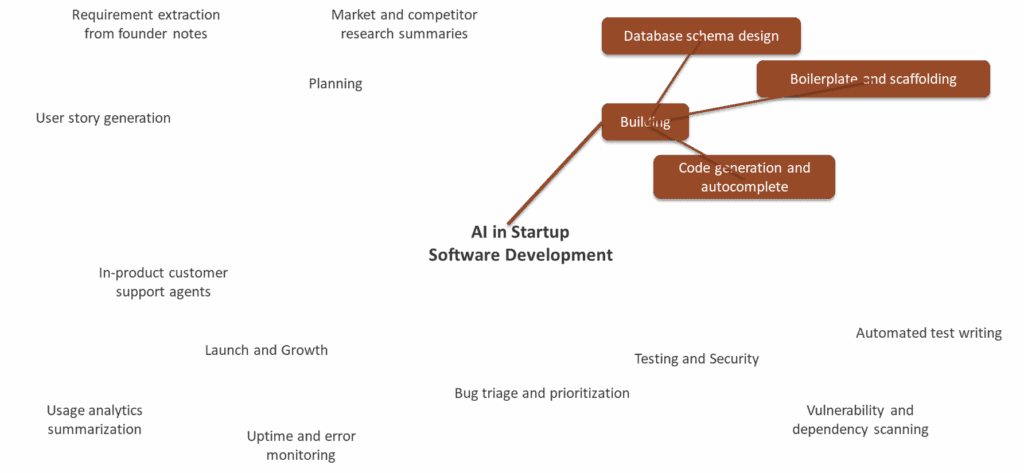
I was told that my MVP would take at least 3 to 6 months before any real users could use it. With the help of AI, the same journey was completed in weeks. It helped me generate scaffolding, database schemas, and first-draft code instantly. This allowed me to test demand way sooner than expected.
What changed on my timeline:
- A database schema is created on the same day
- The first draft of the test suites is automated
- Faster user feedback loops for prototypes
- Weeks today take the place of months for validation
The outcome: My idea reached a user within weeks, not quarters. This redefined the risk of premature stages in my mind.
Cost Structure and Budget Allocation
Previously, all expenses in our development budget were attributed to the hourly wages for manually written boilerplate code. By employing AI, I could allocate more of my budget to areas that require human input, such as security, architecture, and business logic.
Where I watched the money move:
- No overspending on the boilerplate screen
- Reduced cost per simple feature
- Budget directed towards QA and architecture
- Smaller teams are required for launch
This wasn’t cheaper, but it turned out to be a corner-cut product for me. It was a budget-friendly spend on 40% of the work that was the toughest to overcome.
Team Composition and Hiring
The traditional agency team of four to six people- a designer, a project manager, two or three developers, and a QA engineer wasn’t the only path I discovered to a working first version.
In my case, it was fewer roles and more judgment:
- One senior engineer who covered for more
- AI handled all repetitive coding layers
- Hiring has changed and focused on security expertise
- Reduced junior-level roles
What I found: AI didn’t replace experience. It only allowed experienced professionals to focus on more important decisions.
Code Quality, Testing, and Security
This is exactly where my situation turned complicated, and I would have regretted skipping it. AI wrote code promptly. However, faster output didn’t translate into safer, more reliable, or more secure software.
Where I saw founders get burned:
- AI drafts tests while humans verify edges
- High-risk rates without reviews
- Automated scanners detect a few issues
- Developers’ trust in AI is declining
Speed without a thorough review is how technical debt starts to build up in a product before it hits the launch date. So, I ensured mine didn’t.
Ongoing Growth, Maintenance, and Support
The change didn’t stop for me on launch day. AI became part of how my product got tracked, maintained, and supported once real users were depending on it every day.
Life after my launch day:
- Prompt detection of downtime and errors
- AI agents handling first-line support
- Documentation remains automatically updated
- Usage analytics gets summarized immediately
Post-launch, AI helped free up my engineering time for the features that moved the product forward.
The AI-Augmented Software Development Lifecycle I Followed
Here’s exactly how that change looked for me compared to the linear, all-human version that most of the industry grew up with.

The loop never removes the manual review steps. It compresses everything around them, so the dead time between decisions disappears rather than the decisions themselves.
The AI Tooling Landscape Startups Are Actually Using
Founders exploring this domain tend to run across three major categories of tools. Confusing them becomes a common source of misaligned expectations.
| Category | Function | Use Scenarios |
| AI Coding Assistants | Recommends code to complete minor fixes within an existing workflow | Pacing up an entire engineering team instead of any replacements |
| Agentic Coding Tools | Plans and executes several tasks, including scaffolding and a whole feature | Reducing time dedicated to repetitive development tasks |
| AI App Generators | Develops a working executable codebase from English product descriptions | Getting from an idea to a real MVP without cheating any team |
Each category solves a different problem. A coding assistant makes an existing developer faster. An agentic tool reduces the manual work in a build that a team already knows how to do. An AI app generator changes who can start a build in the first place, which matters most for a non-technical founder trying to get a first version in front of users.
Where AI Shows Up Beyond Just Code
The Numbers That Mattered for My Budget
The estimates vary by research. However, the direction remains consistent across different major analysts covering this space.
| Metric | Figure | Source |
| Global custom software development market, 2026 | Roughly $51 billion to $66 billion | Mordor Intelligence, Grand View Research, Precedence Research |
| Projected market size by early to mid 2030s | Roughly $115 billion to $147 billion | Grand View Research |
| Annual growth rate (CAGR) | Roughly 17% to 23% | Aggregate of the major 2026 industry reports |
| Global AI spending, 2026 | $2.5 trillion, a 44% jump year over year | Gartner |
| Share of newly written code that is AI-assisted | Over 46%, projected to reach 60% by year-end | Industry analyst aggregation |
| Startups that fail from building the wrong thing | 43% | CB Insights |
| Enterprises shipping untested AI-generated code | 60% | Tricentis Quality Transformation Report |
Why This Mattered Most for Me as a Small Team
AI writes more code today, and the leading cause behind a startup’s fallback has nothing to do with code quality. It is about quickly developing something wrong.
The team’s under-10 figure is the one I kept returning to. AI-assisted development wasn’t the only advantage for well-funded departments in my experience. More than half the team that captured the real value from these tools is small, like mine. That narrowed the gap that had previously benefited better-funded competitors.
The AI Tools I Actually Ended Up Using
I never required all the categories below to work in unison. Trying to use them all in one day would have required a week’s worth of setup work, rather than focusing on the actual product.
AI pair programmers
Works live within a code editor and completes code as I type. This is ideal for those who are already writing code.
Autonomous coding agents
After I’d already decided on the core framework, this tool handled the task from planning and coding to testing and opening a pull request with minimal supervision.
AI-native full-stack generators
Helped me develop a working front-end, back-end, and database schema from a plain-English description. It was the quickest starting point before I had an engineer.
AI testing and security tools
It closed the trust gap. Meaning it added checks and testing, helping developers ensure the code is safe and reliable before release.
AI project and documentation assistants
It summarized meetings and converted my notes into structured user stories. This ensures that everyone on my small team has a clear idea of what needs to be developed without a dedicated project manager.
Here, I ended up combining two or three categories instead of treating any single one as a complete replacement for the rest. The appropriate combination relied less on my budget and more on the development stage I was actually in.

What I Saw on Main Street: Startups Coast to Coast
- In Austin, TX, I came across a three-person fintech team that implemented AI-based development to launch a compliance dashboard for a credit union. The total timeframe included seven weeks instead of the four months an agency would have estimated.
- I also found various early-stage SaaS founders serving in the greater Seattle area. They are now budgeting for a lean AI-assisted MVP. This added a full engineering team only after paying customers justified it.
- AI tools offer an immediate prototype for LA-based consumer app founders. But senior engineers are brought in before launch to detect issues with security and scalability.
- I also learned about a health-tech founder in Boston, MA, who implemented AI to create a HIPAA-adjacent data schema. They invested real budget in a human security review before real patient data was entered.
- There are founders in Raleigh-Durham who explained the same pattern to me. Fewer waiting periods in an agency queue, with more weeks spent discussing with users.
- I also heard about a two-founder logistics startup in Denver, CO, that freed up its limited budget for the driver-facing mobile app, which required custom engineering.
The common thread I found wasn’t the city. It was a sequential process of validating cost-effectively with AI, then investing in real risks.
What This Meant for My Fundraising
Investors adopted this shift faster than I realized. Earlier, a working prototype was an option at the pre-seed stage of development. By the time I raised funding, using AI in software development had become a norm rather than an exception.
An AI-assisted development changed how my conversation unfolded with investors in a couple of effective ways:
- A functioning demo that replaced a slide-deck mockup during my early pitches
- My burn rate appeared lower since I required fewer contractors ot reach the initial version
- Traction data from real early users arrived sooner, building my seed-round narrative
- Technical monitoring increased prompting, which part of my codebase was AI-generated, and whether it had been reviewed
The last point brought mixed results for me. Investors grew more comfortable with AI-assisted development. But they became sharper about asking whether the technology behind the demo could handle the growing demand as the product grew.
The Catch I Ran Into: What AI Still Couldn’t Do
The areas where my startup faced the most uncertainties were also where AI was least reliable. Compliance-heavy data handling, architecture decisions, and nuanced business logic continued to require an experienced human, in my case.
According to a peer-reviewed study by METR, experienced developers working on the same complex codebases were 19% slower with AI, including review time, even after accounting for time saved. That’s exactly what I saw. Security was the real concern, too. Several reports have found that AI-generated code poses a high risk without adequate review.
AI failed to validate my idea. It developed faster, but the speed was never my bottleneck. It was understanding my customer. Someone had to own the architecture. I learned that unreviewed AI code accumulates technical debt that costs two to three times as much to resolve later.
None of these actually argued against the use of AI. They debated on their own, with a clear owner for the parts they developed, where mistakes proved expensive.
How I Actually Used AI in My Build
- I wrote down the single-core workflow my product targeted, and resisted adding anything else to the initial version
- I used AI to generate a functioning prototype of that one workflow, not a refined full-feature app
- I got that prototype in front of five to ten real users before the other code I wrote
- I brought in an experienced engineer to review the framework and security before real data or money touched the product
- I added AI in the loop for consistent testing, documentation, and monitoring, while a human holds the ownership of anything that is customer-oriented or compliance-sensitive
That workflow wasn’t the shortcut around sound engineering. It was where shortcut AI enabled should stop and where a human expert should start.
Flatlogic’s Approach to AI-Assisted Development
I built on Flatlogic to balance my workflow. It’s an AI software development agent that converted my plain-English product description into a workable codebase. It included a database schema, authentication, and a deployable front end, reducing my time-to-market from months to days or weeks.
Every single line of code that was generated was under my ownership. This removed the risk of vendor lock-in I’d worried about with a no-code platform. When my product outgrew what the generator could handle on its own, Flatlogic’s engineering teams stepped in. The team delivered SaaS platforms, CRM and ERP systems, and client portals for startups and B2B companies with weekly releases and a code-based design for product handover.
If you plan to build, I’d speak with one of Flatlogic’s engineers before writing a specification document. It’s an immediate way to get a realistic timeline and budget without involving any vendor calls.
The Bottom Line for Founders
- AI has meaningfully compressed the cost and timeline of my custom software development, with routine tasks seeing 35% to 45% time savings.
- The gains were strongest in boilerplate and scaffolding and weakest in the novel business logic that gave my startup its edge.
- Small teams like mine were among the biggest beneficiaries, narrowing a gap that once favored only well-funded competitors.
- The risk was real: unreviewed AI-generated code carries measurable security and stability exposure.
- The right evaluation question was never whether a vendor uses AI, but whether that speed is paired with code ownership, engineering judgment, and a maintenance plan that still makes sense a year later.
AI hasn’t removed the difficulty of building a good product for me, but it has changed what I spend my limited time and money on. I wasn’t chasing every new feature release. I used AI to clear away repetitive, well-understood work so my judgment could stay focused on the decisions that actually determined whether my startup survived: what to build, who it was for, and how quickly I could prove that in front of real users.
Comments