


TL;DR
- Lovable: fastest to polished demo and simplest for non-coders, but risks cleanup and complexity ceilings
- Bolt.new: browser IDE with AI help and portable deploys; strong control but token costs can spike
- Replit: full cloud IDE with Ghostwriter; powerful and flexible, yet steeper for non-technical users
- Flatlogic: generates investor-ready code with CI/Docker; higher upfront effort, fewer rewrites later
Fact Box
- GitHub reports AI pair-programming cuts routine coding time by up to 55%. Source
- McKinsey estimates generative AI could add up to $4.4 trillion in annual productivity by 2030. Source
- Lovable can deliver a functional web demo in under 10 minutes for typical apps.
- Bolt.new typically scaffolds a project in about 8-10 minutes after you choose a stack.
- Flatlogic generates a full-stack app with database, auth, tests, CI, and Docker out of the box.
If you’re choosing an AI app builder, the real cost isn’t the subscription – it’s the rewrite you may be forced into later.
Most founders are trying to answer the same four questions:
- Can I ship an MVP fast enough to test demand?
- Will the code survive real users, real changes, and technical diligence?
- Can non-technical teammates contribute without constantly pulling a senior engineer into the loop?
- What costs explode when the app stops being a demo?
AI can meaningfully accelerate development. In controlled studies, developers completed certain tasks ~55% faster with GitHub Copilot. But speed doesn’t guarantee a scalable architecture, and that gap is where startups burn time and runway.
This guide compares Lovable, Bolt.new, Replit, and Flatlogic across the things that matter when you move from “it works” to “we can build a company on this”: speed, maintainability, hosting, ownership, pricing behavior, and how painful the last mile becomes.
Why this comparison matters
In 2025, an early-stage founder can ask a chatbot for an app and, minutes later, watch a live prototype pop into existence. Speed is wonderful, but it hides a trap: the first tool that produces something shiny is not always the one that can carry you through investor due diligence, enterprise security reviews, or the grinding reality of user-feature requests six months from now.
Four platforms dominate the “prompt-to-production” conversation:
| Platform | One-sentence identity |
| Lovable | “Tell me what you want, I’ll build a polished web app and host it for you.” |
| Bolt.new | “Chat with an AI pair-programmer, see the code live, and export whenever you like.” |
| Replit + AI | “A full cloud IDE super-charged by Ghostwriter – anything you can code, you can build faster.” |
| Flatlogic / AppWizzy | Schema-driven generation + AI-assisted iteration aimed at maintainable full-stack business apps. |

All four ship working software from natural-language prompts, all export real source code, and all are dramatically cheaper than hiring a developer for one sprint. But they differ – sometimes sharply – in philosophy, depth, and the cost of going the last mile. The stakes: wasting a month on the wrong tool could eat your runway or cost the momentum you need to close a seed round.
TL;DR cheat sheet
Before you scan the cheat-sheet, here’s the 30-second tour of each platform. Lovable is the sprint-to-UI builder that turns a chat prompt into a live web app in minutes. Bolt is a token-metered browser IDE where an AI pair-programmer assembles the stack as you watch and tweak, and Replit is a full cloud development environment whose Ghostwriter accelerates anything you can already code.
AppWizzy goes a step further – it’s an AI software engineer that builds, edits, and deploys real, production-ready applications inside live development environments. You describe your app in plain English (or voice, or screenshots), and AppWizzy spins up a full-stack VM with React, Node.js, Django, or LAMP – complete with schema, database, roles, auth, CI/CD, and Docker – ready for real users and real traffic.
| Dimension | Lovable | Bolt.new | Replit | AppWizzy (by Flatlogic) |
|---|---|---|---|---|
| Learning curve for a pure non-coder | Easiest – pure chat and one-click deploy | Easy for simple projects, steeper for complex tasks | Moderate – still an IDE with file trees | Conversational setup; no-code entry point, but supports full developer handoff |
| Speed to functional MVP | Minutes | Minutes – plus token cost if you iterate heavily | Minutes for prototypes, hours if you refine | Minutes to deploy a live, editable environment; hours to finalize a production-grade MVP |
| Depth & scalability of code | Good for typical CRUD – refactor later | High-standard frameworks, visible code | Unlimited – you own everything | Enterprise-ready architecture with schema, roles, CI/CD, and Docker from day one |
| Built-in hosting | Yes – auto URL, custom domain | Preview only – deploy yourself | Yes – live URL, scalable via Cloud Run | Yes – live VMs and Docker deploys to Google Cloud Run or self-hosting |
| Typical sweet spot | Stylish landing pages, lightweight SaaS, internal dashboards | Full-stack web or React-Native mobile where you’ll tinker with code | Full-stack web or React-Native mobile, where you’ll tinker with code | Investor-ready SaaS, CRM, ERP, and management systems needing long-term maintainability |
| Pricing vibe | Freemium ~$20/mo Pro – predictable | Token-metered – budget if you iterate a lot | Free core + ~$10-20/mo Ghostwriter | Credit-based “pay-as-you-build” model – transparent and scalable with usage |
| Strategic risk | May hit complexity ceiling; exported code might need cleanup | Token burn on large projects; still requires dev know-how | Non-tech founders can feel lost in IDE land | Anything atypical or algorithm-heavy: education, dev teams |
AppWizzy (by Flatlogic)
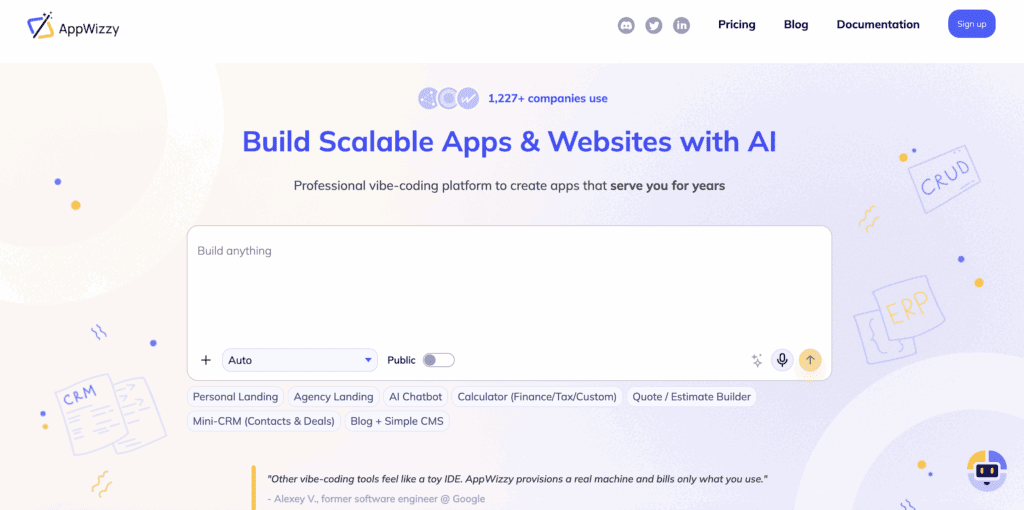
AppWizzy is an AI-powered software engineering platform designed for building production-grade business applications, not just UI demos. It targets founders and teams who want AI speed without sacrificing architectural discipline, code ownership, or long-term maintainability.
Instead of generating code directly from prompts, AppWizzy first converts requirements into a structured application schema (entities, relationships, roles, permissions, workflows). That schema is then compiled into a full-stack codebase using deterministic generators, with AI assisting in interpretation, iteration, and changes.
A typical AppWizzy project includes:
- Front-end – React (Next.js) or other supported frameworks
Typed components, role-aware UI, CRUD screens generated from schema - Back-end – Node.js / Django / LAMP (depending on stack)
Structured APIs, authentication, authorization, and business logic - Database – PostgreSQL / MySQL
Schema migrations, relations, and access rules generated automatically - Infrastructure – Docker + CI/CD
Cloud-ready deployment (e.g., Google Cloud Run) or self-hosting support
Users describe the application in plain English (or iteratively refine it), while AppWizzy maintains a consistent underlying structure. Changes are applied at the schema or code level rather than by rewriting large parts of the app, reducing regression risk as complexity grows.
Generated projects are connected to Git from day one, fully exportable, and intended to be extended by developers as a normal codebase.
Primary benefit:
Produces investor- and enterprise-ready codebases with predictable structure, making it suitable for SaaS products, CRMs, ERPs, and internal management systems that are expected to evolve over years.
Primary limitation:
Initial setup requires more upfront thinking about data models and workflows than prompt-only builders. While non-technical founders can define structure, deeper customization still benefits from developer involvement.
Lovable
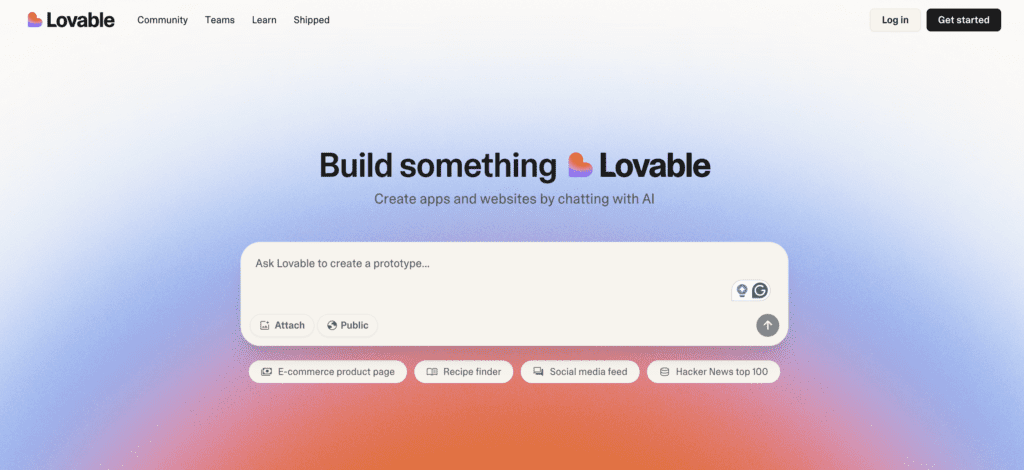
Lovable is an AI-assisted application generator aimed at non-technical founders who need to produce functional web products rapidly. Users describe the desired application in plain language (e.g., “Notion-style event planner with dark mode and Stripe payments”). Within minutes, Lovable provisions a full-stack project:
| Layer | Technology | Details |
| Front-end | Next.js + Tailwind CSS | Mobile-first, accessible components, hot-reload preview |
| Back-end | Supabase (PostgreSQL) | Row-Level Security is enabled, and real-time API endpoints. |
| Infrastructure | Lovable managed edge | Built-in authentication, analytics, and zero-config hosting |
Subsequent changes are likewise expressed conversationally (“Make buttons pill-shaped”), after which Lovable rewrites the underlying code and refreshes the live preview. A ZIP export or direct GitHub push is available, though most clients remain on Lovable’s managed runtime until advanced requirements emerge.
- Primary benefit: Functional, payment-enabled demos can be shipped the same day, giving founders immediate validation.
- Primary limitation: Edge-case requirements – custom indexing, complex multitenancy, and region-specific data residency – often exceed the platform’s AI refactoring capabilities, requiring manual code intervention post-export.
Bolt.new
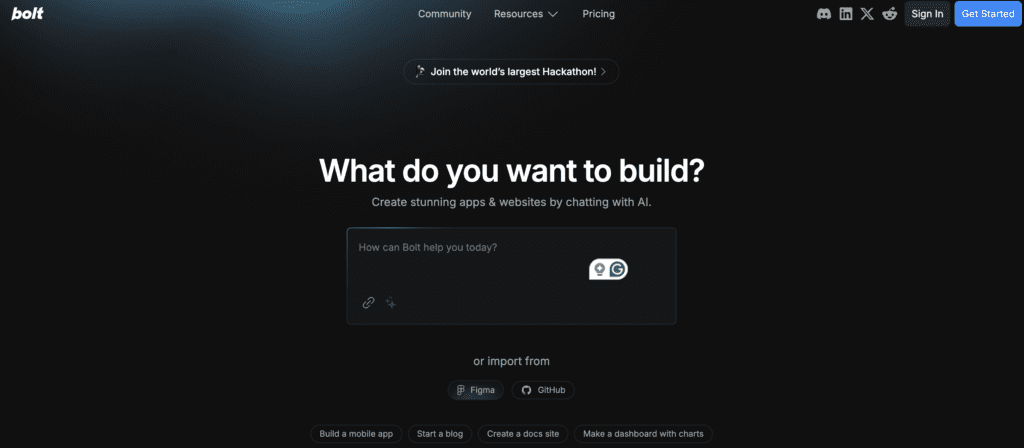
Bolt.new combines a ChatGPT-style conversational sidebar with a full browser-based IDE (Monaco editor and integrated terminal). Users select a technology stack – Next.js, Vue 3, Astro, React Native, Go, Rust, and others – then request features (“Add OAuth with GitHub”) that Bolt implements by modifying actual project files and installing dependencies.
Deployment
Projects deploy to standard targets such as Vercel, Netlify, Fly.io, AWS ECS, or a private Docker registry, and no proprietary runtime is introduced, ensuring portable infrastructure.
- Primary benefit: Experienced teams can remain entirely in the browser – coding, testing, deploying – while preserving full control over every file and configuration.
- Primary limitation: Billing is usage-based (tokens consumed by the AI). Iterative fine-tuning of sophisticated applications can become costly unless budgets are set or minor edits are performed manually.
Replit (with Ghostwriter)
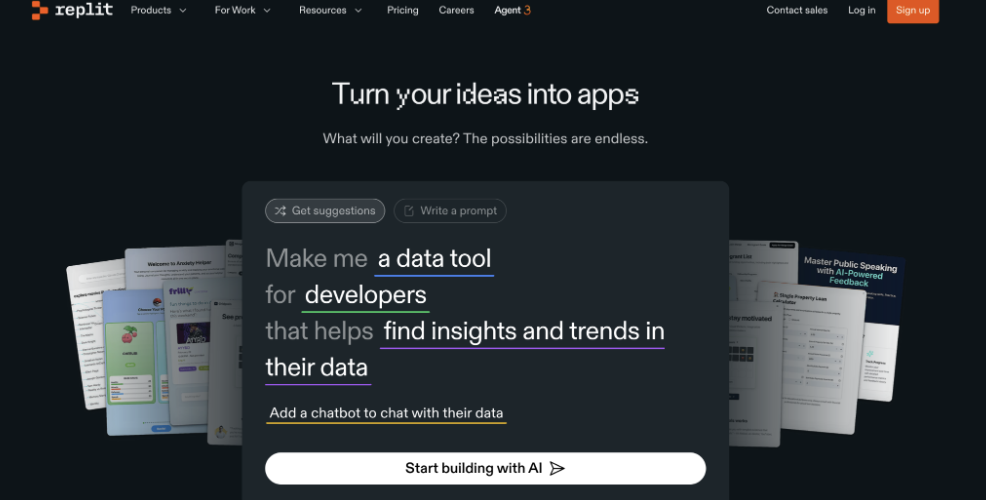
Replit is a cloud IDE supporting 50+ languages. Ghostwriter – its integrated AI assistant – extends the environment by generating boilerplate projects, refactoring existing code, and writing unit tests. A single prompt (“Flask app with Redis cache and OAuth”) initializes a runnable project, complete with a live URL.
| Capability | Description |
| Code generation | Full project scaffolds in languages such as Python, JavaScript, and Rust |
| Refactoring | Breaks large functions into smaller units and adds test coverage |
| Cross-language translation | Converts code snippets between supported languages |
Paid plans keep containers permanently online or deploy to Google Cloud Run, and users maintain root access to every environment.
- Primary benefit: Maximum flexibility – collaborative editing, broad language coverage, and on-demand AI support – suitable for education, prototyping, and production workloads.
- Primary limitation: It remains a traditional IDE. Users without foundational knowledge of HTML, CSS, or command-line tooling should expect a learning curve or involve technical collaborators.
Below is a grounded, detailed comparison of four notable platforms – Lovable, Bolt.new, Replit, and Flatlogic – across critical software development dimensions. This analysis is written for founders, product leads, and engineering managers evaluating build-versus-buy decisions, platform suitability, and long-term maintainability.
Deep Dive Into Critical Dimensions
Speed to a Working Demo
Why this matters: In the early phase of a product, being able to show something tangible – whether to a stakeholder, investor, or team – can have a disproportionate impact.
- Lovable delivers extremely fast results. A short conversation produces a working web UI with basic back-end and hosting. In most cases, a functional demo can be live in under 10 minutes. Ideal for mockups and pitch validation.
- Bolt.new is nearly as fast. After choosing a tech stack, the AI scaffolds a project in 8-10 minutes. The process includes real code generation and package installation, which may add time depending on project complexity.
- Replit is fast for users with programming experience. Generating and launching a simple app can take minutes. For less experienced users, the setup time increases as they navigate an IDE environment and external documentation.
- Flatlogic focuses on foundational correctness over raw speed. Defining the application schema takes 10-15 minutes, after which the platform generates a complete full-stack codebase. While the code may take a day or two to customize or polish, it eliminates weeks of repetitive engineering work.
Conclusion:
Use Lovable for immediate demo needs. Use Flatlogic when the end goal is investor-ready architecture or a system intended to evolve.
Code Quality and Maintainability
Why this matters: Many early-stage projects survive beyond MVP. A weak or inconsistent codebase becomes a bottleneck during scaling, hiring, or technical diligence.
- Lovable generates acceptable code for front-end and basic back-end logic. It uses standard tools like React and Tailwind, but logic can be overly nested or abstracted in ways that reduce readability and increase refactoring cost.
- Bolt. New aligns closely with open-source community patterns. Every line of code is transparent, and the developer retains full control. This makes it easier to audit, extend, and refactor compared to more opaque generators.
- Replit depends on prompt quality. Ghostwriter can write mid-level developer-grade code, especially when guided well. But without clear direction, results may be inconsistent or inefficient.
- Flatlogic prioritizes production-quality code generation. It uses typed ORMs, opinionated layering, consistent folder structures, Dockerized deployment, and integrated CI. The result is a codebase that meets most senior engineering standards and is easier to maintain or hand off to a new team.
Conclusion:
Flatlogic produces the most durable codebase out of the box. Bolt provides strong transparency and extensibility. Lovable and Replit are better suited for early-stage experiments than long-term systems.
Accessibility for Non-Technical Founders
Why this matters: Many early-stage products are built without a full-time engineering team. A tool’s ability to empower non-developers is a significant differentiator.
- Lovable offers the most accessible experience. The chat-based interface abstracts nearly all complexity. Errors can be resolved automatically, and UI changes can be requested in plain English.
- Bolt.new begins as a conversational assistant but transitions quickly into a development environment. It is usable by ambitious non-developers but assumes some technical fluency.
- Replit is a traditional IDE. It provides power and flexibility but requires basic programming literacy. Beginners may struggle with the interface, terminology, and error resolution.
- Flatlogic uses a wizard-driven interface to capture application schema and roles. As long as the user can think in terms of business entities and workflows, they can succeed. Advanced changes after generation will require a developer.
Conclusion:
Lovable is best suited for solo founders without engineering backgrounds. Flatlogic works well for business founders who can define logic and workflows, especially if developer help is available later.
Scalability and Infrastructure Flexibility
Why this matters: Platforms that can’t scale or migrate without major rewrites often impose hidden costs later in the product lifecycle.
- Lovable hosts applications on its managed infrastructure, suitable for small-to-medium workloads. For larger deployments or regulatory requirements, exporting the code and self-hosting becomes necessary.
- Bolt.new is fully infrastructure-agnostic. Projects can be deployed to any modern hosting environment – Netlify, Vercel, AWS, Docker registries – without vendor lock-in.
- Replit offers hosted containers and now supports Google Cloud Run exports. It’s flexible for deployment but less suited to enterprise infrastructure models.
- Flatlogic is designed with enterprise flexibility in mind. It includes Docker and Ansible deployment scripts, allowing teams to deploy to any cloud or on-prem environment immediately after generation.
Conclusion:
Flatlogic and Bolt.new offer the most flexibility for teams with long-term infrastructure needs or compliance constraints. Lovable is excellent for fast starts but requires migration planning later.
Customization and Lock-In
Why this matters: Exporting code is not the same as being able to extend and maintain it. Readability, consistency, and structure are key to post-export usability.
- Lovable exports readable code, but the AI sometimes introduces deeply nested or inefficient structures. Most teams will need to spend time cleaning up.
- Bolt.new provides full visibility throughout the generation process. Developers retain control and context at all times, making future changes straightforward.
- Replit gives full control but is prompt-dependent. It lacks structural consistency unless enforced manually.
- Flatlogic produces code using predictable, widely adopted conventions. It’s optimized for handover, team collaboration, and long-term extensibility.
Conclusion:
For products expected to grow or face technical diligence, Flatlogic provides the cleanest and most maintainable base. Bolt.new is strong for teams who want total control from day one.
Application Scope and Use Case Fit
- Lovable is ideal for marketing sites, UI-heavy prototypes, lightweight SaaS dashboards, and validation demos. It does not support native mobile or complex back-end logic well.
- Bolt.new supports full-stack web apps, mobile apps via React Native, microservices, and API servers.
- Replit is a general-purpose development environment. It supports everything from educational Python scripts to smart contracts, provided the user can write or generate code.
- Flatlogic is designed for structured, data-centric web applications: CRMs, ERPs, admin panels, B2B SaaS, booking systems, inventory platforms, and internal tools.
Pricing and Real-World Cost
Why this matters: Many founders underestimate total cost by only comparing subscription fees. AI usage, support, and developer involvement often have a greater impact.
- Lovable: Free to start, typically $20-$30/month when actively used for hosted MVPs.
- Bolt.new: Low base fee but usage-based pricing tied to AI token consumption can increase costs significantly for complex or iterative work.
- Replit: Free IDE, $10/month for Ghostwriter access. Compute and storage costs scale with use.
- Flatlogic: One-time generation fee. After that, most cost comes from developer time and deployment infrastructure, not the platform itself.
Community and Support
- Lovable has an early but active Discord community. Support is responsive but limited in depth due to the platform’s age.
- Bolt.new is developer-focused, with open-source forks and community experimentation emerging.
- Replit has a massive, global user base. It includes forums, AI support, and a growing bounty system for paid help.
- Flatlogic has a smaller, business-centric user community. Support is direct and technical, with strong documentation and reliance on well-known open-source technologies (React, Node.js, PostgreSQL).
Why AppWizzy May Be the Most Sustainable Long-Term Choice
AppWizzy, born from over a decade of Flatlogic’s experience building production-grade business apps, represents a new phase in AI-powered development: agentic, transparent, and truly production-ready. Unlike one-shot generators that stop at scaffolding, AppWizzy stays involved – continuously reasoning, editing, and deploying inside real dev environments.
Its strength lies in architectural discipline paired with AI agility. Founders can describe their product in plain English, while developers inherit a clean, typed, and standards-based stack (React, Node.js, Django, or LAMP) without translation overhead. Every generated project includes schema, roles, authentication, CI/CD, Docker, and database migrations – ready for real teams, not just demos.
AppWizzy’s hybrid engine combines AI for intent interpretation with deterministic templates for structure, producing consistent, maintainable code that passes investor and compliance scrutiny. The result is software that scales – from pre-seed prototypes to enterprise deployments – without the painful rewrite most AI-built MVPs require.
Choosing AppWizzy signals technical maturity: it’s a statement that your team values transparency, portability, and ownership over black-box speed. While you may invest slightly more upfront, you save months – and six figures – avoiding rebuilds, platform lock-in, and tech debt later.
In short, AppWizzy isn’t just an app generator; it’s an AI software engineer that helps you build once, scale indefinitely, and stay investor-ready from day one.
Conclusion
The allure of AI-generated software is real – and in 2025, it’s no longer a novelty. It’s a powerful lever for speed, cost efficiency, and iteration. But that same speed can be dangerous. Choose the wrong platform, and you’ll find yourself rebuilding under pressure – from users, investors, or compliance demands.
Lovable is excellent for quick demos and polished prototypes, especially for solo founders validating ideas fast. Bolt.new empowers technical founders with full control and an AI pair-programmer that works transparently in the browser. Replit remains the most open-ended option, ideal for developers who want to experiment in a cloud IDE.
AppWizzy, meanwhile, represents where AI app building is headed – a continuous, intelligent development environment that blends Flatlogic’s production-grade foundation with real-time AI iteration. It doesn’t just generate code; it stays with you through debugging, schema updates, UI changes, and deployments. It’s built for teams that want startup agility without sacrificing engineering integrity.
If Lovable gets you to a demo, AppWizzy gets you to a business. It bridges founders and developers, letting non-technical users spin up complete SaaS, CRM, or ERP systems, and letting engineers refine them with clean, typed, and portable code.
Your choice should align with your stage, your skill set, and your ambitions. If all you need is validation, start lightweight. But if you’re building something meant to last – something you’ll raise money on, hire for, and scale – choose a platform that won’t collapse under its own shortcuts.
In AI web development, as in startups, the costliest mistake isn’t moving too slow – it’s building the wrong thing too quickly.