


TL;DR
- AI won’t replace developers soon; developers who use AI well will outperform those who don’t.
- AI excels at boilerplate, code completion, debugging help, test/doc generation, and rapid prototyping.
- Humans remain essential for architecture, security, QA, and long-term maintenance of production systems.
- Startups win by combining AI speed with experienced engineers’ judgment to ship faster and cheaper.
- Flatlogic Generator targets this gap by generating production-ready app foundations so teams can skip weeks of setup.
Fact Box
- AI can generate an initial app foundation (UI, backend logic, DB schema, APIs) in minutes, but needs human review for production.
- AI can narrow down likely causes of errors in seconds instead of hours, but developers must verify fixes.
- The article says human oversight remains essential for architecture, security, testing, and long-term maintenance.
- Flatlogic can generate web apps with auth, databases, CRUD, admin panels, role-based access, APIs, and deployment-ready architecture.
- Using a generator like Flatlogic lets startups skip weeks of repetitive setup and focus on differentiating features.
AI won’t replace software developers, but developers who effectively use AI will outperform those who don’t. The startups that understand this shift early will build faster, spend less, and reach the market before their competitors.
Startup founders are asking the same questions:
- Will AI replace software engineers?
- Should startups hire developers or rely on AI coding tools?
- What can AI actually build today?
- How should startups combine AI and engineering teams to move faster?
As Andrew Ng famously said: “AI is the new electricity”.
Like electricity transformed every industry without replacing every worker, AI is transforming software development, not by eliminating developers, but by fundamentally changing how they work.
This shift is already measurable. AI coding assistants are becoming part of everyday engineering workflows, with studies from organizations such as McKinsey & Company, GitHub, and Stanford University showing significant productivity improvements when developers use AI effectively. At the same time, researchers consistently find that human oversight remains essential for architecture, security, testing, and long-term maintenance. The challenge for startups isn’t deciding between AI and developers, it’s learning how to combine them into a competitive advantage.
By the end of this article, you’ll understand:
- Why AI isn’t replacing software developers anytime soon
- Which development tasks AI performs exceptionally well
- Where human engineers remain irreplaceable
- How startups should organize AI-assisted engineering teams
- Why AI-assisted software engineering is becoming the new industry standard
- How platforms like Flatlogic help startups build production-ready software faster
Why Everyone Is Talking About AI Replacing Developers
Few technologies have generated as much excitement, and anxiety, as generative AI.

Every week brings another headline claiming that software engineers will soon become obsolete. AI can generate code in seconds, create entire applications from prompts, fix bugs, write documentation, and even explain complex algorithms.
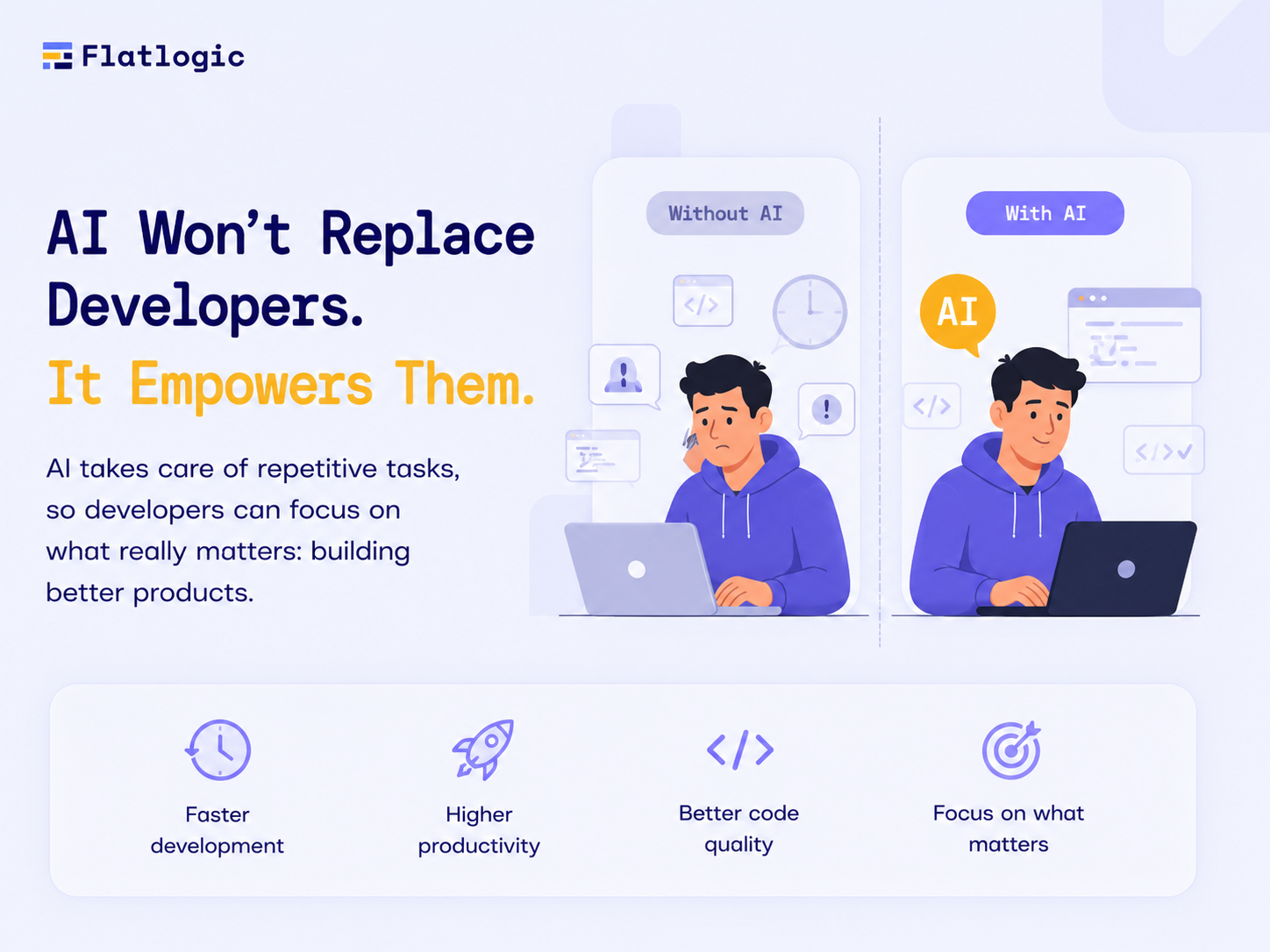
From the outside, it seems inevitable that developers are becoming unnecessary. But reality is considerably more nuanced.
Today’s AI models are extraordinary at generating code. They’re less effective at understanding business strategy, making architectural trade-offs, or maintaining large production systems over time. Building software isn’t simply writing code.
It involves understanding users, translating business goals into technical requirements, designing scalable systems, making security decisions, coordinating teams, reviewing changes, testing edge cases, managing deployments, and evolving products for years after launch.
These activities require judgment, not just code generation. Instead of replacing developers, AI is changing what developers spend their time doing.
What AI Is Already Excellent At
Artificial intelligence has become an indispensable part of modern software development, but its greatest strength isn’t replacing engineers, it’s eliminating repetitive work. Today’s AI coding assistants can generate high-quality code, explain complex systems, identify bugs, and automate time-consuming development tasks in seconds. For startups, this means faster product development, shorter release cycles, and the ability to build more with smaller engineering teams.
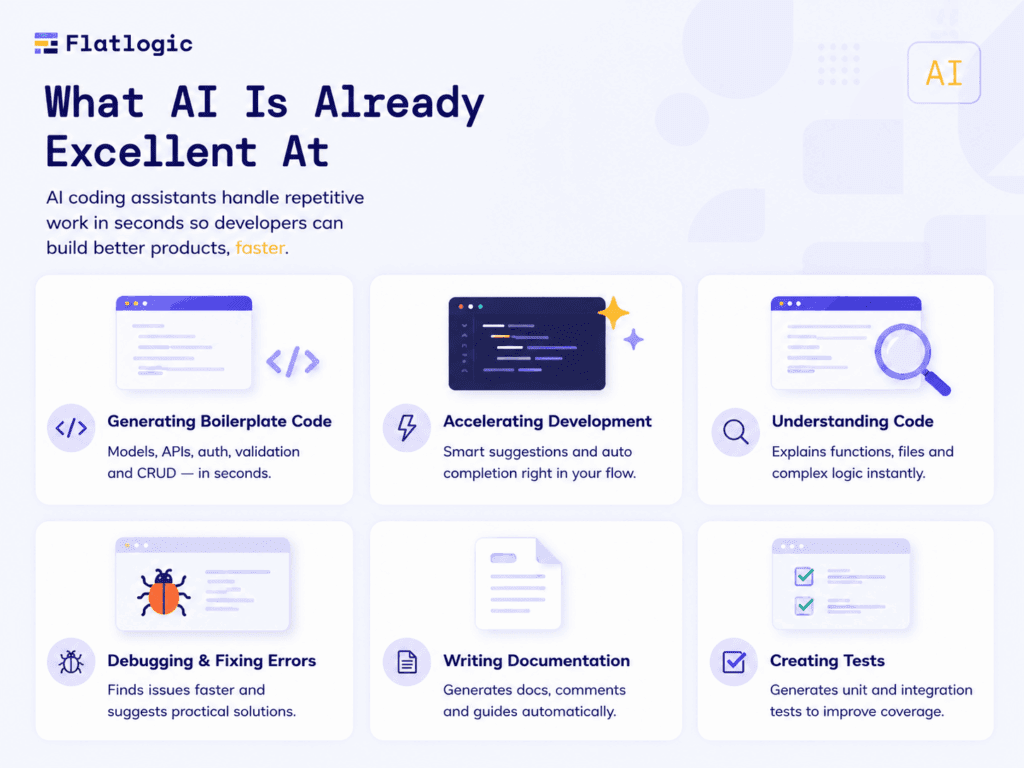
The key is understanding where AI provides the most value. While it can dramatically accelerate implementation, developers are still responsible for making technical decisions, validating results, and ensuring software is secure, scalable, and aligned with business goals.
Generating Boilerplate Code
Every application contains a significant amount of repetitive code. Creating database models, API endpoints, authentication systems, validation logic, and CRUD operations follows well-established patterns that AI can generate almost instantly. Instead of spending days building the foundation of an application, developers can start with production-ready scaffolding and focus on the features that differentiate their product.
This is particularly valuable for startups, where reducing development time can mean launching weeks earlier and validating product ideas before competitors.
Accelerating Everyday Development
Modern AI tools act as intelligent programming partners throughout the development process. They complete functions, suggest implementations, translate natural language into code, and recommend improvements while developers are working. Rather than constantly switching between documentation, search engines, and development environments, engineers receive context-aware suggestions directly within their workflow.
This continuous assistance reduces interruptions and allows developers to maintain momentum when solving problems, leading to significantly higher productivity.
Understanding Existing Code
One of the biggest challenges in software engineering is working with code written by someone else, or even code written months ago by the same developer. AI can quickly analyze files, explain business logic, summarize functions, describe relationships between components, and answer questions about unfamiliar codebases.
For startups with rapidly growing teams, this makes onboarding much faster and reduces the amount of tribal knowledge required to maintain complex applications.
Debugging and Error Resolution
Debugging often consumes more time than writing new features. AI can analyze stack traces, identify likely causes of runtime errors, explain compiler messages, and suggest practical fixes based on the surrounding code. While developers should always verify the proposed solution, AI frequently helps narrow down the problem within seconds instead of hours.
By reducing the time spent troubleshooting common issues, engineering teams can dedicate more effort to product innovation rather than maintenance.
Generating Tests
Writing comprehensive tests is essential for maintaining software quality, yet it’s often postponed because it requires considerable effort. AI can automatically generate unit tests, integration tests, mock data, and edge-case scenarios based on existing code. Developers still review the generated tests to ensure they reflect business requirements, but AI removes much of the repetitive work involved in creating a reliable test suite.
This makes it easier for startups to maintain high code quality even when development timelines are aggressive.
Creating Technical Documentation
Documentation is another area where AI consistently delivers value. It can generate API references, README files, setup guides, architecture summaries, and code comments with minimal input from developers. Keeping documentation up to date becomes much less of a burden, making projects easier to understand and maintain as teams grow.
Well-documented software also improves collaboration, shortens onboarding time for new engineers, and reduces dependency on individual team members.
Building Rapid Prototypes
Perhaps the most transformative capability of AI is its ability to convert ideas into working software in a matter of minutes. A founder or developer can describe an application in natural language, and AI can generate an initial version with user interfaces, backend logic, database schemas, and API endpoints already connected together.
These prototypes are rarely ready for production without human review, but they dramatically reduce the time required to validate ideas, demonstrate concepts to investors, or collect early customer feedback. For startups operating under tight budgets and short timelines, this speed can become a significant competitive advantage.
The Real Advantage: Productivity, Not Replacement
The greatest impact of AI doesn’t come from any single feature, it comes from improving the entire software development workflow. Every repetitive task that AI automates gives developers more time to focus on architecture, product strategy, customer problems, performance optimization, and long-term technical decisions.
For startups, this shift is particularly important. The teams that benefit the most aren’t replacing developers with AI; they’re enabling experienced engineers to accomplish far more than would have been possible just a few years ago. AI accelerates execution, while developers provide the judgment, creativity, and technical expertise needed to turn generated code into reliable, production-ready software.
Where Developers Still Win
AI can generate impressive amounts of code, but software engineering is about far more than implementation. Building successful products requires understanding business goals, making architectural decisions, ensuring security, and maintaining software over time, areas where human judgment remains essential.
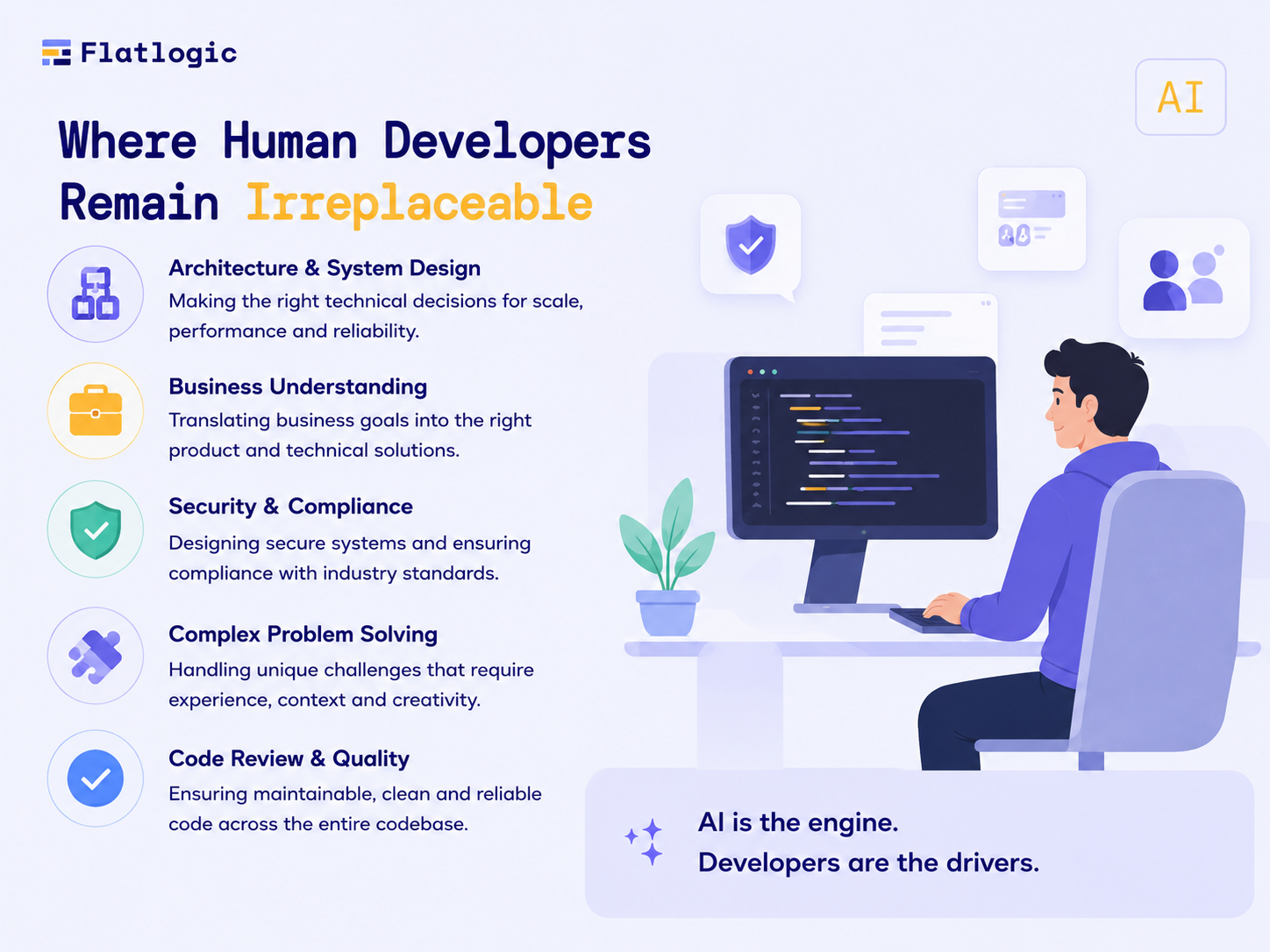
While AI is excellent at automating repetitive tasks, it doesn’t truly understand customer needs, company priorities, or long-term technical trade-offs. Developers provide the critical thinking and accountability needed to turn generated code into reliable, production-ready software.
Developers continue to have a clear advantage in areas such as:
- Designing scalable system architecture.
- Translating business requirements into technical solutions.
- Reviewing AI-generated code for quality and security.
- Solving complex problems that require creativity and experience.
- Maintaining, optimizing, and evolving software as products grow.
As AI becomes more capable, these responsibilities become even more valuable. The future isn’t AI replacing developers, it’s developers using AI to spend less time writing routine code and more time solving high-impact problems.
AI Changes the Role of Developers
AI is shifting the role of developers from writing code to making technical decisions. By automating repetitive coding tasks, AI allows engineers to spend more time on architecture, product strategy, security, and solving complex business problems.
Instead of writing every line of code manually, developers increasingly guide AI, review its output, and ensure the final product is reliable, scalable, and aligned with business goals. In this new workflow, code generation becomes faster, while human expertise becomes even more valuable.
For startups, the biggest competitive advantage isn’t choosing between AI and developers, it’s enabling developers to use AI to build better software, faster.
Why This Is Especially Important for Startups
For startups, AI isn’t just a productivity tool, it’s a way to build more with fewer resources. Every week saved in development can mean reaching customers sooner, validating ideas faster, and gaining an edge over competitors.
By automating repetitive development tasks, AI enables small engineering teams to deliver products at a pace that previously required much larger teams. Developers can focus on building features that create business value instead of spending time on routine implementation.
For early-stage companies, the winning strategy isn’t replacing developers with AI, it’s combining AI’s speed with human expertise to launch high-quality products faster and more efficiently.
The Rise of AI-Assisted Software Engineering
The future of software development isn’t AI or developers, it’s developers working with AI. As AI becomes a standard part of the development workflow, software engineering is shifting from manual coding to AI-assisted problem-solving.
Rather than replacing engineers, AI is changing how software is built. Developers increasingly use AI to accelerate implementation while focusing on architecture, product decisions, code quality, and long-term maintainability. The result is faster development without sacrificing reliability.
This new approach offers several advantages:
- Faster development cycles and shorter time to market.
- More efficient engineering teams with higher productivity.
- Greater focus on product innovation instead of repetitive coding.
- Improved software quality through faster iteration and review.
For startups, adopting AI-assisted software engineering isn’t just about keeping up with new technology, it’s about building products faster and competing more effectively with limited resources.
The New Software Engineering Workflow
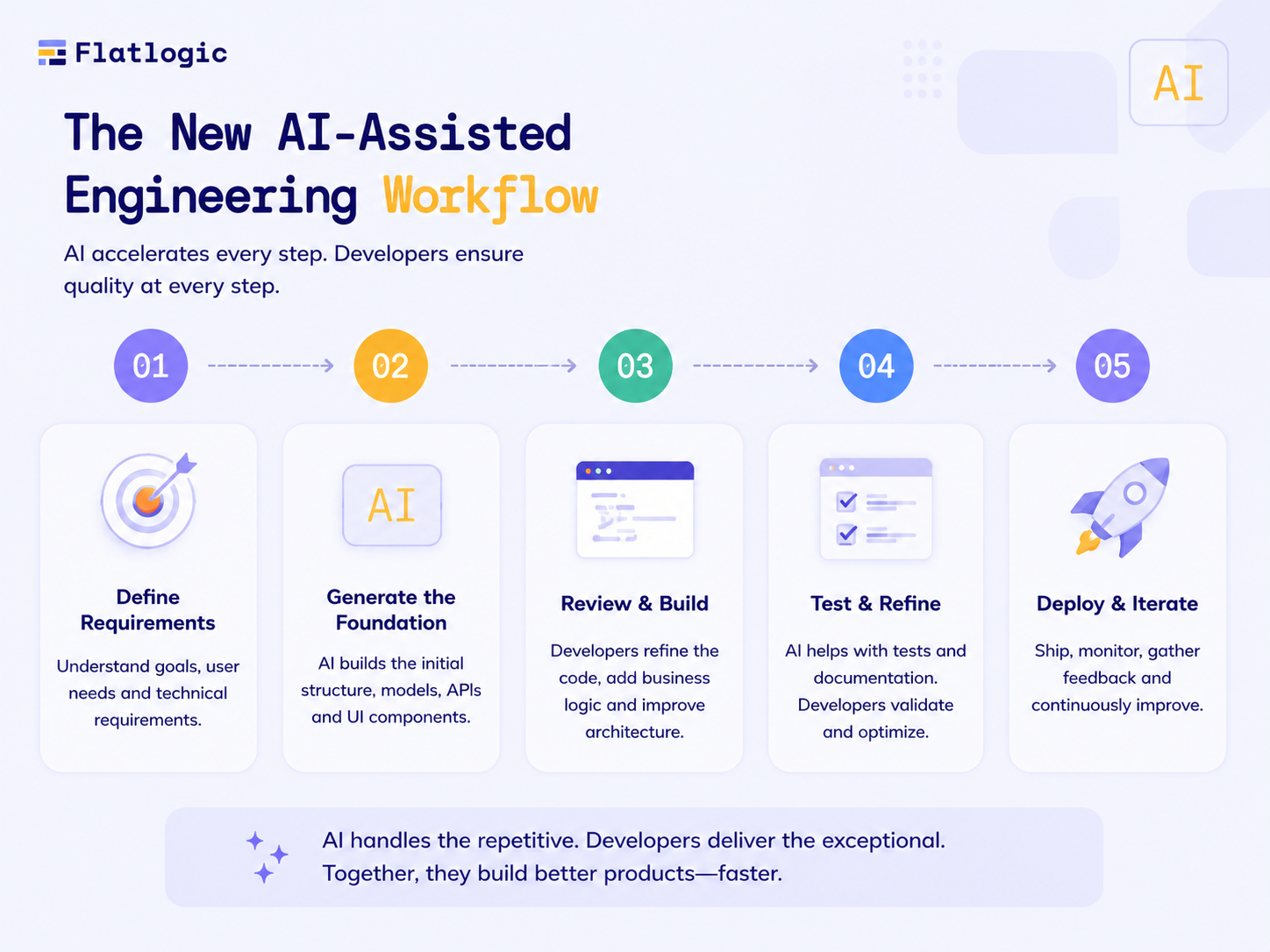
AI is transforming software development into a collaborative process where AI accelerates implementation and developers ensure production quality. Instead of writing every component from scratch, engineering teams use AI to handle repetitive work while focusing on the technical decisions that matter most.
Step 1: Define Requirements
Every successful project starts with understanding the problem. Founders, product managers, and developers define business goals, user needs, and technical requirements before any code is generated.
Step 2: Generate the Foundation
AI creates the initial application structure, including database models, APIs, user interfaces, authentication, and other boilerplate components. What once took days can often be completed in minutes.
Step 3: Review and Build
Developers review the generated code, implement business logic, improve the architecture, optimize performance, and ensure the application is secure, scalable, and maintainable.
Step 4: Test and Refine
AI helps generate tests and documentation, while developers validate functionality, fix edge cases, and refine the user experience before release.
Step 5: Deploy and Iterate
Once the application is production-ready, teams deploy it, monitor performance, gather user feedback, and continue improving the product. AI continues to support development throughout this iterative process, helping teams release updates faster and more efficiently.
Common Myths About AI and Software Development
As AI becomes more capable, misconceptions about its role in software development continue to grow. While AI has transformed how applications are built, many of the most common claims about AI replacing developers or eliminating engineering jobs overlook the realities of building production software.
Some of the biggest myths include:
- “AI writes perfect code.” AI can generate functional code quickly, but it still makes mistakes, introduces bugs, and requires human review before production.
- “Startups no longer need developers.” AI accelerates development, but experienced engineers are still needed to design systems, implement business logic, and ensure quality.
- “AI can build complete production applications on its own.” While AI is excellent at creating prototypes and application foundations, production software still requires human oversight, testing, and ongoing maintenance.
- “Software engineering jobs will disappear.” AI is changing the role of developers rather than replacing them. Engineers who effectively use AI are becoming more productive and valuable, not obsolete.
The companies that will benefit most from AI are those that view it as a powerful engineering tool, not as a replacement for experienced software developers.
What Startup Founders Should Do Today
The question is no longer whether startups should use AI, it’s how they can use it most effectively. Founders who treat AI as a productivity multiplier rather than a replacement for developers will be better positioned to build faster, reduce costs, and bring products to market sooner.
The most effective approach is to use AI for repetitive implementation tasks while relying on experienced developers to make architectural decisions, implement business logic, review generated code, and ensure production quality. This combination enables startups to move faster without compromising security, scalability, or maintainability.
Rather than trying to replace engineering teams, founders should build development workflows where AI accelerates execution and developers provide the expertise needed to deliver reliable, production-ready software. This balance allows startups to validate ideas more quickly, iterate faster based on customer feedback, and compete more effectively with limited resources.
Where Flatlogic Generator Fits
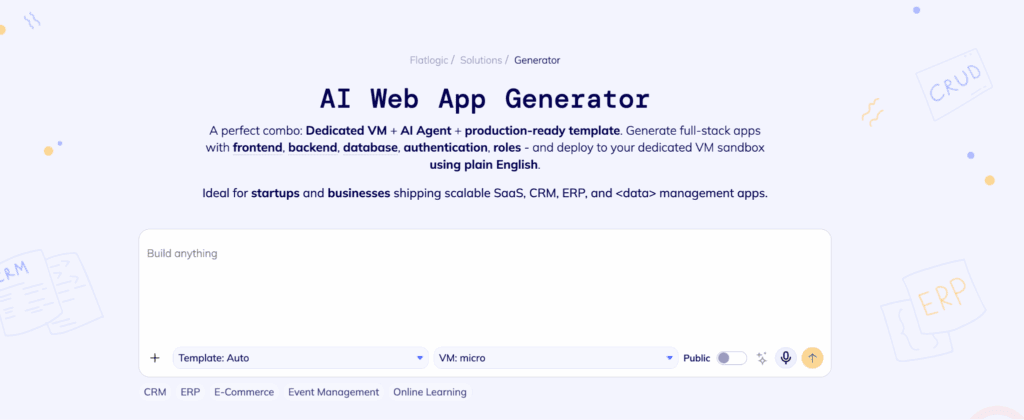
While AI coding assistants are excellent at generating snippets and components, startups still face a major challenge: turning generated code into production-ready software.
This is where Flatlogic provides a significant advantage.
Flatlogic combines AI-assisted development with production-grade engineering practices to generate complete web applications, not just isolated code. Instead of starting from a blank repository, founders and engineering teams can generate applications with authentication, databases, CRUD operations, admin panels, role-based access, APIs, and deployment-ready architecture already in place.
This allows startups to skip weeks of repetitive setup and focus on building features that differentiate their product.
Rather than replacing developers, Flatlogic empowers them to spend less time on infrastructure and more time delivering customer value.
The Future Belongs to AI-Assisted Developers
The future of software engineering isn’t AI versus developers, it’s AI-assisted developers. As AI continues to evolve, writing code will become faster and more automated, but the need for human expertise, creativity, and technical judgment will only grow.
For startups, the real competitive advantage lies in combining AI’s speed with experienced developers who can design scalable systems, make strategic decisions, and deliver production-ready software. Teams that embrace AI as part of their engineering workflow will build products faster, iterate more efficiently, and respond to market changes with greater agility.
AI is changing how software is built, not who builds it. The startups that succeed over the next decade won’t be those that replace developers with AI, they’ll be the ones that empower developers with AI to turn ideas into successful products faster than ever before.